Monday, September 17, 2007

How Script Frenzy Saved My Novel

I will confess to you now that I am not entirely of sound mind, when it comes to writing my own fiction. There was a point, and I only tell you this because we are very close friends, where I was almost paralyzed in my fiction by weird little habits and the writing ticks that I had developed.

I was very concerned about the way things looked on the page. I needed the paragraphs to appear in a certain way, very rectangular, all approximately the same size, and I didn't want words hanging down, no strange line breaks. I felt compelled to write my novel in small sections, not really chapters, but three page sections, and each of the three page sections had to be exactly three pages. Exactly. So, when I took out a sentence here, I had to add one there. When I added a sentence there, and it started hanging onto another page, I had to take out that sentence and add a different one.


It was like math, kind of. It was very engrossing. I told myself that the form was being dictated by the very structured mind of the character, by the nature of the book, that I could always go back and change it later. Except, as the book progressed, I was not going back to change anything, and it was increasingly becoming this awful, hard little nut of overworked prose. With no dialogue. Did I mention that? We can't have dialogue spreading out all over the place and messing up our lovely juicy paragraphs, can we precious? No, precious, we can't. You get the idea. What started out with a mild compulsion turned into a book-crushing mania. I have known some famous and clever postmodernists who do this kind of thing with grace and dignity. I, however, was doing it with teeth-gnashing and forehead-clasping. Not the same.


Then I decided to do Script Frenzy. Script Frenzy is a month-long nightmare similar to Nanowrimo except that in Script Frenzy you write a screenplay in a month, whereas in Nanowrimo you write a novel in a month. Script Frenzy is in June while Nanowrimo is in November. I had never written a screenplay before, but I thought, hey, why not. It's not like my novel is clipping along at such an alarming rate that I can't take a few weeks off to do something else. I wrote my script. I used CeltX which is a free, downloadable script-writing software. It forces you do format everything correctly. Watching my script pour out of my frantic fingers, it did not occur to me to count lines in a paragraph of scene description, it did not occur to me to be offended by the dialogue straggling down the page, and by the end of the experience, the screenplay format looked very normal and familiar and right. And I finished 20K words and got to the end, which means I won, as you can see by my sparkling icon at the left.
When I returned to work on my novel, two astonishing things had happened.
1. I can now comfortably write dialogue. This shocks me, because all of my life as a writer I have avoided dialogue whenever possible. I would write "He told her go to home." six times before I would write ""Go home," he said." When I picked up Script Frenzy, I felt certain I would go mad because of all the dialogue I would have to write. Somehow, I bullied myself through it, and on the other side of that experience, dialogue is no longer my enemy.
2. I have a much better understanding of how to describe a scene in terms of the physical surroundings. I used to really struggle with this, and found myself skipping over it a lot, or doing it in some sort of truculent, obvious way, because I could never feel relaxed about taking time out of the scene to look around the room and say, "The walls were green. The ceiling was high. On the floor, there was a carpet. On the chair, there was a dog." Writing scene descriptions in the screenplay was different. You're forced to create a very succinct paragraph to describe the setting, and the purpose of it is not to be lovely, but to be functional. So you find the three objects in the room that give it its character, or you find the scope of the exterior landscape you're describing, or the hat the character is wearing, or the empty diet Coke can under the radiator, and you hang the scene on that. Very useful. The skill translates perfectly into novel-writing. It's okay to drape a whole scene over the cut of glass on the chandelier. It all evolves from that. I get that now.
As I was writing my screenplay, I felt very strange writing a document that was not meant to be read. That is, it wasn't the final product. These words, in this screenplay, are not the art. They're instructions for creating the art. So, while the words are still important, obviously, the way they look on the page has no meaning. They're crammed into a standard format, and there's no deviating from it -- it's out of your hands. Working in this form really made me think about the story, the characters, the dialogue... and stop concentrating on the form.
Writing a screenplay made me a better novelist, for sure. When I returned to fiction, it was as if the hobbles had been taken off my horse. I'm glad I made the effort and took the chance on a new format, even though the screenplay itself may never see the light. At this rate, the book possibly will.

Thursday, September 13, 2007

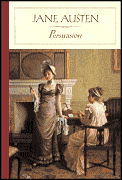
Persuasion by Jane Austen

To: Anne Elliott
CC: Elizabeth Bennett, Emma Woodhouse, Elinor Dashwood
Subject: He loves YOU. YOU are the one he loves.
Attachments: clues.xls


Dear Anne,

It is you that he loves. Obviously. He loves you, only you, and always you, to the end of his days. HOW do you not see this? You spend page after page, heart atwitter. A tiny gasp, a tiny sigh. Is it denial? Is it mental retardation? Or are you actually physically blind and deaf? Has all of your mild, sweet goodness clogged up your aural passages?


I know that you don't like to come right out and say things. I know you prefer to hint around and embroider wainscoating and use your eyelashes to communicate the intricate ticks and giggles of your soul. Your patience, your modesty, they cripple you. You flounder. You languish.


Here's news: If you weren't in a Jane Austen novel, where all comes right in the end, you would never be Mrs. Wentworth. Real men don't pine that much. Real men, if they pay attention to Louisa Musgrove, are doing that because they actually want to get busy with Louisa Musgrove. But you're okay. He's a Jane Austen hero, and that means in spite of all the completely contradictory evidence, he does really love you, you blind, deaf, ignorant fool of a woman. Please, when the truth comes out, take a minute to breathe and weep, and then give yourself a good smack, right on the head, because really, a cocker spaniel could see that he loves you, and only you. Louisa Musgrove? You have got to be freakin' kidding me.


Sincerely,
LYDIA


Jane Austen said that Anne Elliott was too good for her. Jane, Anne Elliott was too good for me too.


Let's face it, Jane Austen novels are not about suspense. There's a man and a woman, or there are two men and two women, and at the end of the novel the church bells will peal, and there will be joy. The pleasure in one of these romantic comedies, like most romantic comedies where the end is predetermined, is watching the characters muddle through, make their mistakes, rush around.


I liked watching Emma, and Elizabeth, and Elinor and Marianne. But not Anne. I didn't like watching Anne. Anne made me impatient and irritated. Maybe it's me. Maybe I'm just a dreadful person, incapable of appreciating the sensitive spirit of Anne. I know this novel is all about the subtle. And most of my friends seem to like it. I, however, was not able to love this book, although I know I should. Anne was too good, Louisa Musgrove was too annoying, and Captain Wentworth was just impossible.


You know what? In the end, they got together. Don't blubber about me spoiling the ending. No one was shocked. I was glad it all ended well, but this time, instead of weeping with joy, like I did for Elinor and Marianne, I snapped the book shut, BAM. Enough already. This time, she took it too far. Bless you, Jane Austen, you do better with sass.

Saturday, September 8, 2007

Angela's Ashes by Frank McCourt

Wow. I look at my little children, who refuse to eat half the things I put in front of them just because the whim of the moment dictates that they don't like orange food, or that they would rather have peaches than grapes, or that they really wanted a PB&J instead of spaghetti. And here is this mother, in this book, watching her children literally die of starvation (and disease, and malnutrition, and whatever else is crawling around in the poverty they inhabit), and there is nothing she can do about it. Living in fleas, in filth, in actual unmitigated poverty of the kind I have never seen in this country, she does the very best she can, and you know what? So does the father. He is a scoundrel and a failure, but he is in a category of man with many others, and no matter how I tried, I could not hate him, because I felt he loved his chilren, and he always gave them his share of the food, and even though he drank every cent that ever came into his pocket, he was not to blame for their troubles.
Angela's Ashes is driven by two strong questions. First, I know that Frank McCourt is now a famous author and a much lauded teacher, and so I know that he dragged himself out of it, through the typhoid and the starvation and the infections and rags, and out into a better place in the world. So the first question of the book is, How did that happen? The second question, implied by the title, is that the mother (Angela) will die. So how is that going to happen? That's the second question. The magic of this particular engine, this particular method of making me turn the pages, is that these questions are never overtly stated in the text, there isn't a "Now that I'm a teacher, I remember back when I was an urchin..." and we don't have any foreshadowing of the mother's death, or any foreshadowing of anything. Those questions that drove me insane with curiosity (How could he survive this? How could he?) were just buried in the fact that the book existed at all, and had that title.
The other genius thing about this book is that the story has no "Now that I'm older and wiser and understand the world" type of context. Everything that happens in the story is filtered only through the consciousness of the main character at exactly that age in his life, whether it's that an angel brings babies and lays them on the stairs, or whether it's that the life of a messenger boy is the best he can hope for, or whether it's that devils will poke him with pitchforks for eternity, or whether it's one line of Shakespeare that infiltrates his education, we only see everything from right inside the character's point of view. Never the author, never the character later in life, only in the moment.

Rather than making the facts of the book more palatable, because the character knows no better, this way of narrating the story actually makes it the more horrifying, because there's no author to step in and say, "And that's just how poor we were, that we had to burn the walls of our rooms, how sad, how dreadful." Which leaves the reader to think it. And there's no author to say, "And with that one line of Shakespeare, the whole possibility of language as art was lit up in me," it's left to the reader to discover that connection for himself.

Brilliant writing, I mean, obviously, I have nothing to say that's not worshipful. Amazing, brilliant, fearful, desperate, grand. I'm linking to Amazon in case you want to have a look at that, but I am also going to bookcrossing my copy, so if you bookcrossing, and you'd like me to send it to you, send me an email.


Wednesday, September 5, 2007

Sin by Josephine Hart


Well, this was a silly little book. A book that treats writing like Juliet Binoche treats acting. That is to say, with a lot of insubstantial intensity, and mystic eyes. You can read Sin in a sitting, and get up feeling pensive, taciturn, and violent. Or you can read it in little chunks over a period of weeks, while you're giving your children a bath, like I did, and every time you open the book you have to remember how serious life is, how morbid, how dire, how dramatic. How everyone uses small sentences, and feels things deeply, so deeply.

I read it before, years ago, and recently somehow via some used book shelf it came back into my life. The same edition too. Page 169 still seems to bear the blush of shame after my shuddering eye-roll. The last few lines:

These questions long engage me. Do you have answers? Please. Please, answer me.
Answer me, as I leave you now.
As I leave you.
As I leave.


The only work of fiction I've seen trying to end on an echo effect, like a power ballad from the 80s. If the ending seems unforgivable, you should know that there are other disastrous lines in the book too. Like this one:

Hours later, Dominick lay on top of me. And whispered love again. And again. Perhaps the music in his own head made him deaf to my silence.

"Deaf to my silence"? That's one of those lines that sounds complex and interesting, but in reality means nothing. Like Juliet Binoche again. She can be thinking of her grocery list, but as long as she fires up her "piercing depths" eye lock, you'd think she was decoding the fate of the world. Hart knows how to ratchet up the drama in the way a scene sounds, even if the plot is really a rather standard soap opera chain of events. Adultery, death, rivalry, hatred, love, etc. The pounding drum in the language, the constant syntactic reminders that This! Is! Dramatic! actually diffuse the drama from her character's troubles, much the way a soap opera's soundtrack can make light afternoon fare out of murder and betrayal.

I am simultaneously reading Angela's Ashes by Frank McCourt, and Sin does not bear up well in contrast, since McCourt's delivery of disaster and wretchedness is at low volume, with no fanfare, no sonorous words, no short sentences drifting off into black. Unfair comparison, maybe, but... still.

SIN

Sunday, September 2, 2007

A Very Important List

1. Maybe writing is just lying.

2. I'm cutting out of my writing group again tonight.

3. I've started walking to the art museum to think. During the walk, you know, not at the museum. When we get to the museum, we turn around and go home. Map My Ride tells me it's 3.6 miles round trip. This is about as much as I can do with inappropriate shoes, a stroller, a dog, and another child on a bicycle. We've done it twice:

The thinking must be happening between reminding the boy to watch for driveways and reminding the dog to keep up. The girl doesn't need reminded of anything but she does need to be hydrated.

So far I've had two ideas, both unrelated to the novel. Two ideas in seven miles is a number I'm comfortable with. I'm not crowning myself Pope or anything but I'm satisfied.

4. "The Libertine" was like the opposite of "Shakespeare in Love." Like all opposite pairs, they have some things in common: 17th century London, playwrights, female actors, and a bunch of people scrabbling around in the street. Strangely, in the time between Elizabeth and Charles II, London got a lot dirtier and nastier. John Malkovich was the king with a prosthetic nose. It was almost possible to forget he was John Malkovich. I never forgot Johnny Depp was Johnny Depp but the remarkable thing was that during his performance I never even caught a sniff of Jack Sparrow, or Ichabod Crane, or Willy Wonka, or J.M. Barrie. He's a master.


5. "Deja Vu" was pretty dreadful. The movie requires such a radical suspension of disbelief that I needed a special crane and a permit from the city. On the other hand, it was nice to see that not every time travel movie ends with the lesson of time travel: "Travel to the past all you want, but if you try to stop something from happening, you'll end up causing it." Are you listening, Sandra Bullock?

6. "Pan's Labyrinth" and "Snakes on a Plane" both started out with someone getting their head beaten in. From there, the two movies diverged in pretty much every way possible.

7. Samantha Morton is not Samantha Mathis. Samantha Morton never played Princess Daisy in "Super Mario Brothers." Samantha Mathis did. Therefore, my shock that Samantha Mathis was playing the female lead in "The Libertine" was misplaced.

8. Chloe Sevigny was in "Zodiac" as a dull, smart girlfriend of Jake Gyllenhaal. I liked her in this role. Between this, that, Big Love, and the other thing, I am ready to forgive her for her slouchy, droopy-lidded performance in "The Last Days of Disco." It's been ten years. I'm over it.

9. We couldn't finish watching "Zodiac" because of all the one month later, six weeks later, three days later, two years later. We never found out what happened. Robert Downey Jr. is so awesome though. He is made of awesome.

10. Speaking of Robert Downey Jr., "Fur" was bad. Susannah says the crime was taking Arbus' asthetic fascination with freaks and sexualizing it. I agree, but felt that the biggest problem was Robert Downey Jr. with all that hair on him.