Showing posts with label GEB. Show all posts

Wednesday, February 6, 2013

Gödel, Escher, Bach: Introduction

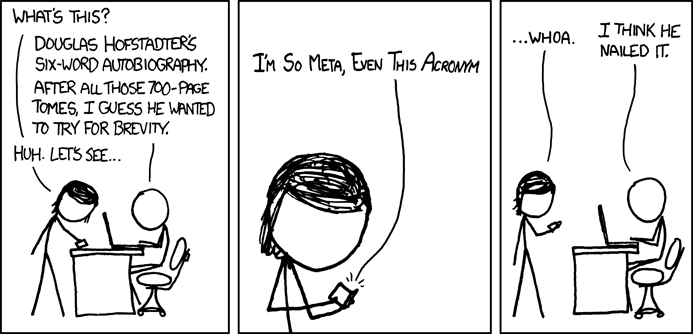
I have to start out this installment with a comic from xkcd, found by a guy in our Facebook reading group:


Yep, nailed it. Our group discussion wandered through self-referential words and the difference between a fugue and a canon, and landed on Gödel's Incompleteness Theorem, which no one really claimed to fully understand, but lots of us wrestled with. Here are some resources and links we found helpful, and my thoughts on the three sections:

Bach:

I really loved the Bach section -- it was so interesting to learn about how these musical compositions really begin with math problems, and how composers would set challenges for each other that could be solved mathematically. The anecdote about Bach sitting down to extemporaneously compose such a complicated canon for the King of Prussia was almost unbelievable, but I'm willing to swallow it. Then again I was a Lance Armstrong supporter for years. Maybe I'll believe anything of someone I want to be brilliant.

Here's a recording of that six part fugue, RICERCAR:


Here's a video of Bach's never ending canon, which rises in a "strange loop," mentioned on page 10:


Escher

I found the concept of "strange loop" easiest to understand visually, in Escher's work. Here is a link to a large image of Escher's "Waterfall" and also a video of Metamorphose, by Escher, hanging in a post office:


Gödel

I fell off the book backward at the Incompleteness Theorem, I'll admit. I was helped by several different ways of looking at it, including this post. Here's an interesting discussion of Gödel, by Stephen Hawking, called "Gödel and the End of the Universe."

I loved the stuff about Ada Lovelace and early computers. Was intrigued by predictably intrigued by L'Homme Machine, enough to buy a used copy in the French. The strange loops elude me at this point, but I think all of us in the group are hoping to understand the mathematics parts more fully as we go along. Comforted by the fact that "This is only the introduction!" we persevere.

Wednesday, January 16, 2013

Gödel, Escher, Bach: Preface to 20th Anniversary Edition

I was challenged to read this book after publicly exclaiming "I think I just made peace with the fact that I can't understand my own actions." Upon researching it a bit, I found it referred to as "the secret nerd bible," and my interest was piqued. This book of philosophy, math, music, and art won the Pulitzer in 1979 and has been inspiring AI programmers with its proposed connections between fugues, recursive figures, and the patterns in the human brain. At least, I think that's what it proposes, because I haven't read it yet.

So I collected 50 or so compliant people in a Facebook group, and laid out a calendar to finish the book in a year, one chapter per two weeks. This first two weeks of January, the assignment is to read the preface.

Things I Liked About the Preface: Hofstadter's self-flagellation over the use of sexist pronouns and the word "mankind" and whatnot. Hofstadter's insistence on not updating the book given recent history and making it a CD-rom or whatever. I like that he said it was a statement of his religion at that moment, and that updating it would be pointless. I also loved the description of the ass pain he had to endure to get galleys made with the images and text exactly the way he wanted -- what an effort!

Things I Did Not Like About the Preface: I don't understand the thing he said about how Bertrand Russell was self-referential while deciding not to be self-referential, thereby creating a conciousness within Principia Mathematica (or whatever). I assume we're going to get more about that in the book itself. I don't understand that, so far, so of course that annoys me.


Here are some interesting things I found helpful to look at:

Principia Mathematica by Bertrand Russell. (Yes, Newton also wrote one.)

A video from MIT Open Courseware about the book, introduction to the class about the book:


A video illustrating the logic problem of Achilles and the Tortoise:


Are you reading this book? Have you read it before? Would you like to join our group? I'll be tagging my posts on this subject GEB so  you can find them all if you like, if you're stumbling upon this farther along in the year.