Friday, March 29, 2013

Shine Shine Shine Paperbacks are Coming!

From St. Martin's Griffin in the USA, July 2 2013:

From Simon & Schuster in the UK, July 4 2013:


Wednesday, February 20, 2013

Robots are like Humans are like Robots

Researchers in France have used their knowledge of the way a human acquires language to create a robot "brain" that listens and understands language using recurrent construction. This gives the robot the ability to decode complex sentences quickly by predicting what follows from each word, and then modifying those predictions from context as new words are spoken. Humans process language in real time, and our brains execute loops of understanding  -- as I grasp it, it sounds like we narrow down all possible meanings as each subsequent word comes to us, until the end of each sentence or phrase, where we've narrowed it precisely.

Of course scientists put this brain into the ridiculously baby-faced and disconcertingly man-voiced iCub robot. Here you can see it understanding the researcher's utterance. In this video the blue object is referred to as a guitar and the red object as a violin. Romantic, isn't it?


They made the robot better. That's fantastic. But here's the fascinating thing. As they make the robot's brain work like the human brain, they get a better understanding of the human brain. In the same way that we learn more about what it means to send the signals and impulses that make us bipedal and make our hands work, we understand more about how our brains actually think about abstractions and meanings by creating robots that think about abstractions and meanings. So these scientists are learning about how we lose function with Parkinson's, or how we gain control of this function as infants, by studying the simulation. They study the simulation to learn about the original.

Really, it makes sense. This terrifyingly complicated and mysterious thing we have in our heads -- the brain -- cannot be understood yet as a piece. We can't map it much, or see the whole thing working. I say terrifying because it boggles my (mysterious) mind that one of the most profound unknowns in all of biology or philosophy is our own self-awareness, our ability to know the things we *do* know. We look back at those silly Egyptians and the way they vacuumed the brain out and discarded it after death because it was useless, while lovingly preserving the spleen and liver. Well, I need my liver too. And how much farther along now are we, really? We know the brain is useful for something, right? Now we know how to make a brain that understands and decodes language in the same way we do. Thanks to his robot brain, we know more about ourselves.

Maybe that's the biggest reason to keep making better and better robots -- they help us understand ourselves, where we stop and machines begin, where that line is blurry and where it overlaps. Something to ponder if you watch the video: Parents, how many times have you asked your human child to repeat instructions back to you, so you know they're understood? Just like the robot does, and for the same reason.  Your kid might not have a creepy man voice (yet) but here's a small way he's just like a robot all the same.

Wednesday, February 6, 2013

Gödel, Escher, Bach: Introduction

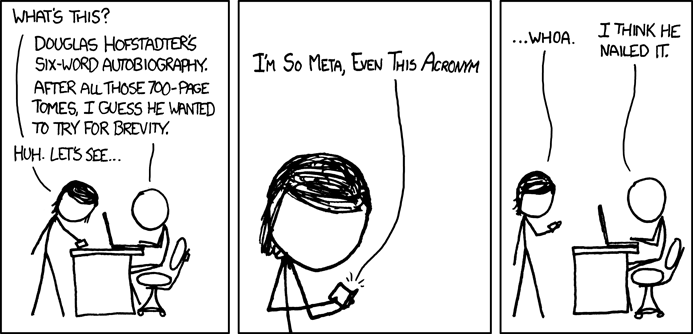
I have to start out this installment with a comic from xkcd, found by a guy in our Facebook reading group:


Yep, nailed it. Our group discussion wandered through self-referential words and the difference between a fugue and a canon, and landed on Gödel's Incompleteness Theorem, which no one really claimed to fully understand, but lots of us wrestled with. Here are some resources and links we found helpful, and my thoughts on the three sections:

Bach:

I really loved the Bach section -- it was so interesting to learn about how these musical compositions really begin with math problems, and how composers would set challenges for each other that could be solved mathematically. The anecdote about Bach sitting down to extemporaneously compose such a complicated canon for the King of Prussia was almost unbelievable, but I'm willing to swallow it. Then again I was a Lance Armstrong supporter for years. Maybe I'll believe anything of someone I want to be brilliant.

Here's a recording of that six part fugue, RICERCAR:


Here's a video of Bach's never ending canon, which rises in a "strange loop," mentioned on page 10:


Escher

I found the concept of "strange loop" easiest to understand visually, in Escher's work. Here is a link to a large image of Escher's "Waterfall" and also a video of Metamorphose, by Escher, hanging in a post office:


Gödel

I fell off the book backward at the Incompleteness Theorem, I'll admit. I was helped by several different ways of looking at it, including this post. Here's an interesting discussion of Gödel, by Stephen Hawking, called "Gödel and the End of the Universe."

I loved the stuff about Ada Lovelace and early computers. Was intrigued by predictably intrigued by L'Homme Machine, enough to buy a used copy in the French. The strange loops elude me at this point, but I think all of us in the group are hoping to understand the mathematics parts more fully as we go along. Comforted by the fact that "This is only the introduction!" we persevere.

Friday, January 25, 2013

How to Teach a Child to Write a Novel

Why teach a child to write a novel? It makes them sharper readers, more critical thinkers, and gives them a vast sense of accomplishment, the confidence to tackle a grand task by breaking it down into bits and knocking them out one by one. A child who understands the construction of a book from the inside, even on the most rudimentary level, will approach the next book she reads more thoughtfully, with better questions, and a deeper grasp of what goes into making books work.

I've been homeschooling since my son was born, and always have tried to keep books at the center of our studies. I first published this set of lessons on my homeschooling blog in 2009, when I took my son and a bunch of his elementary school friends through eight weekly lessons about heroes, villains, plot, and conflict: The Junior Secret Noveling Club. I've updated the PDF this year, prompted by several requests for more info about the lessons, and I'm posting the new link here with this excerpt from the intro.

Download the free 40 page lesson plan booklet here


The process of writing a novel can be broken down for your child into eight lessons. This curriculum is less a curriculum and more a club. Kids will name their club, choose a secret handshake and “oath,” and earn “badges” by doing weekly lessons, games, and activities. By completing these lessons, the student prepares him or herself for the task of writing a novel, without ever getting spooked by the enormity of the task.
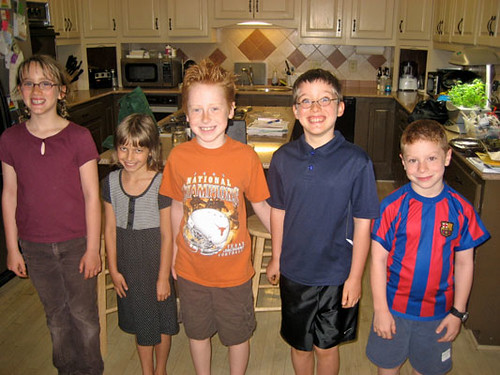
To form your own Junior Secret Novelist Club, you will first need some kids. Six is a good number. For optimal fun and awesomeness, these should be mostly kids who are pretty game. Naysaying kids who are nervous and uncertain will definitely benefit from this course, but there should be a good percentage of kids who will jump in with both feet and not be afraid to get a little crazy. With a few enthusiastic little writers in the mix, the hesitators will be more likely to cast aside doubt and join right in.


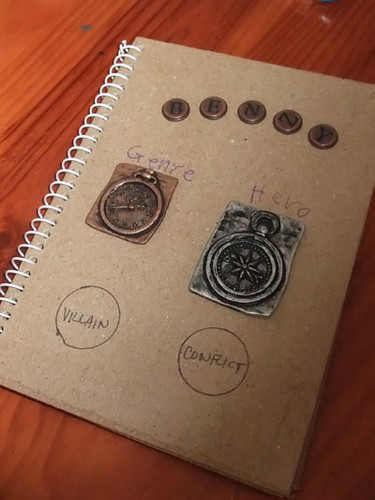
You’ll need a notebook for the kids to write in, do their homework in, and use to collect their exercises. Choose a small notebook, not a standard size, so they can really fill it up. A 3x5 is too small, but an 8x10 is too big. 6x9 is perfect, and recycled paper is cool. Ideally the notebook will have a sturdy front and back cover, since this is where the students will be collecting their badges. You will also need eight very very cool stickers per child that are more like badges than paper stickers. I found three dimensional glossy flower ones for the girls, and metallic compass/clock stickers for the boys. Look in the scrapbooking aisle for something that will really make their eyes go wide.

The key concepts are as follows:

Writing a novel is fun.
Writing a novel can be broken down into easy, manageable steps.
By the time you get to the part where you have a blank page in front of you, you have a solid, detailed plan and lots of material to use in your book.
Planning and writing your own novel helps you become a better reader of books that others have written.
Finishing means getting all your badges, not writing a complete novel and typing The End at the end.

On the front cover of the notebook, mark off four spaces, and label them GENRE, HERO, VILLAIN, and CONFLICT. On the back cover, mark off four more spaces, and label them SETTING, PLOT MAP, ANALYSIS, and CHAPTER LIST. Each week, as the children complete the exercises, you’ll hand out their badges.

The final thing you’ll need is something really super ridiculous to award them at the end of the course. I used a cool-looking paper clip, which became the Official Novel Writing Paperclip. After the final meeting of the club, you will pass out these official totems, and authorize the students to write their novels. Yes, it will be silly, but yes, you very much need something tangible. You could use hats, t-shirts, socks, necklaces, or whatever can be turned into an official, authorized novel writing item.

Kids, notebooks, badges, and a final prize. If you have all that in order, you are ready to begin!






Thursday, January 17, 2013

Open Letter to the White Van Parked on 38th St. and Granby

Dear Large White Van Parked on 38th Street and Granby,

The van is on the north side of 38th, hidden by that building. 
Since moving to my neighborhood, I have driven past you countless times in anger. I have often shaken my head while flattening my lips into a resentful line. You have been parked there... let me see... let’s call it forever.

I understand: what you are doing is legal. There is a parking space on this street, and you are inside it. But you are the biggest vehicle in the world, parked nearly *on* the paint lines, the farthest possible distance from the curb and the closest possible proximity to the intersection.

You know that every honest citizen making a turn at this traffic light feels compelled to slow almost to a stop, worrying if they can make it past. You see them nudge their bumpers into oncoming traffic, causing drivers in the oncoming traffic lane to swerve away and honk. It’s a narrow street. The lanes are not marked. People get anxious.

There is shattered glass around your rear bumper, leaking out of the parking space and into the street. Your wheels are sunken. Whether they deflated from belligerence or despair I do not know. I don’t know whether that shattered glass is from an actual accident or whether it is the large white van equivalent of a middle finger, extending into the traffic lane. Drivers shy away, and there’s really not room for that, on this busy city street.

Until today, I dreaded going past you, wished you would just pack up your spacious running boards and go. I fumed over why your owner wouldn’t just move you twelve inches toward the curb. Or sweep the glass. Something. Why leave this gross abruption in the swift flow of traffic in our lives? It just seemed so inexplicable, and so wrong. I grumbled, and festered, and nudged my bumper into oncoming traffic, and honked, and ground my teeth.

Then today I realized what you are, you decayed, inconvenient old mess. You are Hemingway’s island in the stream. You are Olson’s stone in the shoe. You are Kierkegaard’s imperfection in everything human. Yes, large white van, that is you.

Contemporary author Charles Baxter wrote, “When all the details fit in perfectly, something is probably wrong with the story.” Well the story of 38th Street and Granby, an intersection through which I pass on a daily basis, is insanely disrupted by one magnificently ill-fitting detail: a large white van, tires deflating, bathing in a sea of broken glass, parked in the most inconvenient quadrant of the parking space, grinding traffic inexorably through its maw.

I’m writing now to let you know: Van, I capitulate. I won’t grapple with you. I won’t stab at you, from hell’s heart, or spit at you with my last breath. We don’t need another sensible intersection flanked by tidily parked compact cars. We don’t need another smoothly turning gear in the machine. You are the clunking sound in the apparatus. You are the hesitation in the march, the blip on the graph, the gap in the data.

Your end will come. You will be washed away eventually. Every island in the stream is always eroding. But until that happens, grind on, white van. Grind on.

Love,
LYDIA