Thursday, April 19, 2012

15 Ways to Stay Married for 15 Years

Today is my fifteenth wedding anniversary. I really love Dan, and I am proud of how awesome our marriage is. We certainly haven’t killed each other yet. Hell, we haven’t even maimed each other. We have not always been perfect, but we have made two cool kids, and we have always kept it interesting. For two people as weird and intense as Dan and I are, staying together this long is a big accomplishment. I know some people are surprised.

Here we are going in to our reception. I had a big bow on the back of my dress. This is where we met.


When Dan and I got married, we were 25 years old. Now, we’re staring down the barrel of 40. Looking back I’m surprised we didn’t, as 25 year olds, self-destruct just for the heck of it. Now that we are older, we are perhaps surprisingly also wiser. Here are the things we have learned over the years, that helped us stay married and even happy for fifteen years. (Beyond that, you’re on your own. I can’t promise another 15.) Our list does not resemble the one you will find in Cosmo or Ladies’ Home Journal. We have never had a regular date night, nor do we prioritize “communication” or play sex games or see a therapist. He doesn’t bring me flowers every Thursday, I don’t cook his favorite food very often. But we do have some other ideas.

1. Go to bed mad.

The old maxim that you shouldn’t go to bed mad is stupid. Sometimes you need to just go to freakin’ bed. “Let not the sun go down upon your wrath” is prefaced in the Bible by the phrase “Be angry and sin not.” So, who’s to say it doesn’t mean “Stay angry, bitches. Don’t let the sun go down on that awesome fierce wrath of yours.” Seriously. Whoever interpreted this to mean that you should stay up after midnight, tear-stained and petulant, trying to iron out some kind of overtired and breathy accord -- was stupid. Shut up, go to bed, let your husband get some sleep. In the morning, eat some pancakes. Everything will seem better, I swear.

2. Laugh if you can.

In any fight, there is one person who is really mad, and one person who isn’t that mad. That person should deflect the fight. Make a joke, do something stupid or corny, make the other person laugh. If the fight is very serious for you and you feel like you really want to plant your flag and die on this hill, fine. Do it. But if you’re fighting for entertainment, or because you’re just reacting, then you be the one to deflect. Fights are bad. Deflecting a fight whenever possible is a good idea. When you’re the one who’s being pissy and raw, and the other person helps you get out of it and brings about peace, that feels fantastic. This was a hard lesson to learn, for me. Letting Dan deflect a fight is the best thing, now. He does it really well.

3. Don’t criticize. Ever.

Here is a fact: Whatever critical thing that you are about to say to your wife is already being loudly articulated in her head. And if it’s true, she already feels like crap about it. Assuming you married someone intelligent enough to like you and sane enough to let you put a ring on it, trust that they are self-aware enough to know when they screwed up. It may feel good to you in that moment to say the critical thing, let it go ringing through the air in all its sonorous correctness, but it will feel awful to hear it. The only, only way it’s beneficial to give your wife criticism of any kind is if you’re absolutely positive she is completely unaware. And you better find the nicest, kindest way possible to tell her. And even then, good luck convincing her. Their recognition of the thing you are helpfully trying to point out will be INHIBITED, not facilitated, by your criticism. And then you’re the asshole. So be careful.

4. Be the mirror.

Your husband is the mirror in which you see yourself. And the things you say to him give him an image of himself too, which he will believe. You want him to believe it, so make it good. Be a mirror that reflects something positive: you’re smart, you’re successful, you’re fantastic in the sack, you’re a great provider, you’re the best. Can you MAKE him any of these things just by telling him he is? I don’t know, but consider this: the alternative really sucks. The things my husband says to me are 1000 times more convincing than anyone else’s opinion on earth. Don’t think he won’t believe you because you’re married and you’re contractually obligated to say nice things. He’ll believe the shitty, insulting things you say, and the gloriously positive things. Listen to Nico, girls:


5. Be proud and brag.

Let your spouse hear you talking about them in glowing terms to other people. Be foolish. Be obvious. It will mean everything. You will stay married forever.

6. Do your own thing.

Dan races bicycles. I write books. I don’t race bicycles or have any desire to race bicycles. He doesn’t write books, nor does he even read the books that I write. Seriously. And I don’t care. My opinion is that he’s the fastest, coolest most awesome bike racer ever. His opinion is that I’m the bestest, coolest writer ever. We don’t have to know all about cycling or writing in order to form these opinions -- in fact knowledge of literature or actually reading my book might damage Dan’s opinion of me as “best writer since the dawn of time.” We can still support each other without being all up in the other person’s stuff. Doing your own thing, having your own friends, being completely insanely passionate about something that the other person has no idea, really, about, is awesome. It allows your spouse to be your cheerleader, uncomplicated by knowledge or personal investment. And it means you’ll always have stuff to talk about, because you’re not overlapping all the time. You don’t have to read the same books either. You don’t have to have the same friends.

7. Have kids.

Kids stop you from being as crazy as you want to be. Because when you have kids, you can’t be that crazy.

For example, when I had kids, I stopped smoking. Left to right = Susannah, Joshilyn, Dan, Me. 


8. Get really good at sex.

You’ve got all the time in the world to get really really good, not just at sex in general, but at having sex with your one particular husband. You should make it your life’s mission to become the perfect sex machine exactly for him. And he for you. There is no reason to hold back, or be embarrassed, or not ask questions, and get everything working properly. There’s absolutely no excuse for letting years drag on without becoming fully skilled, gifted sex partners for each other. It makes everything so much better. Does talking about this make you uncomfortable? How uncomfortable would it make you to know that your spouse is secretly, silently “just okay” with your sexual performance? Yeah. You want to last fifteen years, remember? That’s a long time to be mildly happy.

9. Move.

Live in different houses. In different parts of the country. Travel. Make it so that you can look back and divide up your life into the years you spent in different cities, or different houses. If you’re feeling stuck geographically or physically, you can confuse yourself into thinking you’re stuck romantically. See your husband in different places, in different contexts, in different countries even. Try it. Take him to a mountaintop and give him another look. Pretty sexy. Take him to a new city and check out his profile. Along the same lines, don’t be afraid to change personally, or let your wife change as a person. Don’t worry about “growing apart.” Be brave and evolve. Become completely different. Don’t gather moss. Stagnation is unattractive.

10. Stop thinking temporarily.

Marriage is not conditional. It is permanent. Your husband will be with you until you die. That is a given. It sounds obvious, but really making it a given is hard. You tend to think in “ifs” and “thens” even when you’ve publicly committed to forever. If he does this, I won’t tolerate it. If I do this, he’ll leave me. If I get fat. If I change jobs. If he says mean things. If he doesn’t pay more attention. It’s natural, especially in the beginning of your marriage, to keep those doubts in your head. But the sooner you can get go of the idea that marriage is temporary, and will end if certain awful conditions are met, the sooner you will let go of all kinds of conflict and stress. Yes, you may find yourself in a horrible situation where it’s absolutely necessary to get a divorce. But going into it with divorce in the back of your mind, even in the way way way back of your mind, is going to cause a lot of unnecessary angst. Accept that you’re going to stay with him. He’s going to stay with you. Inhabit that and figure out how to make THAT work, instead of living with the “what if”s and “in case of”s.

11. Do not put yourself in trouble’s way.

Leave your ex boyfriends and girlfriends alone. I’m sure you’re very trustworthy. Aren’t we all? The thing is, there’s absolutely no reason to test it. Your husband and your marriage are more valuable than any friendship. Any friendship that troubles the marriage should be over immediately. Protect it with knives and teeth, not because it’s fragile but because it’s precious. Don’t ass around with a “hall pass” or a “harmless flirtation.” Adultery isn’t an event, it’s a process with an event at the end. Don’t put your feet on a path that could lead someplace bad.

12. Make a husband pact with your friends.

The husband pact says this: I promise to listen to you complain about your husband even in the most dire terms, without it affecting my good opinion of him. I will agree with your harshest criticism, accept your gloomiest predictions. I will nod and furrow my brow and sigh when you describe him as a hideous ogre. Then when your fight is over and love shines again like a beautiful sunbeam in your life, I promise to forget everything you said and regard him as the most charming of princes once more. The husband pact is very useful because you want to be able to vent to your friend without having her actually start hating your husband. Because you don’t really mean all those things you say. And she, the swearer of the pact, knows this.

13. Bitch to his mother, not yours.

This is one I did read somewhere in a magazine, and it’s totally true. His mother will forgive him. Yours never will. If you’re a man, bitch to your friends. They expect it.

14. Be loyal.

All the crap you read in magazines about honesty, sense of humor, communication, sensitivity, date nights, couples weekends, blah blah blah can be trumped by one word: loyalty. You and your spouse are a team of two. It is you against the world. No one else is allowed on the team, and no one else will ever understand the team’s rules. This is okay. The team is not adversarial, the team does not tear its members down, the team does not sabotage the team’s success. Teammates work constantly to help and better their teammates. Loyalty means you put the other person in your marriage first all the time, and you let them put you first. Loyalty means subverting your whims or desires of the moment to better meet your spouse’s whims or desires, with the full understanding and expectation that they will be doing the same. This is the heart of everything, and it is a tricky balance. Sometimes it sways one way and some the other. Sometimes he gets to be crazy, sometimes it’s your turn. Sometimes she’s in the spotlight, sometimes you. Ups and downs, ultimately, don’t matter because the team endures.

15. Trust the person you married.

For two people who are trying to help each other, it can almost be harder to let the other person help you than it is to be the one who’s helping. It can be harder to let the other person deflect the fight than to be the one deflecting. It can be harder to believe that your husband is fully committed to a lifetime of marriage than to commit yourself. Harder to change yourself than to let the other person change. Harder to be loved than to love. Weird, but true. I’m saying this to everyone who’s newly married, and to myself: trust that person. Love them completely and let them love you. If it all goes to seed, it’s going to hurt either way. Better to have gone into it full throttle. Full throttle marriage is a thrilling ride.

Believe me when I tell you: I love this dude.


What about you? How long do you want to stay married? Do you have any good tips for staying together? Any of the above that you disagree with? Tell me.


If you like this post, you'll love my novel, Shine Shine Shine, published by St. Martin's Press. It's a love story!
The New York Times called it "A stellar debut," The Boston Globe called it "Luminous" and it was a People Magazine "People's Pick" of the week. Find out more at any of the links above, or buy it here:

Friday, April 13, 2012

Shine Shine Shine Banner Ad and Giveaway!

My publisher, St. Martin's Press, is just adorable. Every day I fall more madly in love with them. From the brilliant editing to the enthusiastic, wise publicity to the razor sharp sales team to the imaginative, thoughtful marketing, it just a winning team from start to finish. Today I woke up to find that my book had a banner ad!

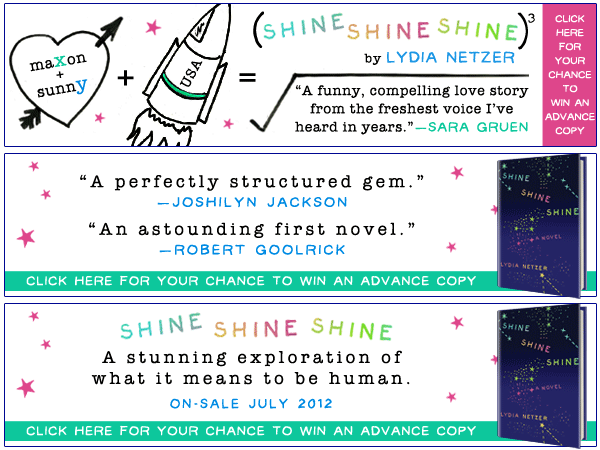
This is the ad:


It's linked to a giveaway of 100 advance reader copies of Shine Shine Shine, which is now over, but check out what these booksellers are saying about the book!


"A quirky, funny, wonderful story about motherhood, young love, adult love, death, and motherhood again. The story goes in a full circle as does Sunny as she is discovering who she really is. I loved all of the characters in the book, especially Netzer's portrayal of Maxon who was, perhaps, the most normal of all."
—Nancy McFarlane, Fiction Addiction
"Shine Shine Shine is a luminous debut about the most unconventional of families: Sunny's mother is dying, her husband is out in space—literally, and her son is severely autistic. Oh—and she is bald. This sounds like the backstory for a most unhappy tale, and yet this is a great love story about a family you really HOPE exists out there somewhere, because you root for them every step of the way. You'll find yourself flashing on this book in the most unexpected moments, which in my book is the hallmark of a great read!" 
—Jill Miner, Saturn Booksellers and the Coffee Cabin, Gaylord, MI
"I cannot think of a more appropriate title for Lydia Netzer's extraordinary novel than Shine Shine Shine; that is exactly what this book does on each and every page. The writing is bright and insightful, the characters fabulously flawed, and the observations on the human condition are winsome and wise. Netzer offers raw glimpses onto the quirks, idiosyncrasies and secrets we all have and hide as husbands, wives, mothers, fathers, neighbors and friends—but are desperate to reveal. It is one of those special stories that seems to speak directly to you, and one that you are compelled to share. It is truly out of this world." 
—Anderson McKean, Page & Palette Bookstore, Fairhope, AL
I'm so grateful to the booksellers who have taken up for this book already, helping it get picked as a SIBA "Okra Pick" for Summer 2012, and supporting it and me throughout this whole launch season. You guys are awesome!
See more about the book here: Shine Shine Shine

Monday, March 12, 2012

Arcadia by Lauren Groff

Lauren Groff's new novel, Arcadia, is a hypnotic, addicting book. Although this is not a plot-driven page-turner in the traditional sense, I found it hard to tear myself away. Two things impressed me enormously here: 


1. Unfiltered Point of View: Groff tells the story of Bit, a child born in a hippie commune, in three stages. In the first section he's a very young child, in the second a teenager, and in the third approaching middle age. Writing from a child's point of view is so dangerous -- it's so easy to send it into sentiment or to clunk it up with asides to the reader all the time. Sometimes you feel the author speaking through the child, trying to push through a meaning at you, and the character disappears. 


Not here. It was immediately obvious that the narration here, while in third person, would have no filter -- there's no "looking back on those days" or "now that he was older." In fact, there is no intrusion between the reader and the child's authentic consciousness. What he sees we see. What he feels we feel. And the things that we as adult readers can piece together from his experience are our own to interpret. That was awesome. 


The part where Bit goes silent, the description of what that was like for him -- really masterful writing.


2. Cast of Thousands: Groff has a huge cast in a fairly short novel yet they never bleed into each other and become muddy. Somehow she deftly maintains the uniqueness of a lot of characters that are very similar in context. And while these hippies are so close to ridiculous -- the nakedness, the soy everything, the language of love revolution -- they never become cartoons. Many of these images, many of these phrases now make us roll our eyes. The outfits sound like Halloween costumes. Yet these people are so real on the page, so specific to themselves, it's impossible to dismiss them as caricatures or deny them as wholly rounded, interesting characters with their own lives, their own identities within the demographic they typify. 


photo: Sarah McKune
One of my favorite things about feeling like I have "backstage access" is that I'm emboldened to ask authors questions about their novels. Because I'm me, and quite fixated on the actual structure and construction of books, I am focusing my questions as I have been focusing my reviews: on craft. This time, I was able to ask Lauren Groff a question about her methodology in handling such a mass of characters. Here's what she said:


LN: As I was reading, I kept trying to figure out how you were managing to seamlessly keep all these balls in the air with all these different characters -- I mean SO many! And to my eye, you never resorted to the easy route of just categorizing them and referencing that. Can you talk about how you approached this -- did you originally have more or fewer characters, did you take out anyone in revisions, did you consciously bring back references to characters if we had been too long without hearing of them (like in the middle section)? For example, there were several times when Sweetie was mentioned that I thought, I wonder if this is a nudge to my brain so I don't forget who Sweetie is?
LG: This is a marvelous question because it made me go all the way back to the very long drafting process and try to noodle through what I had done. In the end, I think I'd made a kind of character palimpsest: I made very long profiles of about forty of the important characters, I made a physical map of the way the characters related to one another, and I tried to see how they would pop up in the later sections. I hope I didn't try to nudge your brain to keep in mind who a character was--that's taking you out of the story, which I'd hate to do!--but the very short answer is: oh my gosh, that was a very long time ago, so maybe? If the character is useful later, maybe it's good to nudge your brain once in a while to keep in mind who they are. 
(Aside: I think I was really looking hard for the scaffolding here, and I don't think these references were heavy-handed or noticeable at all. I actually think it was gracefully invisible and impressed the hell out of me.) 
LN: I have one tiny extra bonus question, because I was really curious, while reading the last section especially -- do you see this as Bit's story really, or is it ultimately Hannah's story?

LG: Oh, I love you for saying that. I think that, though Bit is the point-of-view character, it's really the story of both mother and son. I probably meant to make it Bit's story, but because I'm a mother, like Hannah, and because my eldest son really shares a lot of Bit's soul, I couldn't help but make it also Hannah's story.
Confession: Hannah is my favorite character. Her experiences really illustrate, to my eye, the agony and the ecstasy of the Arcadian experience in ways that Bit, who doesn't know any better, can't possibly show. Yet she is never in the foreground, never takes up the full screen -- the restraint that Groff demonstrates in allowing this character to exist so completely through the lens of another is really majestic. 


To sum up. At one point in the book, someone articulates the priorities of the Arcadia commune: hard work, poverty, simple food, and community. Somehow, it all goes awry. Yet it is not only in the beginning that it is beautiful and in the end that it's terrible. In the small ways, in the real ways, it's beautiful and terrible all the way through.


Arcadia launches tomorrow. Find Lauren Groff on Twitter and tell her happy launch day. 

Saturday, March 3, 2012

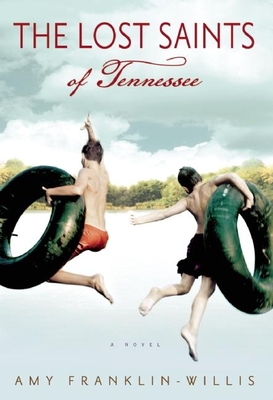
Lost Saints of Tennessee by Amy Franklin-Willis

Lost Saints of Tennessee is the story of Ezekiel Cooper, a man in his forties, driven to the brink of suicide by the death of his twin brother, ten years ago. It's a book that surprised me with its heart and its raw emotion. You must not miss the suicide scene that comes early in the book. I don't want to give too much away but it's in no way what you expect.

Amy Franklin-Willis has set herself the daunting task of drawing out a good old boy from Tennessee, divorced, working at a factory, taciturn, connected only to his old dog and his truck, into the lovable and believable narrator of his own story. It's a story of loss, betrayal, and bitterness in the past, despair in the present, and the possibility of a new chance at life in the future. She does it majestically -- portraying love without sentimentality, grief without mawkishness, hope without artifice. I can't remember when I have connected on such an emotional level to a male character written by a female author.

Maybe not since Water for Elephants has a male character been so moving. Lost Saints in Tennessee is authentic, deep, and true. A heartbreaking story of the realities of loneliness and the power of brotherly love.

I got the chance to ask Amy a few questions about the craft choices she made in her novel. I loved learning about how the novel came about -- some early narrators that dropped away and the process of opening up her main character in a way that would be true to his personality and still support narrating an entire novel. Here are her answers:

LN: You wrote from the point of view of a narrator who is not really a talker, by his own confession and as evidenced by his behavior in the novel. How did you go about finding a speaking/writing/narrating voice for this character who is so taciturn and so guarded?

AFW: Zeke's voice was a real challenge for me in the first year or two of writing the book. He is so shut down when the story begins that in writing his story, I really had to go back to his childhood and meet him then to get to know the man he became. Earlier versions of the story included a lot more of the "past storyline" which allowed me to see Zeke as a happy young boy, full of promise and connected to his twin brother, to understand the devastation he feels as an adult when Carter drowns. 

For me, some of the best lines Zeke utters are the two times he uses the f-word in the novel. In both cases, he is at a break-point, a place where he must either stay in the Loserville he's been hanging out in for 10 years or DO something. Zeke's primary companion in the early sections of the book is the dog Tucker. He was not originally in the book but he provides much needed humor and connection for Zeke in the story. You can see the goodness in Zeke through how he interacts with Tucker. What people say can be so far from what they actually do or who they are. With Zeke, you almost only have his actions to take the measure of his character. But it took me years to find the right balance of insight into Zeke and action on the page because I'm not a big fan of books that are only in the character's head. 

LN: One thing I really loved was how this prickly, locked-up character took a whole novel to warm up to telling us the question that haunts the novel from the beginning, and it takes another character's prodding to drag it out of him. So instead of feeling like you as the author were keeping a secret, it genuinely felt like the narrator was developing the ability to talk about it more as the book went on. Can you talk a bit about the decision to put that final reveal in dialogue? 

AFW: In Lost Saints, I think one of the things I was trying to explore was the notion of how a person can be pulled back from the edge of disaster or despair by another person or being. The guilt Zeke's been toting around for ten years finally gets let loose through his confession of what he regards as his own unspeakable sin. But he has to tell someone, the secret has to be shared in order to lift the burden from his shoulders. 

LN: The book is told in three sections -- the first and third from Ezekiel's point of view, and the second from his mother's. Did you always know that you would give Lillian her own voice in the novel? At what point did you decide to include a section where she could tell her story? 

AFW: I originally wrote Lost Saints with three narrators--Zeke, Lillian & Moses Washington. After a draft or two, I realized Moses had to go as a narrator--though I think he's got enough in him for his own novel. The primary writing challenges I had with this book were structural. Once I narrowed the narrators down to Zeke and Lillian, I had to figure out how their voices should be heard. 

I experimented with going back and forth between chapters, or having the time shift change from past to "current" in each chapter, and none of it felt right. I was aiming for this seamless world for the reader, where you stepped in on page one and none of the writing work showed--it was just a story told as compellingly as I could make it. With all the shifting around of voice and time, it felt choppy to me. And as a reader, I can get annoyed when I start feeling close to a character and then the author takes me into another character. I finally settled on the three-part structure for the book because it honestly seemed like the only way to tell the story. By putting Zeke's voice first, I felt like the reader was on a blind date with Zeke. You get introduced in Part One, you learn some of his history, you meet some of his family. Part Two is when things start getting serious. You meet his mother. You hear her side of Zeke's childhood story, which offers perspective Zeke can't give you. Part Three brings back Zeke's voice and now you know enough about him to understand some of the choices he's made and to be just a bit annoyed, perhaps, by his stubborn refusal to forgive his mother. 

Lillian's voice was one of those "taking dictation from God" kind of characters for me. Some of the scenes in her chapters are almost as I wrote them in first draft form. And I certainly can't say that about the rest of the book. I'm not sure where her voice came from but as I moved through the book, I began to think about my maternal grandmother. She, like Lillian, got pregnant when she was 15, married at 15, and had seven children by her mid-twenties. My grandmother had her fair share of tragedy as well. Through writing Lillian's story, I gained some empathy for my grandmother, whom I recall as an odd and distant person. My mother, who turns 70 this year, told me recently that her mother never told her that she loved her. Not once. And she lived into her early 80's. Hard to fathom.

My recommendation: go get Lost Saints of Tennessee and see how it all comes together.

Monday, February 20, 2012

The Future of Publishing: A Meditation on the Purging of VHS Tapes

Recently we moved.

Goodbye, friends. Imma download you.
Instead of wisely and slowly sifting through our possessions first, and taking only what we wanted to keep, we paid movers to pack everything into boxes and bring it here, to the new house, where we would dutifully sort as we unpacked. We moved in a hurry. Living in that old house after our new one was bought seemed like continuing to live with that guy you've broken up with already, just because you had a lease together. And moving things bit by bit in an orderly fashion to the new house was like surreptitiously trying to date someone new at the same time you're still living with that guy. Even though it's not really cheating, you still sneak. And because you're not Jennifer Aniston and he's not Vince Vaughn, you don't end up falling back in love, you just move out at the end of the lease, and it's not funny, it's just awkward. And you forget everything that was in the bathroom, and you don't go back for it.

Anyway, we moved.

In the mountain of stuff we no longer want that is now sitting grumpily in our new house, there are a mazillion VHS tapes. These are objects that should have been purged years ago. We haven't watched any of them since we moved the last time. We don't even have a VCR connected to our TV. If we did hook up a VCR, and managed to remember what the button "Rewind" does, I guarantee the tapes would look awful in 1080 resolution. It's at a point with these VHS tapes that I don't even think the Salvation Army wants them. I don't think anyone wants them. But every time we began to hustle them into bags to push them out the door, we got all oogly about it. Here's our copy of "The Long Kiss Goodnight," which we watched and rewound several times. Here's "Household Saints," one of the first movies I ever owned. "Welcome Home Roxy Carmichael." "Go." "Four Rooms." "Sweetie." Here's that copy of "City of Lost Children" that was almost impossible to get. "Evita." Shut up, I have the whole thing memorized. I have a romantic attachment to these objects -- they remind me of when we were younger, poorer, and dumber, when I was working at a 1/2 porn video store during graduate school, when our TV was small and given to fits of rage instead of large and austere and firmly in control of itself.

So I put them, all, ruthlessly in the trash. I kept the ultrasound videos from my kids. I kept a couple of other personal things. But anything that I can get on DVD or download, I tossed.

Then I had a horrifying thought. AM I DOING THAT THING THAT PEOPLE DO WHEN THEY ARE LIKE, "OH, WHATEVER, BOOKS ARE PASSE, I HAVE MY WHOLE LIBRARY RIGHT HERE IN THIS ELECTRONIC THINGER." Shudder.

This was not the cover.
But I wish it had been.
Because this cover's badass.
I have a romantic attachment to my books too. But I don't need to tell you that. You know I have the first paperback edition of Moby Dick I read in high school, with all my scrawled little teenaged marginal notes. You know I have the Candide I got in college, the used Italo Calvino I got in Milan, all my signed copies of friends' books, including stuff you can't hardly find ever like My Horse and Other Stories by Stacey Levine and You're a Bad Man Aren't You by Susannah Breslin. I like books. I have a lot. And I will never, ever, ever get rid of them. EVER.

But will my children? Will their children? Will publishing really change forever like everyone is saying it will, so that we'll all be walking around in future times with retinal projectors that allow us to store small libraries behind our ear drums and books will seem dumb like VCRs and twisty knobs on televisions, and jello molds? If I throw away these tapes, will I tomorrow throw away my Gormenghast novels? With the same reckless abandon? Will I?

Moment of panic. Moment of almost pulling those VHS tapes back out of the trash. Then, relief.

Here's what I realized. Books are not like VHS. They're not like DVDs or film canisters or analog recordings or vinyl. You can't say "Well, I can get my books on my Kindle" just like you can say "Well, I can get my songs on my iPod." They're not like that. Here's what they're really like: Theater. Live concerts. You can make them work just with your eyes. You can make all the parts function just by looking at them. It's not a product, it's an entertainment. It's not an object, it's an experience. An experience you can collect, and keep in pretty rows, and share, and and have again and again. And then I felt much better.

I felt better because not only did I NOT have to keep all those VHS tapes, and not only did I NOT have to get rid of all my books and start buying up eBooks on Google, but this: publishers are going to be okay. They really are. Call me Pollyanna or a crack addict or in denial or call me ignorant but here's what I'm saying: Books aren't going anywhere. 

Things may change, in publishing. E-books rise. Paperbacks fall. Publishers will try fetishizing, and niche marketing, and different production models. Fine. But people will still go to the theater. People will still go to live music shows. And people are still going to have books, want books, read books, hoard books, dive into books, and love books. Believe it.

Some of my favorite books.