Showing posts with label publishing. Show all posts

Tuesday, July 17, 2012

Dear Reader,

Dear Reader,

My novel is released today. Let's pretend you've bought it. Let's pretend you're holding it in your hands. I know what it feels like. 


Visible Woman by Perry Vasquez
The novel you are about to read has been with me for over a decade. Like all authors I’ve tried to put into it everything I have to say about life, just in case I never get a chance to do this book thing again. So what you’re holding is my best attempt at downloading everything I have in my head that matters.

I’ve been asked what pieces of this novel are from real life and which are pure invention. The truth is that nothing here is a direct representation of anything in “real life.” At the same time, everything here is very real to me, and all of my most important pieces: my kids, my husband, my mother, and even my robot fixation, are present. This book is a treatise; it’s what I believe. And that means true love and merciless death and mechanical evolution and happy motherhood and mortal fear. There’s some weird stuff, some serious stuff, some goofy stuff. Some of it is pretty dark.

Publishing a novel is, I am finding, a very personal public act. In the book, I expose my self – dark and light, good and bad – and when you have read it, you will know me better than I will probably ever get the chance to know you. I am so grateful that I have this way to explain myself, this book-sized opening in my head. And I am so grateful to you that you are willing to listen, to hear this story, and to understand.

In other words, I have waited a long time to meet you, and I’m so happy that you are finally here.

Love,
LYDIA

Monday, February 20, 2012

The Future of Publishing: A Meditation on the Purging of VHS Tapes

Recently we moved.

Goodbye, friends. Imma download you.
Instead of wisely and slowly sifting through our possessions first, and taking only what we wanted to keep, we paid movers to pack everything into boxes and bring it here, to the new house, where we would dutifully sort as we unpacked. We moved in a hurry. Living in that old house after our new one was bought seemed like continuing to live with that guy you've broken up with already, just because you had a lease together. And moving things bit by bit in an orderly fashion to the new house was like surreptitiously trying to date someone new at the same time you're still living with that guy. Even though it's not really cheating, you still sneak. And because you're not Jennifer Aniston and he's not Vince Vaughn, you don't end up falling back in love, you just move out at the end of the lease, and it's not funny, it's just awkward. And you forget everything that was in the bathroom, and you don't go back for it.

Anyway, we moved.

In the mountain of stuff we no longer want that is now sitting grumpily in our new house, there are a mazillion VHS tapes. These are objects that should have been purged years ago. We haven't watched any of them since we moved the last time. We don't even have a VCR connected to our TV. If we did hook up a VCR, and managed to remember what the button "Rewind" does, I guarantee the tapes would look awful in 1080 resolution. It's at a point with these VHS tapes that I don't even think the Salvation Army wants them. I don't think anyone wants them. But every time we began to hustle them into bags to push them out the door, we got all oogly about it. Here's our copy of "The Long Kiss Goodnight," which we watched and rewound several times. Here's "Household Saints," one of the first movies I ever owned. "Welcome Home Roxy Carmichael." "Go." "Four Rooms." "Sweetie." Here's that copy of "City of Lost Children" that was almost impossible to get. "Evita." Shut up, I have the whole thing memorized. I have a romantic attachment to these objects -- they remind me of when we were younger, poorer, and dumber, when I was working at a 1/2 porn video store during graduate school, when our TV was small and given to fits of rage instead of large and austere and firmly in control of itself.

So I put them, all, ruthlessly in the trash. I kept the ultrasound videos from my kids. I kept a couple of other personal things. But anything that I can get on DVD or download, I tossed.

Then I had a horrifying thought. AM I DOING THAT THING THAT PEOPLE DO WHEN THEY ARE LIKE, "OH, WHATEVER, BOOKS ARE PASSE, I HAVE MY WHOLE LIBRARY RIGHT HERE IN THIS ELECTRONIC THINGER." Shudder.

This was not the cover.
But I wish it had been.
Because this cover's badass.
I have a romantic attachment to my books too. But I don't need to tell you that. You know I have the first paperback edition of Moby Dick I read in high school, with all my scrawled little teenaged marginal notes. You know I have the Candide I got in college, the used Italo Calvino I got in Milan, all my signed copies of friends' books, including stuff you can't hardly find ever like My Horse and Other Stories by Stacey Levine and You're a Bad Man Aren't You by Susannah Breslin. I like books. I have a lot. And I will never, ever, ever get rid of them. EVER.

But will my children? Will their children? Will publishing really change forever like everyone is saying it will, so that we'll all be walking around in future times with retinal projectors that allow us to store small libraries behind our ear drums and books will seem dumb like VCRs and twisty knobs on televisions, and jello molds? If I throw away these tapes, will I tomorrow throw away my Gormenghast novels? With the same reckless abandon? Will I?

Moment of panic. Moment of almost pulling those VHS tapes back out of the trash. Then, relief.

Here's what I realized. Books are not like VHS. They're not like DVDs or film canisters or analog recordings or vinyl. You can't say "Well, I can get my books on my Kindle" just like you can say "Well, I can get my songs on my iPod." They're not like that. Here's what they're really like: Theater. Live concerts. You can make them work just with your eyes. You can make all the parts function just by looking at them. It's not a product, it's an entertainment. It's not an object, it's an experience. An experience you can collect, and keep in pretty rows, and share, and and have again and again. And then I felt much better.

I felt better because not only did I NOT have to keep all those VHS tapes, and not only did I NOT have to get rid of all my books and start buying up eBooks on Google, but this: publishers are going to be okay. They really are. Call me Pollyanna or a crack addict or in denial or call me ignorant but here's what I'm saying: Books aren't going anywhere. 

Things may change, in publishing. E-books rise. Paperbacks fall. Publishers will try fetishizing, and niche marketing, and different production models. Fine. But people will still go to the theater. People will still go to live music shows. And people are still going to have books, want books, read books, hoard books, dive into books, and love books. Believe it.

Some of my favorite books.

Wednesday, July 27, 2011

How Other People Edited My Novel

I spent over ten years writing my novel. There was a lot of self-editing that happened during those ten years. From tweaking sentences to throwing out chapters and even whole drafts, I edited pretty constantly as I went along. I edited based on my own opinions, and based on suggestions from my critique group. I edited when Susannah told me on an early draft, "No, this isn't right. You haven't got it yet."

But in this post I'm going to talk about the editing that happened between the point that I slammed my hand down beside my laptop and shrieked "DONE" and the point that my editor at St. Martin's said, "Good job, we can move on to line edits." The major, conceptual edits that came from my agent, my editor, and my beta readers.

Lots of people have asked me how much influence my agent and editor had on my book, and if that bothered or upset me. The answer is that they had a lot of influence, and all of it was good in the end, and none of it ultimately bothered me. There were changes that made me hesitate, and some that I thought might be impossible. I had decided that I was not going to be some sort of annoying prima donna. I told myself that I was going to be a good girl and not argue, and that I would take every suggestion and try and make it work in the book. There was only one suggestion that I could not find a way to do. All the rest of them made the book better, I strongly feel. So when I look at the book I don't see my darling book underneath the mean changes and ugly edits forced on me by other people. I see a book that's so much better than it was a year ago, I hardly recognize it.

So what was the last year like, in edits? Here's how it went:

At the end of July, I finished my novel. I sent it to several friends, some of whom are writers. The friends who are writers had some feedback -- some suggestions for pretty deep structural changes. My novel was built in three big chunks, and they felt that the sections should be mixed up more. One friend passed it on to a friend who is an agent. The agent agreed with the structural changes and had some other suggestions too. We did not sign a contract, or get married to each other as author/agent, but I really like her and wanted to try these changes for her, especially since they were agreed on by the other writerish friend types. Thus began revision #1. I blew up the major sections of the book, and started shaking out the pieces.

Revision #1 ended on November 17 when I had made all the changes discussed. I sent the revised book off the the beautiful agent, hoping she would love me and want to marry me in a literary way.

Here is a real, true fact for you: Very little happens in publishing over the winter holidays. Very little happens in any industry.

On January 21, the beautiful agent told me she liked my revisions and on January 25, she sent me a contract and we were literarily entwined. By the first week of February, and the book appeared to be done, only six short months after I had proclaimed it done.

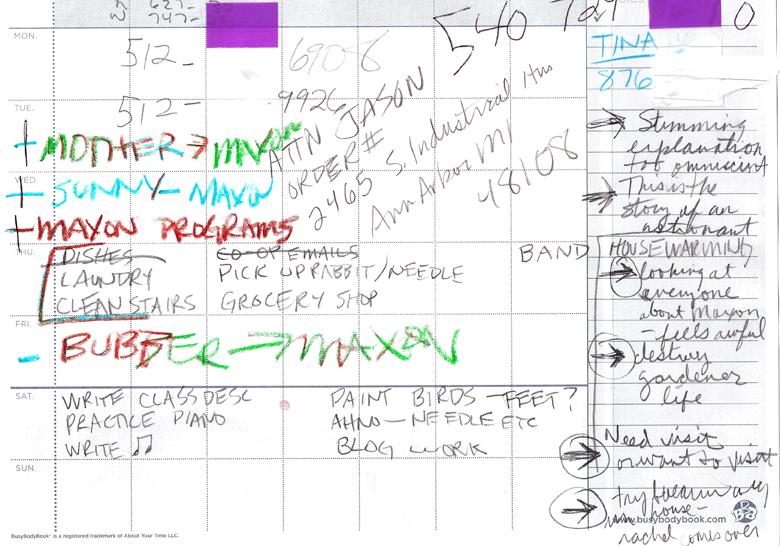
This piece of paper was stuck to my refrigerator during the months of February and March, and it shows the notes I made during phone calls with my agent -- scenes to be written or revised. I would march around my house during the calls, writing notes onto this paper. Some of the notes are in scrawled onto the paper in big scratchy CRAYON. This is proof that I am mentally unstable, or that I have a seven year old daughter and I had a crayon handy. If you click on it, it takes you to a bigger version.


Unfortunately at this point I had a major idea, an idea which sort of demanded that it be not only included in the book but included into almost every part of the book. This tiresome, obnoxious idea of mine endeared itself to the beautiful agent, and increasingly endeared itself to me, although I wrote several emails to various people shouting that it was impossible and ridiculous to even consider doing it. Email evidence shows that I resisted putting it in until March 22. Eventually, with the help of a mathematician (real) and a crowbar (metaphorical), I incorporated this idea. In doing so, I turned up a few more things that needed revisions. An additional scene here, a tweak there, a shift of emotional content over here, and it was done by April 2. Done, done, done, never to be edited again. Completely finished.

Beautiful agent wrote the pitch letter (It's like Eat, Pray, Love, but in SPACE!!!) and compiled a list of editors. On April 26, she started pitching it, and in a couple of weeks we had a deal. And an editor. You may notice that the word "edit" is prominently featured in the title "editor." Unsurprisingly, my adorable editor had a list of things she wanted tweaked and twirled in the book. One character was to have a much larger role. One subplot was to get a much more complete treatment. We talked about the edits on the phone, and I pondered and toiled over them in the manuscript. Here's a screen shot of the notes I took on our phone call. You can see a checklist I added later, when I had boiled down our conversation into discreet tasks.


The checklist helped, but it was not until we were sitting around a table at lunch in New York, that is adorable editor, beautiful agent and I were sitting around this table (the tallest people in the room, it is to be believed) that adorable editor came up with a very specific, tangible idea that really lit up the whole problem and got me excited to get into the manuscript and tear it up a bit.

I finished my revisions on July 9. A week or so later, adorable editor wrote back that she liked them. And that's where we are at this moment.

The next step is to get her line edits and start working on those. I'm hoping to get an astronaut to read the manuscript and give me some input on the space scenes. But I have the strong feeling that the book is in its final shape in terms of the scenes and characters, the plots and ideas. Many hands have touched it and changed it. I feel like every suggestion, whether to change something, to add something, or to take something out, was essentially the same message: This isn't working. Writers should never ignore a reader who is telling them "this isn't working." Even if I didn't know how to fix it, or how to implement the change, and even if I felt strongly that it shouldn't be changed, I really tried to address every single issue and respond to every suggestion. From my early readers in my critique group down to my editor at St. Martin's, I valued all the input I got.

No novel falls perfectly from a writer's head. Mine has maybe been through more changes and permutations than most. But when the cover goes on and the pages get numbered and the release date finally comes, there aren't going to be any more chances to fix it. This is my chance to make the book as perfect as possible, and I'm taking every opportunity I get.

Sunday, May 22, 2011

We Have a Book Deal

Just a few short weeks after she began shopping it, my agent Caryn Karmatz-Rudy sold my novel to St. Martin's Press. On Tuesday, the deal was announced in Publisher's Lunch. I'm in Italy right now, and didn't get to properly drool over it, so she forwarded it to me. I have only read it out loud to Dan a few times, but in my head I have it memorized:

Lydia Netzer's SHINE, SHINE, SHINE, in which a young mother's "perfect" suburban existence unravels in unexpected ways as her astronaut husband's endangered mission to colonize the moon brings to light her dark childhood secrets, their strange and wondrous relationship and forces her to question the nature of motherhood, dying and what it means to be human, to Hilary Rubin Teeman at St. Martin's, in a very good deal, in a pre-empt, by Caryn Karmatz Rudy at DeFiore and Company (World).

I am so happy. Wondering and wondering.

Monday, August 17, 2009

To Hell with Publishing: Neither Irreverent nor Inventive

The name promises much. The name inspires obstreperous agreement. Yeah, to hell with publishing, anyway! This is 2009. We're all about downloads, and Kindle, and Twittered novels, and free information, and Google books, and plots we can download via wires straight into our arteries, and plugging into authors via Friendfeed, and instant updates, and modules! To hell with publishing, to hell with journals, to hell with prizes, to hell with first novels. Yeah! Fist-pump!


From a group of projects so provocatively named, I now expect mind-blowing innovation. I expect earthshaking progress. I expect, at the very least, heaps of scorn for the old way of doing things, and arms flung wide open to the new, digital world. Please, make sense of fiction on Twitter for me. Please, package blogged novels. Please, help me to understand new media. I beg you! Unfortunately, what I'm finding here is same old, same old. Instead of revolution, "To Hell with Publishing" is pushing cardstock, ink, and contracts. Readings at a library under a dropped ceiling. Submission guidelines -- click here! And please include a cover letter.


"To Hell with Publishing" is just another small press. Like every other small press in the history of earth, they desire to "return vital writing, and in particularly, the best in contemporary fiction, to the main literary stage." Well bra-thumping-vo. They publish... books. Books made of paper and glue. And they publish journals. They have a prize for... unpublished manuscripts, but unagented manuscripts are not considered. Please submit paper copies in triplicate, because at "To Hell with Publishing" they are all about the snail mail.


That name followed by that business model is like the sound of a trumpet fanfare followed by the sound of a drunk falling downstairs. Where's the innovation? Where's the middle finger raised to the literary establishment? Listen: Here are the two ways that "To Hell with Publishing" bites its thumb at the mainstream presses.


1. They will only publish first novels. No second novels! Oh my god! Their plan is that other publishers will swoop in and take over their authors' careers after novel #1. Because yeah, mainstream publishers are so interested in picking up seconds after the author has been deflowered of his first novel. Do I really have to pursue that analogy?


2. Their journal (To Hell with Journals) will only have 26 issues. They have decided this... in advance. Only 26 and no more, even if thousands of screaming fans are lined up outside the bookshop, demanding just one more issue, tearing up their organs in despair that only 26 issues can possibly be produced. They will stand innovatively firm on this principle: THEY WILL FOLD AFTER TWO YEARS.


These two policies manage to be simultaneously defeatist and overly ambitious. Yeah, we MEANT that journal to go under, and we MEANT that author to never produce another book, because that's all part of the rakish, devil-may-care plan we have here at "To Hell with Publishing." Look, there are already small presses out there doing exactly what THWP desires to do, but without these weird stipulations that seem to undercut any kind of longevity or long term relationship between press, author, and reader. Obviously a few more domain names are needed: tohellwithlegitimacy.com, tohellwithauthorloyalty.com, and tohellwithrelevance.com. "To Hell with Publishing" is a profound disappointment, leaving this reader still looking for the next great thing. When it comes along, I have a feeling that "To Hell with Publishing" would be a really cool name for it. Unfortunately, that domain name is already taken.


For more info: I found out about To Hell With Publishing from the Book Ninja.

Monday, January 21, 2008

My Future Shelf

This is the shelf where my non-fiction book will be sold in the future.

Monday, January 7, 2008

A New Experience

Today I did something I haven't done in ten years. I cold-queried agents. Bolstered by the support and advice of my friends and husband, energized by a new idea for a non-fiction project, I googled and spreadsheeted and perused, and then I sent off my seven little queries.


Just doing that made me feel pretty happy. Every time I clicked "Send" I got a little sicker and a little more interested. I had this idea for the book two weeks ago, and I wrote the chapter list this weekend. Today I worked on the query letter, incorporating significant wisdom and womance from Susannah, and sent it off. So far I've had two positive responses. The next step is to write the book proposal and send that.

This afternoon when I went upstairs, the light coming in the window in the bedroom looked kind of different. We are having a weird kind of indian summer here in Virginia. Or it's because I put my foot on a different kind of pedal than I have put my foot on before. This is not the strange, amorphous pedal of clove smoke and brain waves that is literary fiction. Sometimes pressing on that pedal gives you a sore throat, or a poodle, or a trip to Paraguay. This is a firmer, brighter, more substantial pedal that you can actually see and feel, and if you exert pressure on it, it actually moves according to the Newtonian laws of motion.

At least, that's the impression I have today.

Wednesday, October 10, 2007

What the World Needs Now is Another Literary Magazine Like I Need a Hole In My Head

Literary magazines, the time has come that we all knew was coming. It’s over. It’s done. The lady in the Viking corset has belted out the final high C sharp. Please exit quietly at the rear door, but leave your plastic 3D glasses in the bins provided. You will no longer be hosting the revolutionary planning sessions. The revolution already happened, and at someone else’s house.

You had a good run. Well, not really, but for the sake of politeness, we’ll say that you did. I have no ill will. I have no desire to wound you in these, your final hours. You once served a purpose, but the purpose is extinct, and so are you. No more glossy coverstock. No more precious author bios. No more black and white photography opposite poems about rain on the window pane and how it’s like roads. No more “This page purposefully left blank.”


I’m with you, and we can go through this together, but let’s face the facts. Literary magazines used to exist for two reasons. The first was immediacy. Rather than waiting for the long, grinding, seasonal cycle of big traditional publishers to get new books on the shelves, readers could find fresher fare in literary magazines, published quarterly, or even monthly. The second reason was for content, as literary magazines reached farther out of the mainstream, farther into the margin, to pull new writers, strange writers, uncommercial writers, into the world of print and out to the world of readers.

Now we have the internet. Do I need to explain, or would it be too painful?

With web sites enjoying daily updates, the old publishing schedule of even an ambitious quarterly magazine now seems yawning and slow. My attention span stretches approximately to the update cycle of The Onion, and then shatters into a thousand pieces. Are you publishing your literary magazine twice a year? Are you kidding?

Then there’s the content and readership. Any brilliant, strange, new, marginalized writer with a Blogger account and a willingness to network can gain far more readers than any literary magazine was able to reach in the history of time. In fact, any jackass with a LiveJournal can reach more of an audience than most literary magazines have ever boasted, even the big ones. I’ve been published in respectable, established literary magazines that I bet fewer than a hundred people actually read. And that is true. Hold me. It is true.

Then there’s the subject of money. The internet is, mostly, free. And well, you know the rest.

So, really, do we need another literary magazine? Just one last really special one? Do we need to hear about how this publication is different, this one is going to be a “really beautiful object,” this one is going to change publishing forever? Do we need to hear from another self-congratulatory editor-in-chief, lovingly stroking his in-jokes, musing fondly on how many subscribers he’ll need to break even, figuring out how to woo in another bored midlist author to showcase in the autumn issue? How about one more magazine named “BRICK” or “PHYLACTIC TUNA”?

Let’s admit it, we were all there at one time. Graduate school can make you feel like that. I freely admit that I, with milk-white hope in my shiny heart, at one time published a collection of short stories written by a friend of mine, and got it placed in local bookstores. I think I was twenty-two. It was fun to play pretend that way. But for the love of Kinko’s, as grim as it may sound, you have to grow up.

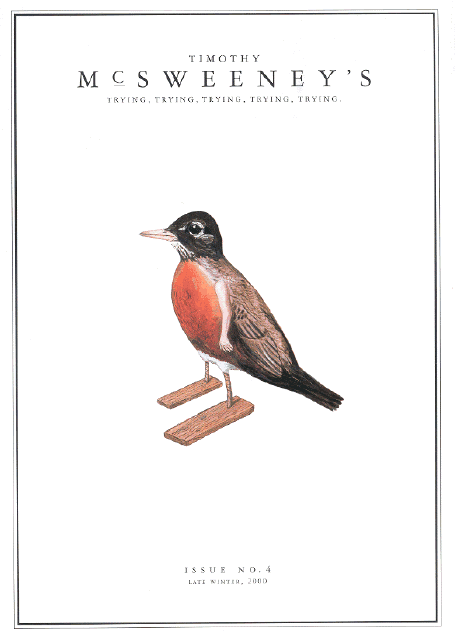
Enough is enough. You cannot change the world with really expensive paper, you cannot revolutionize literature by being “more ironic than McSweeneys” (is that even possible?), and you cannot sell a literary magazine. Literary magazines are not books, no matter how you try to fetishize them, they will never be on the shelf with the novels. They never have and they never will. Literary magazines are the cousins of newspapers. Novels are the cousins of history.

What can we do? I would call for a boycott, I guess, but boycotting literary magazines would be like boycotting sandpaper pants. Nobody’s rushing out to the stores to grab them up anyway. The sad fact is that nature will take its course, and these beautiful, exotic creatures will be eaten by literary evolution. But will anyone survive?

The lumbering giants will survive: The Paris Review, Ploughshares, Triquarterly, etc. These are the litmags you have to get in because they put a big gold star on your resume, and they will survive because of their prestige and tradition. People still want to break their heads open on the editorial boards that published Jack Kerouac, Flannery O’Connor, Samuel Beckett. We’ll eventually be using The Paris Review to line the fork drawer, but not yet.


Which brings us to blogs. Remember zines? Blogs are the new zines. People used to staple together mimeographed pieces of crap in their grandmother’s basement and distribute it via copy machine, coffee shop counter, and word of mouth. They were subversive, populist, and updated instantly on the whim of the publisher. Blogs are the zines of the new millennium – now instantaneous, with open access for all. With all of this magic at the other end of a short wire, is it really worth our time to go around trying to sell paper and glue for ten dollars a glob?

It’s time to stop the presses. I know it’s not easy to pull that plug. Litmags are icons of intellectual privilege. You have to fight against a lifetime of programming that’s telling you literary magazines are good, therefore more literary magazines must be better. You respond out of habit, and assume it’s good news, like when a baby is born. It’s not. Magazines aren’t babies. In the world we live in, we need literary contraceptives. So stop. Put down the telephone. Put down the really nice pen. We don’t need another literary magazine. Literary magazines are dead.