Thursday, August 1, 2013
A Marker to Measure Drift by Alexander Maksik: A Master Class in Craft
Sometimes when I finish a novel that has really lit up my brain, I am restless with questions for the author. Why did you make that choice? What was going on here? This is exactly the type of novel I want to dissect, as if I can get to the bottom of it, find out what makes it so successful. A Marker to Measure Drift has some excellent lessons for writers.
Lesson #1: Everything is Personal.
Maksik's main character is a young black woman from Liberia, and when the novel opens she is starving to death near a beach on a resort island in Greece. Maksik himself is a man, an American, and lives in New York. Yet one of the most arresting things about this book is how immediate and real Jacqueline's experience is, how unfalteringly close the prose brings us to her, physically and mentally, so I asked him...
LN: Your main character is a 24 year old African woman, and your novel is an antidote for that poisonous advice: "Write what you know." Your voice never felt contrived, Jacqueline's voice never felt artificial, and the relationship between her and her mother seemed to me to be particularly authentic. Did anyone ever tell you to write what you know, or imply that you couldn't properly write this character because you're a man?
AM: I don’t think there’s a writer alive who hasn’t heard that adage. The problem is that it’s often misunderstood as law, as a kind of strict limitation: you must only write about your immediate experience. It’s an absurd idea and it goes counter to the whole idea of fiction, the point of which is to fabricate, invent and imagine. On the other hand, what I know about relationships, about sorrow, about joy, about love, about lust, about loneliness, I know from experience. How can I not use what I know when I’m writing about these things? The adage should provide writers a sense of freedom rather than restriction. Writing fiction should be an act of deep empathy, a way to inhabit lives outside of our own, to imagine the experiences of others.
As for the rest, I believe strongly that it is the writing that must be evaluated. Not the writer.
Yes. Just because you're not in the demographic of the character doesn't mean you're not writing something sharply personal, something you "know" intimately, something from your own life.
Lesson #2: Memories Aren't Tidy
I'm always interested in the structure of novels and how these structures emerge -- whether they spring up fully formed in a first draft or whether they're the result of revision, rearranging. This book stays very tight to a short timeline, with flashbacks to earlier memories and scenes. However, the flashbacks aren't tidy and informative as flashbacks can sometimes be -- arriving just in time to provide a piece of information to a reader. The way Maksik handles his flashbacks, they're more glimpses or really "flashes" and the scattered way they came through seemed to mimic real memory and how haphazard and uncontrolled it can be. As a result, we don't really get "the whole story" wrapped up neatly, but we do get the whole story that's important to the character in the present. And I never felt like "Ah, I'm being filled in on the backstory."
LN: I found your choices regarding timeline fascinating -- there is a lot of the story that's left out, and yet we know enough, as readers, to follow the emotional arc of the character if not every little detail of her life. Did you write this book longer, and then cut? Or did you always know that this little piece of her story, with the past bleeding in in fragments, would be enough?
AM: I knew early on that this would be a short novel, and that it would be focused very precisely and intensely on Jacqueline’s immediate life. And I wanted as little separation as possible between Jacqueline and the reader, who would know only as much as she does. I like the idea of coming to understand a character through fragments, as you say. That’s the way we come to know people in life, isn’t it?
Whether or not it would be enough to be successful is another question entirely. I hoped so, but I certainly wasn’t sure. I’m still not.
Lesson #3: Follow Your Instinct, Not Your Rulebook.
Another rule that Maksik violates, without drawing much attention to it at all, is the directive we've all heard to keep verb tense consistent within a novel. The end of the book moves to present tense. Switching verb tense is something close to my brain, since I've just finished going through revisions on a novel with some present tense sections, and it was a point of debate, whether that should be allowed to stand. When I asked Maksik about it, he didn't explain his choice or defend his scheme -- it seems he had no scheme and feels no explanation is necessary. He's just letting the material dictate how it needs to be told, and there's a narrative instinct at work there that he doesn't question. This answer was enormously satisfying for me to read, especially when he brought up another paragraph in present tense that I hadn't even noticed. I almost wanted to ask: "And your editor let you do that?" But the point is he knew it was there, and while it wasn't intentional it also wasn't an oversight. Somewhere between intention and oversight -- this must be where instinct lives.
LN: You switch to present tense in the final section. I feel it torques up the tension beautifully and almost invisibly draws us closer to Jacqueline as the book peaks. At what point in your process did you decide to do this, and why? Did you write other bits in present tense, and change?
AM: With that kind of thing, I really go by feel, by instinct. It wasn’t a conscious consideration, but I didn’t hesitate to do it. There’s another brief passage (p. 92) in the present tense. A single paragraph. I can’t say exactly why I made that choice. It hardly feels like a choice, really. It has something to do with that moment being a significant turning point in the novel. I could go on about it being a moment of tremendous relief for her, of change, of deep engagement. But that would suggest some serious intention and consideration, which if I’m to be honest really isn’t the case.
A Marker to Measure Drift is dense, foreign, and beautiful, but ultimately it is a very simple book. Here is a human, detached from humanity, in pain and need. The world swirls around, the past lingers, but this human is at the center, small and yet deep. Maksik's prose brilliantly delivers -- I think he has fully realized what this story could be, and has told it in the best way possible. An amazing accomplishment. Of course you should read this book, if you are a reader who is looking for a great story. But especially if you are a writer, this is one you should not miss.
(Find Alexander Maksik on Facebook and Twitter and you can preorder a signed edition here.)
Wednesday, August 22, 2012
The Infinite Tides by Christian Kiefer
Christian Kiefer has written a novel about the solitude of an individual. He shows us the magnitude of our individual planet in the vast chaotic reach of space by way of creating an individual person, stripping him of family, job, connection, and possessions, and stranding him in the vast impersonal landscape of suburbia. Keith Corcoran, astronaut, is this man. Earth is this planet. Both are one of many, many, uncountable replications of themselves, yet both are stunningly, inconceivably alone. We are all alone, and Kiefer warns us there are no emotional epiphanies to save us from this.
What matters, when all you have is your *self*, and that self is so vulnerable, so fragile? In The Infinite Tides, an entire personal history can be wiped out by a lost bit of mail. A man can be laid low by a single blood vessel, a planet by a stray meteor, a great love by a collision with a tree. Nothing is safe, and the dangers intrude without regard or warning: termites, migraines, car accidents, meteors -- you can't control anything, and you can't even react. You just have to take whatever comes, even if it annihilates everything. There is no fate -- there is only math, and math is more ruthless than fate, and more final.
What saves the book from being basically a prose poem for a nihilist, is that redemption does come. Not from a glowing unicorn friend that takes Corcoran to Disneyland on a glitter rainbow (an ending I suggested to Kiefer on Twitter when I was part way through the book) or a wonderful carefree puppy that teaches him how to embrace life, or anything stupid like that. (Corcoran was ripe for the magical effects of a Manic Pixie Dream Girl, for example. Fortunately one did not appear -- just a cynical housewife on the cul de sac, ready to yank his pecker but not forthcoming with life lessons.) Instead, redemption comes from the only place it can come: math. The same thing that brings the desolation, and the horror, and the isolation, brings the hope.
As we are small, and as iterations of us extend across the universe, there is a beauty and satisfaction, for Corcoran, in the infinity of fractals. The tiny speck at a central chamber of the nauticus' spiral, weak and fragile as it might seem, is actually the same chamber as the biggest one, a massive hypothetical chamber that takes up half the universe, and even a hypothetical chamber beyond that, that takes up double another universe.
The concept of fractal iterations is one that haunts Corcoran from his own youth, to his parenting of his daughter, to the pivotal moment of the book which happens quite early in its pages -- he's at the end of a robotic arm that he's built for the International Space Station, and the arm is used to move things from one end of the station to the other, and he swings wide, away from the vehicle, and extends out into space. But when he's out there, swinging loose, it's not "Oh, I should have spent more time with my family" or "Oh, I miss love" that strikes him -- it's the vastness of it, the visible infinity of it, the real, brutal beauty. That's what matters. Fractals don't stop in either direction, do they? Can something be terrifying and comforting at the same time?
In the tiniest is the most enormous. One leaf on the pythagorean tree is the entire tree, because it is of the same number. Really it's the ONLY way to address the solitude of the space between your ears, or the magnitude of the universe -- to draw a mathematical equation that says they're the same thing.
Kiefer's writing is perfect. His language is tight, but swells in all the right places. He uses words you'll want to look up, but places them so gently that you won't have to. His idea is big, but his character is what the story is all about -- this lost and grounded astronaut. Maybe being where he's been, and having lost what he's lost, Corcoran is the loneliest human on earth. Or maybe only the one who has been outside the earth and has seen it from afar is suited to see how we are all connected. Don't miss this quiet masterpiece.
Monday, March 12, 2012
Arcadia by Lauren Groff
1. Unfiltered Point of View: Groff tells the story of Bit, a child born in a hippie commune, in three stages. In the first section he's a very young child, in the second a teenager, and in the third approaching middle age. Writing from a child's point of view is so dangerous -- it's so easy to send it into sentiment or to clunk it up with asides to the reader all the time. Sometimes you feel the author speaking through the child, trying to push through a meaning at you, and the character disappears.
Not here. It was immediately obvious that the narration here, while in third person, would have no filter -- there's no "looking back on those days" or "now that he was older." In fact, there is no intrusion between the reader and the child's authentic consciousness. What he sees we see. What he feels we feel. And the things that we as adult readers can piece together from his experience are our own to interpret. That was awesome.
The part where Bit goes silent, the description of what that was like for him -- really masterful writing.
2. Cast of Thousands: Groff has a huge cast in a fairly short novel yet they never bleed into each other and become muddy. Somehow she deftly maintains the uniqueness of a lot of characters that are very similar in context. And while these hippies are so close to ridiculous -- the nakedness, the soy everything, the language of love revolution -- they never become cartoons. Many of these images, many of these phrases now make us roll our eyes. The outfits sound like Halloween costumes. Yet these people are so real on the page, so specific to themselves, it's impossible to dismiss them as caricatures or deny them as wholly rounded, interesting characters with their own lives, their own identities within the demographic they typify.
![]() |
| photo: Sarah McKune |
LN: As I was reading, I kept trying to figure out how you were managing to seamlessly keep all these balls in the air with all these different characters -- I mean SO many! And to my eye, you never resorted to the easy route of just categorizing them and referencing that. Can you talk about how you approached this -- did you originally have more or fewer characters, did you take out anyone in revisions, did you consciously bring back references to characters if we had been too long without hearing of them (like in the middle section)? For example, there were several times when Sweetie was mentioned that I thought, I wonder if this is a nudge to my brain so I don't forget who Sweetie is?
LG: This is a marvelous question because it made me go all the way back to the very long drafting process and try to noodle through what I had done. In the end, I think I'd made a kind of character palimpsest: I made very long profiles of about forty of the important characters, I made a physical map of the way the characters related to one another, and I tried to see how they would pop up in the later sections. I hope I didn't try to nudge your brain to keep in mind who a character was--that's taking you out of the story, which I'd hate to do!--but the very short answer is: oh my gosh, that was a very long time ago, so maybe? If the character is useful later, maybe it's good to nudge your brain once in a while to keep in mind who they are.
(Aside: I think I was really looking hard for the scaffolding here, and I don't think these references were heavy-handed or noticeable at all. I actually think it was gracefully invisible and impressed the hell out of me.)
LN: I have one tiny extra bonus question, because I was really curious, while reading the last section especially -- do you see this as Bit's story really, or is it ultimately Hannah's story?Confession: Hannah is my favorite character. Her experiences really illustrate, to my eye, the agony and the ecstasy of the Arcadian experience in ways that Bit, who doesn't know any better, can't possibly show. Yet she is never in the foreground, never takes up the full screen -- the restraint that Groff demonstrates in allowing this character to exist so completely through the lens of another is really majestic.
LG: Oh, I love you for saying that. I think that, though Bit is the point-of-view character, it's really the story of both mother and son. I probably meant to make it Bit's story, but because I'm a mother, like Hannah, and because my eldest son really shares a lot of Bit's soul, I couldn't help but make it also Hannah's story.
To sum up. At one point in the book, someone articulates the priorities of the Arcadia commune: hard work, poverty, simple food, and community. Somehow, it all goes awry. Yet it is not only in the beginning that it is beautiful and in the end that it's terrible. In the small ways, in the real ways, it's beautiful and terrible all the way through.
Arcadia launches tomorrow. Find Lauren Groff on Twitter and tell her happy launch day.
Saturday, March 3, 2012
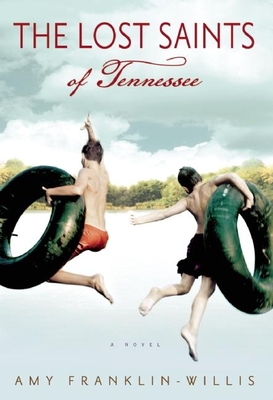
Lost Saints of Tennessee by Amy Franklin-Willis
Amy Franklin-Willis has set herself the daunting task of drawing out a good old boy from Tennessee, divorced, working at a factory, taciturn, connected only to his old dog and his truck, into the lovable and believable narrator of his own story. It's a story of loss, betrayal, and bitterness in the past, despair in the present, and the possibility of a new chance at life in the future. She does it majestically -- portraying love without sentimentality, grief without mawkishness, hope without artifice. I can't remember when I have connected on such an emotional level to a male character written by a female author.
Maybe not since Water for Elephants has a male character been so moving. Lost Saints in Tennessee is authentic, deep, and true. A heartbreaking story of the realities of loneliness and the power of brotherly love.
I got the chance to ask Amy a few questions about the craft choices she made in her novel. I loved learning about how the novel came about -- some early narrators that dropped away and the process of opening up her main character in a way that would be true to his personality and still support narrating an entire novel. Here are her answers:
LN: You wrote from the point of view of a narrator who is not really a talker, by his own confession and as evidenced by his behavior in the novel. How did you go about finding a speaking/writing/narrating voice for this character who is so taciturn and so guarded?
AFW: Zeke's voice was a real challenge for me in the first year or two of writing the book. He is so shut down when the story begins that in writing his story, I really had to go back to his childhood and meet him then to get to know the man he became. Earlier versions of the story included a lot more of the "past storyline" which allowed me to see Zeke as a happy young boy, full of promise and connected to his twin brother, to understand the devastation he feels as an adult when Carter drowns.
For me, some of the best lines Zeke utters are the two times he uses the f-word in the novel. In both cases, he is at a break-point, a place where he must either stay in the Loserville he's been hanging out in for 10 years or DO something. Zeke's primary companion in the early sections of the book is the dog Tucker. He was not originally in the book but he provides much needed humor and connection for Zeke in the story. You can see the goodness in Zeke through how he interacts with Tucker. What people say can be so far from what they actually do or who they are. With Zeke, you almost only have his actions to take the measure of his character. But it took me years to find the right balance of insight into Zeke and action on the page because I'm not a big fan of books that are only in the character's head.
LN: One thing I really loved was how this prickly, locked-up character took a whole novel to warm up to telling us the question that haunts the novel from the beginning, and it takes another character's prodding to drag it out of him. So instead of feeling like you as the author were keeping a secret, it genuinely felt like the narrator was developing the ability to talk about it more as the book went on. Can you talk a bit about the decision to put that final reveal in dialogue?
AFW: In Lost Saints, I think one of the things I was trying to explore was the notion of how a person can be pulled back from the edge of disaster or despair by another person or being. The guilt Zeke's been toting around for ten years finally gets let loose through his confession of what he regards as his own unspeakable sin. But he has to tell someone, the secret has to be shared in order to lift the burden from his shoulders.
LN: The book is told in three sections -- the first and third from Ezekiel's point of view, and the second from his mother's. Did you always know that you would give Lillian her own voice in the novel? At what point did you decide to include a section where she could tell her story?
AFW: I originally wrote Lost Saints with three narrators--Zeke, Lillian & Moses Washington. After a draft or two, I realized Moses had to go as a narrator--though I think he's got enough in him for his own novel. The primary writing challenges I had with this book were structural. Once I narrowed the narrators down to Zeke and Lillian, I had to figure out how their voices should be heard.
I experimented with going back and forth between chapters, or having the time shift change from past to "current" in each chapter, and none of it felt right. I was aiming for this seamless world for the reader, where you stepped in on page one and none of the writing work showed--it was just a story told as compellingly as I could make it. With all the shifting around of voice and time, it felt choppy to me. And as a reader, I can get annoyed when I start feeling close to a character and then the author takes me into another character. I finally settled on the three-part structure for the book because it honestly seemed like the only way to tell the story. By putting Zeke's voice first, I felt like the reader was on a blind date with Zeke. You get introduced in Part One, you learn some of his history, you meet some of his family. Part Two is when things start getting serious. You meet his mother. You hear her side of Zeke's childhood story, which offers perspective Zeke can't give you. Part Three brings back Zeke's voice and now you know enough about him to understand some of the choices he's made and to be just a bit annoyed, perhaps, by his stubborn refusal to forgive his mother.
Lillian's voice was one of those "taking dictation from God" kind of characters for me. Some of the scenes in her chapters are almost as I wrote them in first draft form. And I certainly can't say that about the rest of the book. I'm not sure where her voice came from but as I moved through the book, I began to think about my maternal grandmother. She, like Lillian, got pregnant when she was 15, married at 15, and had seven children by her mid-twenties. My grandmother had her fair share of tragedy as well. Through writing Lillian's story, I gained some empathy for my grandmother, whom I recall as an odd and distant person. My mother, who turns 70 this year, told me recently that her mother never told her that she loved her. Not once. And she lived into her early 80's. Hard to fathom.
My recommendation: go get Lost Saints of Tennessee and see how it all comes together.
Wednesday, February 8, 2012
Pure by Julianna Baggott

Pure
Reviewers are comparing Pure to The Hunger Games. Alright, let's talk about that. I've read The Hunger Games. At the base of it, the idea is simple: People are cruel. War is hell. Power corrupts. Compelling engines, but not exactly ripping the lid off anything new. A spunky heroine takes on the cruel world. This is familiar.
Pure explodes more interesting questions. Where does humanity begin and end? What is absolute ruin, beyond which point you cannot be saved? and what does redemption look like, for people beyond that point? Where is the point of no return? What happens after that? These characters have no precedent -- they're not salvageable, they can't be cleaned up and put right or dressed properly and put in a parade, and that's what makes them so interesting. Meet Pressia, who has a doll head fused to her hand, so it is part of her. Meet Bradwell, who has living birds embedded in his back. Meet El Capitan, whose brother Helmud is permanently affixed to him in a life-and-death piggy-back ride. They cannot be extricated. Since it cannot end well for these characters, how will it end?
Baggott takes every question too far, and then asks it anyway. She's got her fist around a full throttle and she's burning every drop of gas in the tank. I have absolute respect for the scope of her vision, I'm totally obsessed with these fascinating characters, and I can't believe I have to wait so long to read the next book in the series.
I met Julianna Baggott in person at ABA Winter Institute. I had been a fan since my son decided her The Ever Breath
Lydia: My favorite character was El Capitan. He is so original, so complicated. He had my full attention from the first time he came on the scene. Talk to me about the evolution of this guy. Did he emerge from your imagination as fused with his brother -- was that the beginning of the idea of his character? When did his backstory come to you? Did you always know that Helmud would be on some level separately sentient or did that happen during the writing? I'm so interested in how these layers evolved and how he came to be... anything you can share about your process in creating him, without giving too much away?
Julianna: I was a small child. Abnormally small and the youngest of four kids. And so I was always hoisted on shoulders, piggybacked. I complained to my mother that the other kids in kindergarten were always picking me up. I was the smallest in my school for years. I remember when I finally got ONTO the doctor's charts at all, as undersized. A real feat. My 16 year old daughter will now often walk up to me and instead of a hug, she'll pick me right up off the ground. I also grew up in the era of doubling people on the backs of bikes, on handle bars. There were packs of kids all over the place and we rode in packs on bikes and someone was always short a bike. I was the one on the back of the bike, never strong enough to peddle.
In other words, I was, in fact, Helmud, El Capitan's younger brother, the one who was fused to him when the Detonations hit, while he was doubling Helmud on the back of his motorbike. El Capitan is doomed to carry his brother for the rest of his life. I'm that brother. El Capitan loves his brother and is deeply burdened by him. This is how I was raised -- by my siblings at least -- sometimes cute sometimes a terrible burden.
I love El Capitan. He began for me as purely evil. He had no point of view. But as soon as he showed up eating a tin of chicken, his brother bobbing over his shoulder, I felt for him. Once he started having his own voice, I was in. No characters in the novel surprised me more than El Capitan.
Pressia with her doll-head fist came first to my mind, along with Our Good Mother, fused to her child. In fact, Our Good Mother may have come first. The fusings, in general, come in large part from having offspring -- oddly named, because in those early years, they don't spring off. They are Velcro-ed to the body, attached, fused. Partridge was next. Bradwell, too. He's Marquez-influenced. I had the concept of Beasts, Dusts, and Groupies wandering the scorched earth, and I wanted a groupie as an important set of characters. He' ain't heavy; he's my brother... Yeah, I know the song. Not well, but those lines are there in my head.
It felt like the quintessential story of brothers -- literally bound. I wanted to explore that relationship and then, of course, Helmud surprised me greatly, and, of course, El Capitan's response to his brother's surprise was completely and absolutely natural. (I think is what you meant by "without giving much away.")
The fact is that I can't write a character who's purely evil -- not if I get into their point of view. I don't know anyone who thinks they're the evil in the world. El Capitan is a strong character, a survivor, a protector, and as I got to know him, I learned how very, very tender he is.
I'm deep into book II edits, FUSE, and looking closely at this relationship. I love them both. But of the two, yes, I'm Helmud. No doubt about it.
Thank you, Julianna, for that window into your head. I recommend Pure
Sunday, August 7, 2011
Timoleon Vieta Come Home by Dan Rhodes

I've just finished Timoleon Vieta Come Home, by Dan Rhodes, and I feel I've been very gently, gently shaken until my teeth rattled. Though it is humor, this is not a book for a merry gambol. It's going to mess you up; depend on it. Yet it has the tone and flavor of a gentle frolic, disguising its very black worldview in the sorts of details and stylistic points one might generally classify as "amusing."
I found myself loving this book, which follows tendrils of plot, as an abandoned dog makes his way back home to Umbria from Rome, touching the lives of various characters around Italy. Don't worry -- it's not touching in that droopy, learn-how-to-feel sort of way. One of the stories is about a sister of someone who once photographed the dog. It's that tangential. And yet the idea of the book is firm and strong throughout, though the plot seems to wander so randomly along every branch of Timoleon Vieta's ramble.
The book is about damage, and the short distance between being damaged just enough to be real, and being damaged too much, hopeless. The difference between what ruin is romantic, and strange, and lovable, and what is too far gone, too messed up, unredeemably horrific. In some ways, it's brutal, this book, but in its heart it's also powerfully true. The cradle hovers over the abyss, and the difference between love and loss is a step, a flaring match, a couple of chromosomes, or a misunderstood folktale.
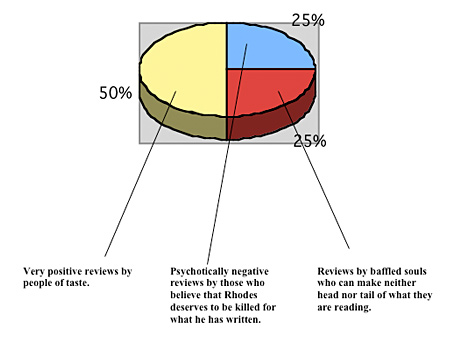
Dan Rhodes is a funny character. Judging from his blog, he is both funny ha-ha and funny odd, but I like him. I particularly like his long and belligerent pouting about bad reviews which violates all advice to writers and includes this graph:

I like his dry wit. I would definitely pick up another book by him, even if I feel a bit wary of getting punched in the eye again.
Saturday, May 7, 2011
The Chronology of Water by Lidia Yuknavitch
The Chronology of Water is Lidia Yuknavitch's sexy, dirty, wordy, wet memoir. Lidia is not that much older than I am. Is it time for us to write memoirs? 
Saturday, May 22, 2010
Trickle Down Timeline by Cris Mazza

Is it voyeurism, that makes reading Cris Mazza so pleasurable? It feels like a guilty secret at times, like a VH1 show writ sublime, where there's beauty in the degradation, transcendence in the small moments of hopelessness, the banal details of everyday life for average characters transformed by the unflinching exactness of the description into something timeless. Until a woman trying to disgust her husband's friend by calling a meatball a bull's testicle becomes a statement on what it means to be female, and a dying dog becomes a symbol of a lifetime goal.
Thursday, February 18, 2010
The Widow and the Tree by Sonny Brewer
In a connected world, where every place is right next door to every other place via cell phones, airplanes, and the internet, it was really lovely to read a novel that was truly of a very certain place. The Widow and the Tree takes place in extremely rural Alabama, and the disconnected nature of the location separates the reader from any particular time, or any invasive modern influence. Without the ringing, buzzing, and informing, what's left is a quiet book that ends up booming, a small story that resonates.A five hundred year old live oak is the central character, as it frames the lives of a few strange characters who also inhabit this swampy and wild backwater. If you told me before I cracked it open that I would be deeply engrossed in a novel which is essentially about a tree, and tangentially about a couple of hermits, I would have been skeptical. However, the scene that Sonny Brewer paints is compelling and surprising in its depth. Rather than limiting the book, the narrow scope propels the reader farther into the landscape, so it's possible to read a chapter about the noises a bird makes tapping on the branch of a tree and actually still stay engaged. It's possible to really be quietly present in this dangerous, haunting world of the Ghosthead Oak and start to know it, or at least to know how much you don't know about it.
The book is small, but it penetrates like a bullet. It's as specific as a fingerprint, and as unforgettable as a face. I'm impressed with Brewer's restraint, both in language and in characterization. There is nothing goopy and romantic about this widow, nothing drearily tragic about her hero either. The wilderness is hard, and the book is hard, but it's also beautiful in its simplicity.
The Widow and the Tree is a prime example of why MacAdam/Cage is great and would be sorely missed.
Saturday, February 13, 2010
Water for Elephants: a Master Class in Craft
Water for Elephants was a runaway bestseller, a breakout book for author Sara Gruen, and a book club darling. The comments you hear in reaction to this book range from "Loved it" to "It blew my mind, changed my life, and I chewed my own wrists open when it was over." Not everyone likes every book, but I have to say that this one has met with universal approval from readers of every stripe. Writers, take heed. Water for Elephants is more than a good story; it's a seminar in technique from which aspiring writers could definitely benefit.Lesson #1: Milieu. Choose to write in a world that people want to read about. Gruen set her book in a traveling circus during the depression. I wanted to read it before I had any idea what the plot might be like just because of where it was. For this book, you could almost write the pitch just based on the setting: the time, the place, the freaks, the violence, the hidden world, the desperation... it is automatically interesting just because of where and when it is. Want to write another book about someone who lives in an apartment in a trendy neighborhood in a modern city? Good for you. Have fun tweaking that one. Sure, Gruen had to research the hell out of her book, but she wisely chose a deep deep deposit of fuel in which to sink her well.
Lesson #2: Pacing. Water for Elephants has no down time. There is no break in the plot, no difficult middle section, no long period of rising action and building complication. The story goes from peak to peak, escalating constantly from the day the main character sets foot on that train to the very end. Gruen provides relief from the action by switching from the main plot in the past to the framing story in the present, but she never gives us a slow chapter in the circus plot. Looking at the structure and pacing of WFE, you realize that the thing about writing a novel is, you really don't have time for those slow chapters. Are you sitting on a middle section that kinda drags, just because things are "developing"? Are you happy with a plateau in the center of your book? Don't be lazy. Ratchet up the slope of that line that takes you from low start to high finish. Steeper is better. Don't waste time on low energy chapters.
Lesson #3: Transparency. In this book, there are no distractions from the characters, the story, and the world that Gruen is revealing to us. Her prose is not glamorous; it's not fancy. It is effective because it disappears. It's the kind of book you forget you're reading. You think you're listening, and not listening to some pretentious twat rhapsodizing just to hear herself talk, but listening to a story urgently told, every detail important. Instead of witnessing the construction of a narrative, it's like we're seeing a curtain pulled back. The focus is only the story, only the work, and it's so clearly rendered it's like a pane of glass. Any imperfection and you know you're looking through a window. So when you're writing away and you're falling in love with a turn of the phrase, a bit of something you think will be called "lyrical" or whatever, think carefully about whether what you're adding in there is going to show up in that pane of glass, or whether it's going to work to make the view more clear.
Writers, if you're waiting to read Water for Elephants, don't wait any longer. There are more than a few ways to tell a story, but here is a very successful formula for you: 1. Write in an interesting world. 2. Write without pause, relentlessly, every scene amplified and alive. 3. Write transparently. You're not the focus, the words aren't the focus, but the story is the focus.
Monday, December 28, 2009
Everyday Psychokillers: A History for Girls by Lucy Corin

Lucy Corin's first novel, Everyday Psychokillers: A History for Girls, published by FC2, begins as a wild, unapologetic mess. The story of a young girl in southern Florida, Psychokillers reminded me initially of Lynda Barry's Cruddy, Kathy Acker's Blood and Guts in High School, or a number of other ragged, jagged narratives yanked out of confused teenaged women. It's messy in that way, in that essentially female way, and its zigs and zags are almost familiar to me, this unpredictable, non-linear tempo.
It's the kind of book that leads reviewers and jacket copy writers to create lists of disparate elements: a Ted Bundy reject, the God Osiris, a Caribbean slave turned pirate, a circus performer living in a box, broken horses, a Seminole chief in a swamp, and a murderous babysitter. And the book is good in this way; it's inventive, fresh, out of control. You spend most of the first half asking yourself, "Where is she going with this?"
But ultimately what's interesting about the book is not the way it's fragmented. The story is told in mad, intense chunks, increasingly so disconnected from the central narrative of the young girl. We go from a fairly chronological account of a home life, a school life, of this main character, into digressions that start as anecdotes or asides from the character herself and evolve into separate stories -- stories of death and killers, murders, fear. That aspect of it is great, and Corin pulls together a very bold collage.
The interesting thing, though, is how it isn't fragmented, how the book spirals back on itself, revisiting ideas, images, and even sentence structures, so that while in some ways time, characters, and realities are fractured, the idea of the book spirals inward to a point, and comes together where the book blows apart. There are six or seven absolutely tight and monstrous pages toward the end that clearly express the book's central theme. I realized, reading them, the path I had to take to get there, to be told I am a killer, and that I am being killed, and that both are me. That realization is at the center of the spiral.
Looking at it from the top, a spiral moving outward looks the same as a spiral moving inward. It's not immediately obvious how Corin's book functions in this way, but the destination is worth the journey, and the investment in the book, you will find, sneaks up on you. Along the way, you'll find chapters that work as short stories, you'll see a dazzling slideshow of images you definitely have not seen before, and you'll find yourself falling into suspense over this character. Yes, in the middle of a novel built of formal experimentation, you'll be worried about this girl, and the question central to her psycho psyche -- will she kill or be killed?
Thursday, December 24, 2009
Elegy for a Fabulous World by Alta Ifland

For its second offering to the hungry world of literary fiction, Ninebark Press brings us Alta Ifland's short story collection, Elegy for a Fabulous World. From the very first story, Ifland had me in her grasp with merciless, darkly funny tales from her childhood in communist Ukraine. In bleak, unapologetic images, she shows us the gypsies that camped outside her town, the gravedigger the children all harrassed, the way the trash collectors failed, and the magic of one coveted bottle of Coca Cola. You can read the titular story online at AGNI Magazine. Not my favorite example, but the strange picture of what constitutes a seaside vacation for Soviets will give you an idea of what the rest of the book has to offer.
Ifland's gift is control. She shrugs at absurdity with the measured pace of a female Nabokov. Yet just as you're sinking into a mild rhythm of predictable slice-of-life revelations, she jerks the image just a bit, skews it enough to remind you: this is foreign. So, the mute adopted sister you're accustomed to seeing, with her iconic silence and her mild beauty, may not stop as a symbol of some unknowable aspect of childhood. She may suddenly go jetting off into space as the story takes a sudden flinch outside the deftly drawn limitations of the village, the family, the characters, the way of life. Ifland injects just enough of these blank surprises to elevate her work from competent memoir into the realm of contemporary craft.
The second half of the book delivers more typical contemporary short stories. Well crafted, interesting, satisfying, but lacking the depth and impact of the first section.
A few stories into the collection, when I was so enchanted with the voice, the landscape, the complex dark shadows of it, it occurred to me how impossible, how thin it would all seem if these same stories were set in modern times, in the loud, plastic American world. Is it possible for her, I wondered, to create this same kind of elegant starkness without the exterior starkness of village life, without cell phones or televisions or that brisk cacophony a more contemporary set of characters would be wading through. There's a timelessness to the childhood that Ifland renders that would be, maybe, fractured by the introduction of technology, information, something faster and less private. The second half of the book answered, to some extent, my question, as the stories that took place in office buildings and other less austere locations didn't have the same effect on me as those in the sort of anti-fairytale settings of the earlier pieces. So the mute sister could only fly away into space out of the house without wires attached to it, and the man crying in the graveyard could only be as profound if his life existed in rumor and legend, instead of a newspaper story.
The best thing about the book is the way the identities shift and change, particularly the mother and the main character herself. One can find these common characters in the earlier stories but not necessarily pin down a "she" throughout, or even an "I." A great example of this is a story where the main character takes her husband back to the old country to meet her parents, whose desire to feed him and nurture him and impress him with food nearly kills him. Her return to her homeland, accompanied by the uninitiated American, made me think of my experience reading the book, how hopeless it was for the husband to understand her family, or for her to show him to them properly. Ultimately, there is only the reality of what they are, and what he is, physically, to show for it. And this was what impressed me about Elegy for a Fabulous World. Ultimately, it is in surreal images and what facts and memories can be clearly delivered that this other, fabulous world exists. And if this old, communist life can only be understood in fragmentary, shifting narratives, looped through with the myths of the old country and the realities of the new, then Ifland's atttempt is a success.
For more information: Purchase Elegy for a Fabulous World, visit Alta Ifland's web site, read more about Ninebark Press.
Sunday, June 28, 2009
Reading Wickett's Remedy in the Time of Swine Flu

You think you've got it bad?
Myla Goldberg's novel, Wickett's Remedy, begins pleasantly enough, as a quaint period piece about a young girl in the early 20th century, escaping South Boston to experience big city life as a shop girl selling men's shirts. Lydia Kilkenny finds love, gets married to a medical student, and sets up house. The narrative is augmented by marginal notes in the point of view of ancillary characters, and newspaper articles and editorial letters from the time, and other snatches of dialogue.
Then the Spanish Influenza happens. The book stops being cute, derails itself from a nice little plot about a ghetto girl who conquers the world, and heads into dark and dangerous territory. Now the marginal notes, the newspaper articles, and disembodied dialogues and unexplained bits of correspondence become sinister, threatening, and the main character, who had seemed a little too sweet, too plucky, too dear, is now our only hope. The book was extremely moving, after things got dire. Once I got to the awful part, I could hardly put it down. The multiplicity of voices becomes part of the story itself, as if the only way the unfairness, the starkness, the confusion of the times could be portrayed is through this fragmentation of the narrative.
Goldberg illuminates a world of which I had absolutely no knowledge, no experience. One third of the world's population was infected with this flu. The mortality rate was 10%. That meant that more than 3% of the world's population died of this disease. Seventeen million in India. Six hundred thousand in the US. The most gruesome fact of the pandemic was that the disease killed strong young adults more effectively than the old or young, because the stronger your immune system the more violently the disease came on. Truly horrific. And the things that happened on the Navy ships. Goldberg hints at horrors, via snatches of dialogue and reports, that defy belief.
I highly recommend Wickett's Remedy to anyone who has been loudly panicking about the swine flu, has felt themselves put upon and afflicted by this outbreak, or has been walking around in a face mask. The things Goldberg will show you will make your life in 2009 seem like a paradise of health and vigor.
Saturday, March 21, 2009
Surviving The Quincunx by Charles Palliser

Yesterday, watching CNN, I saw a feature piece about a man who has been feeding the homeless daily out of the back of his truck in a Queens neighborhood for ten years. I found myself astonished that such a man could exist, that such selfless charity could be going on. Surely he must have some hidden motive, some personal failing out of which this commitment has arisen. He can't be just a NICE GUY doing a NICE THING for people in NEED. Of course, he can. He does. Nice people do nice things all the time with no hope of personal gain, no secret, devious agenda. I just had a hard time believing it.
I blame Charles Palliser, and his novel, The Quincunx, which I have been reading for about a month. This 800 page behemoth of a Victorian novel (neo-Victorian? 1989) drags its readers and main character through every milieu of horror, every site of human want and degradation, through the most wretched poverty, the most abject misery the 19th century had to offer. And of course, the 19th century offers plenty. Feel like you've been there, done that? After all, you've read Dickens, right? Seriously, this is Dickens on crystal meth. Imagine the nightmares of Dickens, but without the comfortable distance of Dickens' hyperformal language. And imagine that everyone, everywhere, is purely selfish, purely wicked, and does nothing for any reason but blunt personal gain. The protagonist of this novel, who starts out a boy and ends up a much thinner, much more suspicious boy, lives through every possible awfulness of the time, from agricultural slavery to being a knife-and-boot boy, to various murder attempts, and many, many, many betrayals. Everyone who appears to be trustworthy is false. Everyone who offers love is immediately killed or destroyed.
It is BAD. It is bad in early 19th century England. Very very bad.
However, I am glad I read it for two reasons.
First, if I'm ever tempted to be one of these people who says, "How dare the government take my money to give it to poor people? Leave that to the churches and to my personal charity!" I have only to recall what the churches and individuals of the time were able to do for the working class when the industrial revolution was just beginning, when common lands were being fenced and sold, when there were no legal protections for children, no laws governing labor, no laws governing housing standards, etc. Individuals and churches I'm sure did a lot for a lot of people, but it wasn't enough, given the grinding, irresistable motivation of people to get more money, more power, more property. You could read this book and come away saying, "Wow, the poor in this country really have it made." And I say that's a good thing. I don't want to have to step over dying people and starving orphans. Paying taxes will be just fine, thanks. The thing is, and this is what became clearer to me while reading this book, that without public education, school lunch programs, health care, and other entitlements, there truly is a caste system from which there is no escape. Without money, you can't get money, and you are just trapped. Palliser is a scholar, and he researched the book for 14 years. He's truly captured the period, and seeing it played out before you in such lurid and exacting detail is so much more compelling than reading about it in facts and figures.
The other reason I'm glad I read it is that it was a great read! I was completely fascinated by the time I was ten pages in, and the story just grabbed me by the collar and railroaded me right through to the end. It was almost un-put-downable and I spent many sleepy mornings having stayed up way too late the night before. It is *not* a morality book, although I've spent time talking about that aspect of it. I haven't talked about the plot at all, but much has been
made of the mystery in the extremely elaborate, very intelligently wrought story that drives the book. Go here if you've read it and want to ponder all its intricacies. It involves an inheritance, a murder, and a whole lot of family tree.If you do decide to read The Quincunx, make sure you have some time set aside to cope with obsessive reading. And it might be good to take this one on in the summer months, when you can go outside periodically and remember that life is good, that people can love, and that redemption is possible.
Jack Pendarvis is One of Those Guys
I just can't hang. I don't know what happened to me. I want to say that when I was 23 I could tolerate or even enjoy these books organized on the principle of "what the hell." These novels that challenge what it means to be a novel, characters who defy the idea of a character, whose authors seem to make decisions because they're the ones holding the pen, and tee-hee who's going to stop them?I know I dated guys who wrote books like this when I was in my 20s. But I also remember putting down The Hitchhiker's Guide to the Galaxy as a child, and only part of the reason was because I thought the sacrilege would send me to hell. I have a feeling that if the narrative truly compelled me, I would have dared to face the consequences.
The first book I read by Jack Pendarvis was Your Body is Changing, a collection of short stories. At first, I was really digging it. Yes, it tended a little toward the type of story collection that holds up one character after another saying, "Look at this idiot! Okay, now look at this idiot! Isn't he a tool? Now check out this guy -- what a tool!" But it was really imaginative and interesting. I particularly liked the story "Outsiders" about a woman who announces constantly that she's really someone who will "call you on your shit." Then I got to the title story, about an adolescent zealot who comes into age and cynicism in various har-har ways. And I started to wonder, is Jack Pendarvis one of those guys? One of those guys who produces desultory idylls revolving around randomness, irony, and a wry, intellectual detachment? One of those McSweeney's type guys? When the main character set off on a cross country journey in a goat cart, I had to face the truth: Jack Pendarvis is one of those guys.Then I read his novel, Awesome, which is about a giant and his robot friend. Pendarvis' giant (named "Awesome") is as inaccessible as the prose itself, and unfortunately he tells his own story mixing low and high discourse like it's 1999. I couldn't finish Your Body is Changing, but I will admit I read to the end of Awesome, to see if penises are really like guns. You know the old plotting rule: If you show a gun in Act I, it has to go off in Act III, right? So, if you cut off your penis on a whim in Act I, does it have to return to you when you least expect it, in Act III? Answer: yes. Penises are just like guns in this respect.
Right after I had finished reading Awesome, a friend loaned me The Thirteen and a Half Lives of Captain Bluebear. It was through realizing the proximity of the latter to The Hitchhiker's Guide that I realized the proximity of Awesome to this iconic work, and so I have to admit: There may be people out there who will find this book to be gorgeous, revelatory, and profound. I am not one of them. However, I salute MacAdam Cage for publishing it, I salute Pendarvis for writing it, and I'm glad it's out there on the bookshelves, in all its weirdness, in all its belligerent quirkiness, because the world doesn't need another mild romance, and Jack Pendarvis ain't no Nicholas Sparks.
Friday, January 23, 2009
Wait by Frank Turner Hollon
Frank Turner Hollon has written the life story of Early Winwood, a guy you might pass on the street without noticing, a character you might not think was worthy of having a novel written about him. A regular guy. The difference between Early and most regular guys is that right in the middle of the book, after living through a few dozen unremarkable years, Early does something very remarkable: he kills a man. Then, later, he kills another one.
This book is telling me one of two things. No, there are no other interpretations:
1. The narrator is unreliable. The book is psychological study that takes us deep under cover in the mind of a murderer, to show us how he, twisted and inhuman as he is, sees himself as normal, fitting snugly into the fabric of society. I have two bits of evidence for this interpretation. First, the ambiguity of his relationship to Kate Shepherd, and the fact that this drug user turned model citizen at one point tells the court he is a kidnapper and a stalker. The second is the way the murders really fail to haunt the guy, at least fail to haunt him to the extent that a murder would haunt me. Or maybe a murder wouldn't really haunt me that much, which brings me to possibility #2.
2. Early is a murderer, and Early is an average guy. Both. One does not preclude the other. Murder is closer to you than you think it is, reader, and only a thin hair of opportunity and impetus stands between you and the act itself. Looking back on the book, this explanation seems more elegant. It is as if the whole plot of this man's life was constructed to be a doughy, bland container for that one act of violence, so that the blandness leaks into the violence, and makes it ordinary, all part of the whole.
I don't know which one is the correct reading but I hope it's two. It's not that I agree with him, in fact I don't like the idea that we're all base, we're all murderers, we're all that low, as vile as the least of us is vile. I don't agree. But I think that makes the more perfect novel, and I've never read a book constructed like this, with so much fire-retardant wadding packed around a fuel cell on fire.
The book fails me in a couple of ways -- the second "murder" doesn't seem to fit either of my explanations, and it blurs the lines of what's a reasonable excuse to commit the crime. I was disappointed also a little bit in the lesser characters, in Early's fake son and fake daughter. I never knew what lens I was seeing them through, and Early's take on it seemed more suspect when he was describing these relationships than it did when he was talking about Kate.
Ultimately, a very interesting book and a book that worked my brain. I will have to try another by this author.
Friday, January 16, 2009
Sin in the Second City by Karen Abbott
There are two fine lines that Abbott had to navigate when writing Sin in the Second City, a historical account of the Everleigh Club, the fanciest and most infamous brothel in Chicago at the turn of the century.The first line is between two moral positions.
Abbott has two heroines here: Minna and Ada Everleigh, the jewel-encrusted madams who elevated their little corner of the vice district beyond the dirty dance hall and onto a level of elegance and sophistication that attracted millionaire visitors and international attention. Minna and Ada are characters that the author clearly loves. As we follow their story from a mysterious lowly past to their glorious position as quiet, powerful queens of vice in a vicious city, we are invited to fall in love with them as well. There are pimps and madams that we can scorn, lesser characters who live down the street from the Everleighs, who run shitty dives and beat their girls, drug their customers and stick to their own floors. But the Everleighs are a different breed: smart, ethical, pure.
If the Everleighs are the heroes, then the villains must be the reformers, the demonstrators and politicians who were trying to eliminate the vice district and "save" the girls who had "fallen" there as prostitutes. Among the characters on this team are pastors and evangelists, pious ladies, and also city officials trying to look good and crack down on crime. The problem with villainizing this side of the fight is that they actually did have a point. The danger with making a madam your hero is that there actually was a lot of horrifying stuff going on in these houses, stuff you don't want to cheer for, and can't fall in love with.
So, as a writer, do you position yourself with the madams, and giggle and titter your way through the book, pretending it's all so naughty and wry, and those stuffy old reformers are just party poopers? Or do you position yourself with the reformers, and spend the book pushing out that really new and interesting concept that prostitution is bad? Maybe there's a third solution, to just report what happened, be historically accurate, and educate us all so we can make... oh, wait, I just fell asleep while suggesting that as an option. So, none of those are books that I would want to read.
Fortunately, Abbott is smart. Very smart. And her smart book can present all these possibilities simultaneously. This is not an expose of the horrors of segregated vice in turn of the century Chicago. Nor is this a blushing homage to all those fabulous madams and the sexual excesses of the times. No one is exempt from criticism here. Abbott tells the stories of those vainglorious preachers and the hypocritical politicians, but also shines an unforgiving fluorescent light into the depths of vice: the strip-and-whip fights where girls lashed each other bloody for an audience, the girl's palm rotting from syphilis while still performing its handjob, the lies, the greed, the corruption, and all of it.
No one is exempt, that is, except the Everleighs themselves. In understanding this, I began to understand where the moral compass of the book truly points. I believe that Abbott would say that the sins of the vice district were black enough -- the sins of the white slavers and the opium dealers and the lower madams operating their 50 cent dives. The Everleighs, however, weren't doing anything very wrong, and in shutting down their clean, sophisticated, elegant club, where the men were treated fairly and the girls lined up to get a job, where the health and well being of the harlots was a priority and the customers were treated like customers, not sinners, the authorities threw the baby out with the bathwater. That is, I think, the way the book gets out of its predicament.
This moral subtlety allows the book to transcend that "choice" between the whores and the reformers, and allows the story of the characters to flourish without the weight of a judgment or the tension of the absence of judgment.
The second line that Abbott dances down is a literary one. She is, of course, telling the true story of actual people, and the research that went into this book is amazing. One look at the bibliography and your jaw will drop. However, there are things that cannot be known from research. The biographer's job is to tell the story in an engaging way that will live on the page, without embellishing the facts too much, to navigate between too strict a focus on reality and too fanciful an elaboration. Abbott accomplishes this brilliantly. Everything in quotation marks, in the book, was actually said by the real Everleighs, or other characters, and recorded in court documents, journals, or letters. But Abbott's story goes beyond the bare facts and delivers a prose that reads like fiction. None of the "we can't possibly know" or "it's unclear" but loads of vibrant descriptions, delightful details, and a narrative sense that really brings the landscape of the levee to life.Sin in the Second City exploded my expectations. You know I loves me some violated dichotomies, yo. By defying the obvious choices, and creating her own rules, Abbott pays the Everleigh sisters great honor by putting them in the context they deserve.
Friday, February 22, 2008
Tom Wolfe: A Man in Full
Since I have been writing about American Idol for two days, I feel the need to elevate the tone of this blog a little. Of course John Irving called this book "entertainment" as opposed to "literature." I'm not going to get into it with John Irving on the merits of various books. John Irving and I have never had a problem before, in all the many times we've exchanged thoughts on art and pop culture.After I recover from the effort, I will read another book by Tom Wolfe. Maybe I Am Charlotte Simmons. Want to trade your copy of that for my copy of this? Wolfe takes a long time to write his novels. I like that about him. A Man In Full
Wednesday, October 24, 2007
The House of the Seven Gables by Nathaniel Hawthorne

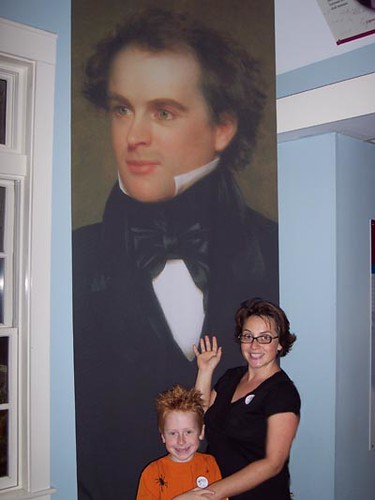
Yes, he looks kind of two dimensional and like he's not paying attention to me enough, and yes, that is my child there, my child with my husband, who lives here with me in the 21st century, but... Hawthorne and I have a special bond. I'm the only one in my American Lit class in high school who actually *liked* Young Goodman Brown, actually read My Kinsman Major Molineaux, who didn't buy the "good vs. evil" explanation that was being spooned out by Miss Cardimone to the rest of the class.
By the way if you're reading this and I knew you in high school, assume you weren't in that class. I'm looking at you, Ann. Any disparaging remarks do not apply.
I loved Hawthorne, and Melville, and Poe, and the way Melville loved Hawthorne, and the way Poe hated everyone, and how they wrote to and about each other, and how they all spat on Emerson, and his ilk, and pooped in Walden Pond, and dug around in their dark hearts and and wrote about what they found.
Last week I was in Boston. My husband suggested we go up to Salem to see Nathaniel Hawthorne's birthplace and the House of the Seven Gables. I was, of course, panting with excitement. Wouldn't you be? Except that I'm serious.

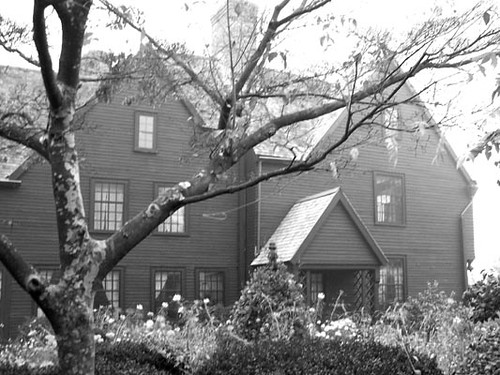
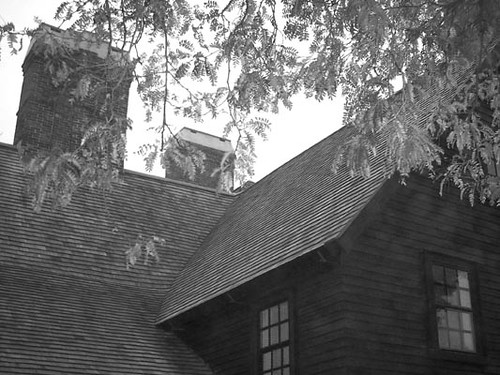
This is the House of the Seven Gables. It is the house on which Hawthorne based the house in his book. The house that represents original sin. This is it. He visited it as a child; it was owned by relatives of his. It's been restored, in fact restored to be more like the one in the book than the original house actually was (Hepzibah's store was there, and there is also a secret and terrifying passageway up through the chimney).
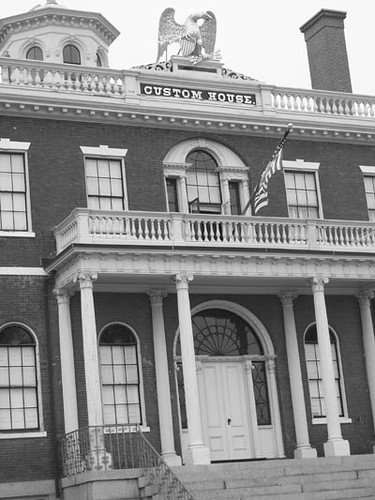
On the day we went to Salem, it was foggy and chill, although the rest of our week in Massachusetts was sunny and breezy. We walked all over the place and then down to the harbor where the Custom House is, where Hawthorne did some writing:

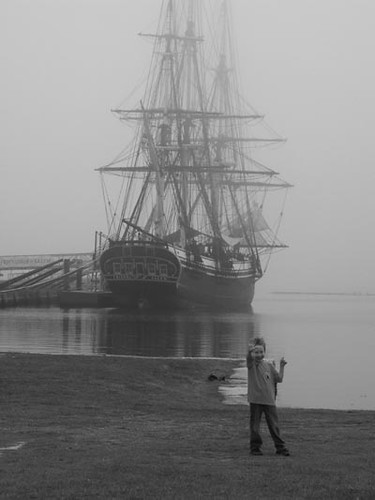
Here's the USS Friendship, across the street. And my son:

The house was neat, interesting, educational. So was the house in which Hawthorne was born, which is also on the property, having been drug there from five blocks down the street in order to add it to the museum. It was a historical site, well-preserved, well presented, valuable.
Now, I hesitate before exposing my soft underbelly like this, but I must say that beyond the interestingness and the educationability of it all, I got a little misty thinking about the history of the house. Considering Hawthorne sitting there in the parlor, about the book he wrote, about the period of time he wrote about, I found myself swallowing hard and wiping my eye.
They had only recently rid themselves of the British, and they were living in a brand new country. It would have been so vital, so fascinating, so *patriotic* and so important, to create this new national identity in literature. I know, I know, I had read about this before too, and I knew it in my brain. About how James Fenimore Cooper and Washington Irving drew dark lines around a colonial asthetic. But until I was standing there in Massachusetts, having walked through the South Meeting Hall in Boston, where they had the rabble-rabble meeting before the Boston Tea Party, having looked at Paul Revere's Grave, having stood on Bunker Hill, I did not get what they were doing, those people up at Brooks Farm and in Concord and what it meant while my boys were pissing on transcendentalism -- it was more than just ideas, it was identity. I get that now.
I have two reactions to that: one is that I need to think more about what I'm writing and why. What are we doing here? Do we still take up a black marker and make bold outlines around American literature any more? Are we all just happy to be citizens of the world? The other is that I wish more urgently that I could have been there when Melville walked out of that Emerson lecture, when Poe wrote that criticism of Hawthorne, when Hawthorne was sexually rejecting Melville.

At least I got to go to the house. I knocked on the front door, climbed around under the rafters, put my hand on the original bricks in the fireplace. I wouldn't have thought someone mean and cynical like me could be moved by such an experience, but I was. Next time, we're going to Concord.