I picked up this novel with no expectations and no idea what it was about. By the time I got to the bottom of the first page, the book had me by the throat and I finished it on the same day. I wish you could have the same experience, so if you trust me to recommend books, I'd say go and get it, read it, and then come back to read my interview with author Alexander Maksik, below.
Sometimes when I finish a novel that has really lit up my brain, I am restless with questions for the author. Why did you make that choice? What was going on here? This is exactly the type of novel I want to dissect, as if I can get to the bottom of it, find out what makes it so successful. A Marker to Measure Drift has some excellent lessons for writers.
Lesson #1: Everything is Personal.
Maksik's main character is a young black woman from Liberia, and when the novel opens she is starving to death near a beach on a resort island in Greece. Maksik himself is a man, an American, and lives in New York. Yet one of the most arresting things about this book is how immediate and real Jacqueline's experience is, how unfalteringly close the prose brings us to her, physically and mentally, so I asked him...
LN: Your main character is a 24 year old African woman, and your novel is an antidote for that poisonous advice: "Write what you know." Your voice never felt contrived, Jacqueline's voice never felt artificial, and the relationship between her and her mother seemed to me to be particularly authentic. Did anyone ever tell you to write what you know, or imply that you couldn't properly write this character because you're a man?
AM: I don’t think there’s a writer alive who hasn’t heard that adage. The problem is that it’s often misunderstood as law, as a kind of strict limitation: you must only write about your immediate experience. It’s an absurd idea and it goes counter to the whole idea of fiction, the point of which is to fabricate, invent and imagine. On the other hand, what I know about relationships, about sorrow, about joy, about love, about lust, about loneliness, I know from experience. How can I not use what I know when I’m writing about these things? The adage should provide writers a sense of freedom rather than restriction. Writing fiction should be an act of deep empathy, a way to inhabit lives outside of our own, to imagine the experiences of others.
As for the rest, I believe strongly that it is the writing that must be evaluated. Not the writer.
Yes. Just because you're not in the demographic of the character doesn't mean you're not writing something sharply personal, something you "know" intimately, something from your own life.
Lesson #2: Memories Aren't Tidy
I'm always interested in the structure of novels and how these structures emerge -- whether they spring up fully formed in a first draft or whether they're the result of revision, rearranging. This book stays very tight to a short timeline, with flashbacks to earlier memories and scenes. However, the flashbacks aren't tidy and informative as flashbacks can sometimes be -- arriving just in time to provide a piece of information to a reader. The way Maksik handles his flashbacks, they're more glimpses or really "flashes" and the scattered way they came through seemed to mimic real memory and how haphazard and uncontrolled it can be. As a result, we don't really get "the whole story" wrapped up neatly, but we do get the whole story that's important to the character in the present. And I never felt like "Ah, I'm being filled in on the backstory."
LN: I found your choices regarding timeline fascinating -- there is a lot of the story that's left out, and yet we know enough, as readers, to follow the emotional arc of the character if not every little detail of her life. Did you write this book longer, and then cut? Or did you always know that this little piece of her story, with the past bleeding in in fragments, would be enough?
AM: I knew early on that this would be a short novel, and that it would be focused very precisely and intensely on Jacqueline’s immediate life. And I wanted as little separation as possible between Jacqueline and the reader, who would know only as much as she does. I like the idea of coming to understand a character through fragments, as you say. That’s the way we come to know people in life, isn’t it?
Whether or not it would be enough to be successful is another question entirely. I hoped so, but I certainly wasn’t sure. I’m still not.
Lesson #3: Follow Your Instinct, Not Your Rulebook.
Another rule that Maksik violates, without drawing much attention to it at all, is the directive we've all heard to keep verb tense consistent within a novel. The end of the book moves to present tense. Switching verb tense is something close to my brain, since I've just finished going through revisions on a novel with some present tense sections, and it was a point of debate, whether that should be allowed to stand. When I asked Maksik about it, he didn't explain his choice or defend his scheme -- it seems he had no scheme and feels no explanation is necessary. He's just letting the material dictate how it needs to be told, and there's a narrative instinct at work there that he doesn't question. This answer was enormously satisfying for me to read, especially when he brought up another paragraph in present tense that I hadn't even noticed. I almost wanted to ask: "And your editor let you do that?" But the point is he knew it was there, and while it wasn't intentional it also wasn't an oversight. Somewhere between intention and oversight -- this must be where instinct lives.
LN: You switch to present tense in the final section. I feel it torques up the tension beautifully and almost invisibly draws us closer to Jacqueline as the book peaks. At what point in your process did you decide to do this, and why? Did you write other bits in present tense, and change?
AM: With that kind of thing, I really go by feel, by instinct. It wasn’t a conscious consideration, but I didn’t hesitate to do it. There’s another brief passage (p. 92) in the present tense. A single paragraph. I can’t say exactly why I made that choice. It hardly feels like a choice, really. It has something to do with that moment being a significant turning point in the novel. I could go on about it being a moment of tremendous relief for her, of change, of deep engagement. But that would suggest some serious intention and consideration, which if I’m to be honest really isn’t the case.
A Marker to Measure Drift is dense, foreign, and beautiful, but ultimately it is a very simple book. Here is a human, detached from humanity, in pain and need. The world swirls around, the past lingers, but this human is at the center, small and yet deep. Maksik's prose brilliantly delivers -- I think he has fully realized what this story could be, and has told it in the best way possible. An amazing accomplishment. Of course you should read this book, if you are a reader who is looking for a great story. But especially if you are a writer, this is one you should not miss.
(Find Alexander Maksik on Facebook and Twitter and you can preorder a signed edition here.)
Showing posts with label interviews. Show all posts
Thursday, August 1, 2013
Saturday, March 3, 2012
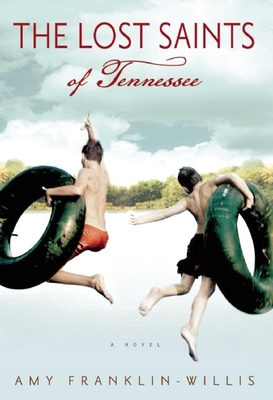
Lost Saints of Tennessee by Amy Franklin-Willis
Lost Saints of Tennessee is the story of Ezekiel Cooper, a man in his forties, driven to the brink of suicide by the death of his twin brother, ten years ago. It's a book that surprised me with its heart and its raw emotion. You must not miss the suicide scene that comes early in the book. I don't want to give too much away but it's in no way what you expect.
Amy Franklin-Willis has set herself the daunting task of drawing out a good old boy from Tennessee, divorced, working at a factory, taciturn, connected only to his old dog and his truck, into the lovable and believable narrator of his own story. It's a story of loss, betrayal, and bitterness in the past, despair in the present, and the possibility of a new chance at life in the future. She does it majestically -- portraying love without sentimentality, grief without mawkishness, hope without artifice. I can't remember when I have connected on such an emotional level to a male character written by a female author.
Maybe not since Water for Elephants has a male character been so moving. Lost Saints in Tennessee is authentic, deep, and true. A heartbreaking story of the realities of loneliness and the power of brotherly love.
I got the chance to ask Amy a few questions about the craft choices she made in her novel. I loved learning about how the novel came about -- some early narrators that dropped away and the process of opening up her main character in a way that would be true to his personality and still support narrating an entire novel. Here are her answers:
My recommendation: go get Lost Saints of Tennessee and see how it all comes together.
Amy Franklin-Willis has set herself the daunting task of drawing out a good old boy from Tennessee, divorced, working at a factory, taciturn, connected only to his old dog and his truck, into the lovable and believable narrator of his own story. It's a story of loss, betrayal, and bitterness in the past, despair in the present, and the possibility of a new chance at life in the future. She does it majestically -- portraying love without sentimentality, grief without mawkishness, hope without artifice. I can't remember when I have connected on such an emotional level to a male character written by a female author.
Maybe not since Water for Elephants has a male character been so moving. Lost Saints in Tennessee is authentic, deep, and true. A heartbreaking story of the realities of loneliness and the power of brotherly love.
I got the chance to ask Amy a few questions about the craft choices she made in her novel. I loved learning about how the novel came about -- some early narrators that dropped away and the process of opening up her main character in a way that would be true to his personality and still support narrating an entire novel. Here are her answers:
LN: You wrote from the point of view of a narrator who is not really a talker, by his own confession and as evidenced by his behavior in the novel. How did you go about finding a speaking/writing/narrating voice for this character who is so taciturn and so guarded?
AFW: Zeke's voice was a real challenge for me in the first year or two of writing the book. He is so shut down when the story begins that in writing his story, I really had to go back to his childhood and meet him then to get to know the man he became. Earlier versions of the story included a lot more of the "past storyline" which allowed me to see Zeke as a happy young boy, full of promise and connected to his twin brother, to understand the devastation he feels as an adult when Carter drowns.
For me, some of the best lines Zeke utters are the two times he uses the f-word in the novel. In both cases, he is at a break-point, a place where he must either stay in the Loserville he's been hanging out in for 10 years or DO something. Zeke's primary companion in the early sections of the book is the dog Tucker. He was not originally in the book but he provides much needed humor and connection for Zeke in the story. You can see the goodness in Zeke through how he interacts with Tucker. What people say can be so far from what they actually do or who they are. With Zeke, you almost only have his actions to take the measure of his character. But it took me years to find the right balance of insight into Zeke and action on the page because I'm not a big fan of books that are only in the character's head.
LN: One thing I really loved was how this prickly, locked-up character took a whole novel to warm up to telling us the question that haunts the novel from the beginning, and it takes another character's prodding to drag it out of him. So instead of feeling like you as the author were keeping a secret, it genuinely felt like the narrator was developing the ability to talk about it more as the book went on. Can you talk a bit about the decision to put that final reveal in dialogue?
AFW: In Lost Saints, I think one of the things I was trying to explore was the notion of how a person can be pulled back from the edge of disaster or despair by another person or being. The guilt Zeke's been toting around for ten years finally gets let loose through his confession of what he regards as his own unspeakable sin. But he has to tell someone, the secret has to be shared in order to lift the burden from his shoulders.
LN: The book is told in three sections -- the first and third from Ezekiel's point of view, and the second from his mother's. Did you always know that you would give Lillian her own voice in the novel? At what point did you decide to include a section where she could tell her story?
AFW: I originally wrote Lost Saints with three narrators--Zeke, Lillian & Moses Washington. After a draft or two, I realized Moses had to go as a narrator--though I think he's got enough in him for his own novel. The primary writing challenges I had with this book were structural. Once I narrowed the narrators down to Zeke and Lillian, I had to figure out how their voices should be heard.
I experimented with going back and forth between chapters, or having the time shift change from past to "current" in each chapter, and none of it felt right. I was aiming for this seamless world for the reader, where you stepped in on page one and none of the writing work showed--it was just a story told as compellingly as I could make it. With all the shifting around of voice and time, it felt choppy to me. And as a reader, I can get annoyed when I start feeling close to a character and then the author takes me into another character. I finally settled on the three-part structure for the book because it honestly seemed like the only way to tell the story. By putting Zeke's voice first, I felt like the reader was on a blind date with Zeke. You get introduced in Part One, you learn some of his history, you meet some of his family. Part Two is when things start getting serious. You meet his mother. You hear her side of Zeke's childhood story, which offers perspective Zeke can't give you. Part Three brings back Zeke's voice and now you know enough about him to understand some of the choices he's made and to be just a bit annoyed, perhaps, by his stubborn refusal to forgive his mother.
Lillian's voice was one of those "taking dictation from God" kind of characters for me. Some of the scenes in her chapters are almost as I wrote them in first draft form. And I certainly can't say that about the rest of the book. I'm not sure where her voice came from but as I moved through the book, I began to think about my maternal grandmother. She, like Lillian, got pregnant when she was 15, married at 15, and had seven children by her mid-twenties. My grandmother had her fair share of tragedy as well. Through writing Lillian's story, I gained some empathy for my grandmother, whom I recall as an odd and distant person. My mother, who turns 70 this year, told me recently that her mother never told her that she loved her. Not once. And she lived into her early 80's. Hard to fathom.
My recommendation: go get Lost Saints of Tennessee and see how it all comes together.
Subscribe to:
Posts (Atom)