Showing posts with label reading. Show all posts

Wednesday, February 6, 2013

Gödel, Escher, Bach: Introduction

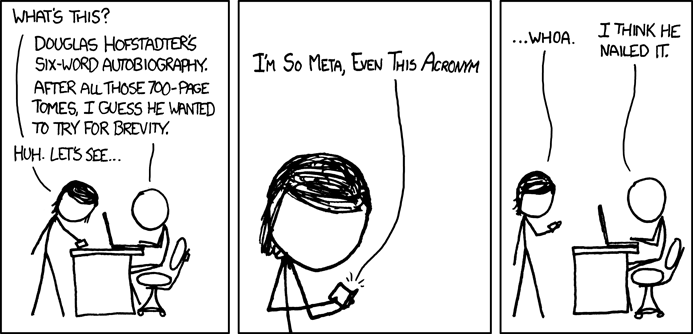
I have to start out this installment with a comic from xkcd, found by a guy in our Facebook reading group:


Yep, nailed it. Our group discussion wandered through self-referential words and the difference between a fugue and a canon, and landed on Gödel's Incompleteness Theorem, which no one really claimed to fully understand, but lots of us wrestled with. Here are some resources and links we found helpful, and my thoughts on the three sections:

Bach:

I really loved the Bach section -- it was so interesting to learn about how these musical compositions really begin with math problems, and how composers would set challenges for each other that could be solved mathematically. The anecdote about Bach sitting down to extemporaneously compose such a complicated canon for the King of Prussia was almost unbelievable, but I'm willing to swallow it. Then again I was a Lance Armstrong supporter for years. Maybe I'll believe anything of someone I want to be brilliant.

Here's a recording of that six part fugue, RICERCAR:


Here's a video of Bach's never ending canon, which rises in a "strange loop," mentioned on page 10:


Escher

I found the concept of "strange loop" easiest to understand visually, in Escher's work. Here is a link to a large image of Escher's "Waterfall" and also a video of Metamorphose, by Escher, hanging in a post office:


Gödel

I fell off the book backward at the Incompleteness Theorem, I'll admit. I was helped by several different ways of looking at it, including this post. Here's an interesting discussion of Gödel, by Stephen Hawking, called "Gödel and the End of the Universe."

I loved the stuff about Ada Lovelace and early computers. Was intrigued by predictably intrigued by L'Homme Machine, enough to buy a used copy in the French. The strange loops elude me at this point, but I think all of us in the group are hoping to understand the mathematics parts more fully as we go along. Comforted by the fact that "This is only the introduction!" we persevere.

Wednesday, January 16, 2013

Gödel, Escher, Bach: Preface to 20th Anniversary Edition

I was challenged to read this book after publicly exclaiming "I think I just made peace with the fact that I can't understand my own actions." Upon researching it a bit, I found it referred to as "the secret nerd bible," and my interest was piqued. This book of philosophy, math, music, and art won the Pulitzer in 1979 and has been inspiring AI programmers with its proposed connections between fugues, recursive figures, and the patterns in the human brain. At least, I think that's what it proposes, because I haven't read it yet.

So I collected 50 or so compliant people in a Facebook group, and laid out a calendar to finish the book in a year, one chapter per two weeks. This first two weeks of January, the assignment is to read the preface.

Things I Liked About the Preface: Hofstadter's self-flagellation over the use of sexist pronouns and the word "mankind" and whatnot. Hofstadter's insistence on not updating the book given recent history and making it a CD-rom or whatever. I like that he said it was a statement of his religion at that moment, and that updating it would be pointless. I also loved the description of the ass pain he had to endure to get galleys made with the images and text exactly the way he wanted -- what an effort!

Things I Did Not Like About the Preface: I don't understand the thing he said about how Bertrand Russell was self-referential while deciding not to be self-referential, thereby creating a conciousness within Principia Mathematica (or whatever). I assume we're going to get more about that in the book itself. I don't understand that, so far, so of course that annoys me.


Here are some interesting things I found helpful to look at:

Principia Mathematica by Bertrand Russell. (Yes, Newton also wrote one.)

A video from MIT Open Courseware about the book, introduction to the class about the book:


A video illustrating the logic problem of Achilles and the Tortoise:


Are you reading this book? Have you read it before? Would you like to join our group? I'll be tagging my posts on this subject GEB so  you can find them all if you like, if you're stumbling upon this farther along in the year.

Saturday, March 21, 2009

Surviving The Quincunx by Charles Palliser


Yesterday, watching CNN, I saw a feature piece about a man who has been feeding the homeless daily out of the back of his truck in a Queens neighborhood for ten years. I found myself astonished that such a man could exist, that such selfless charity could be going on. Surely he must have some hidden motive, some personal failing out of which this commitment has arisen. He can't be just a NICE GUY doing a NICE THING for people in NEED. Of course, he can. He does. Nice people do nice things all the time with no hope of personal gain, no secret, devious agenda. I just had a hard time believing it.

I blame Charles Palliser, and his novel, The Quincunx, which I have been reading for about a month. This 800 page behemoth of a Victorian novel (neo-Victorian? 1989) drags its readers and main character through every milieu of horror, every site of human want and degradation, through the most wretched poverty, the most abject misery the 19th century had to offer. And of course, the 19th century offers plenty. Feel like you've been there, done that? After all, you've read Dickens, right? Seriously, this is Dickens on crystal meth. Imagine the nightmares of Dickens, but without the comfortable distance of Dickens' hyperformal language. And imagine that everyone, everywhere, is purely selfish, purely wicked, and does nothing for any reason but blunt personal gain. The protagonist of this novel, who starts out a boy and ends up a much thinner, much more suspicious boy, lives through every possible awfulness of the time, from agricultural slavery to being a knife-and-boot boy, to various murder attempts, and many, many, many betrayals. Everyone who appears to be trustworthy is false. Everyone who offers love is immediately killed or destroyed.

It is BAD. It is bad in early 19th century England. Very very bad.

However, I am glad I read it for two reasons.

First, if I'm ever tempted to be one of these people who says, "How dare the government take my money to give it to poor people? Leave that to the churches and to my personal charity!" I have only to recall what the churches and individuals of the time were able to do for the working class when the industrial revolution was just beginning, when common lands were being fenced and sold, when there were no legal protections for children, no laws governing labor, no laws governing housing standards, etc. Individuals and churches I'm sure did a lot for a lot of people, but it wasn't enough, given the grinding, irresistable motivation of people to get more money, more power, more property. You could read this book and come away saying, "Wow, the poor in this country really have it made." And I say that's a good thing. I don't want to have to step over dying people and starving orphans. Paying taxes will be just fine, thanks. The thing is, and this is what became clearer to me while reading this book, that without public education, school lunch programs, health care, and other entitlements, there truly is a caste system from which there is no escape. Without money, you can't get money, and you are just trapped. Palliser is a scholar, and he researched the book for 14 years. He's truly captured the period, and seeing it played out before you in such lurid and exacting detail is so much more compelling than reading about it in facts and figures.

The other reason I'm glad I read it is that it was a great read! I was completely fascinated by the time I was ten pages in, and the story just grabbed me by the collar and railroaded me right through to the end. It was almost un-put-downable and I spent many sleepy mornings having stayed up way too late the night before. It is *not* a morality book, although I've spent time talking about that aspect of it. I haven't talked about the plot at all, but much has been made of the mystery in the extremely elaborate, very intelligently wrought story that drives the book. Go here if you've read it and want to ponder all its intricacies. It involves an inheritance, a murder, and a whole lot of family tree.

If you do decide to read The Quincunx, make sure you have some time set aside to cope with obsessive reading. And it might be good to take this one on in the summer months, when you can go outside periodically and remember that life is good, that people can love, and that redemption is possible.
Friday, February 22, 2008

Tom Wolfe: A Man in Full

Since I have been writing about American Idol for two days, I feel the need to elevate the tone of this blog a little. Of course John Irving called this book "entertainment" as opposed to "literature." I'm not going to get into it with John Irving on the merits of various books. John Irving and I have never had a problem before, in all the many times we've exchanged thoughts on art and pop culture.

I very much like entertainment. However, it took me six weeks to read A Man in Full. It is very long. If you had told me on the first of the year that I would spend six weeks of my young, vibrant, fascinating life reading a book about Atlanta politics, real estate developers, bank management, and Stoic philosophy, I would have said, No. However, Wolfe's true subject was one that held me in its thrall from the first chapter, and kept me coming back eagerly, through all 750 pages, during ballet class and through late nights, until the paperback was falling apart from being crammed into my bag. His subject is men. What is it to be a man at the end of the 20th century? What is it to be a man at all? The book follows four men through a twisted plot that would take me several pages to summarize. I'd rather talk about the way the book is written.

Wolfe goes back. Way back. And he goes in. Way in. There are two main characters who meet at the very end of the book, and in a sense the book truly begins when they meet. However, the book begins months in advance of that meeting, and the ostensible impetus for the book is only actually tangentially related to them. There is an alleged crime, if you must know. Which has also got a tangential relation to the real theme (what is a man). The books starts after 700 pages, when the main characters meet for the first time. Using the fake impetus allows Wolfe to begin at the true beginning, when these characters are at a stable place. Then Wolfe can put them in the butter churn and start beating them into butter.
The other thing that I found interesting about the construction of this novel was the episodic nature of the chapters. At the beginning of the book, the chapters focus exclusively on one character or another, and some of them are so brilliantly episodic that they would be amazing short stories, with no context at all. After one of the early chapters about Conrad, the youngest and possibly most sympathetic of the four central men, I shut the book and put it down, because I felt I had just read such a great scene, I had to stop.
Let's talk about the whole concept of sympathetic characters, for a moment. With the exception of Conrad, every one of the men has significant flaws. Even Conrad, if you think about it, is deeply flawed. It's hard to see the flaws of these male characters, however, because they are presented so sympathetically. Well, not sympathetically. The narrative is not sympathetic, but it is exhaustively detailed, claustrophobically close to the characters' consciousnesses, minute. We feel that we know them so well, understand them so well, perceive their contexts and histories so well, it is hard to pull back enough to remember that they are doing things that are pretty reprehensible. It's part of what makes this book so interesting -- the moral ambiguity that's available to the reader, as we are allowed to put on all of these different identities, and really inhabit them without judgment, without even reflecting on right and wrong.
How does Wolfe do this? How does he simultaneously show us all of these slimy lowlifes, and give us permission to cheer for them, to wish them luck, to hope things work out somehow. I am not even sure.

After I recover from the effort, I will read another book by Tom Wolfe. Maybe I Am Charlotte Simmons. Want to trade your copy of that for my copy of this? Wolfe takes a long time to write his novels. I like that about him. A Man In Full was just wonderful. I highly recommend.