Monday, March 12, 2012

Arcadia by Lauren Groff

Lauren Groff's new novel, Arcadia, is a hypnotic, addicting book. Although this is not a plot-driven page-turner in the traditional sense, I found it hard to tear myself away. Two things impressed me enormously here: 


1. Unfiltered Point of View: Groff tells the story of Bit, a child born in a hippie commune, in three stages. In the first section he's a very young child, in the second a teenager, and in the third approaching middle age. Writing from a child's point of view is so dangerous -- it's so easy to send it into sentiment or to clunk it up with asides to the reader all the time. Sometimes you feel the author speaking through the child, trying to push through a meaning at you, and the character disappears. 


Not here. It was immediately obvious that the narration here, while in third person, would have no filter -- there's no "looking back on those days" or "now that he was older." In fact, there is no intrusion between the reader and the child's authentic consciousness. What he sees we see. What he feels we feel. And the things that we as adult readers can piece together from his experience are our own to interpret. That was awesome. 


The part where Bit goes silent, the description of what that was like for him -- really masterful writing.


2. Cast of Thousands: Groff has a huge cast in a fairly short novel yet they never bleed into each other and become muddy. Somehow she deftly maintains the uniqueness of a lot of characters that are very similar in context. And while these hippies are so close to ridiculous -- the nakedness, the soy everything, the language of love revolution -- they never become cartoons. Many of these images, many of these phrases now make us roll our eyes. The outfits sound like Halloween costumes. Yet these people are so real on the page, so specific to themselves, it's impossible to dismiss them as caricatures or deny them as wholly rounded, interesting characters with their own lives, their own identities within the demographic they typify. 


photo: Sarah McKune
One of my favorite things about feeling like I have "backstage access" is that I'm emboldened to ask authors questions about their novels. Because I'm me, and quite fixated on the actual structure and construction of books, I am focusing my questions as I have been focusing my reviews: on craft. This time, I was able to ask Lauren Groff a question about her methodology in handling such a mass of characters. Here's what she said:


LN: As I was reading, I kept trying to figure out how you were managing to seamlessly keep all these balls in the air with all these different characters -- I mean SO many! And to my eye, you never resorted to the easy route of just categorizing them and referencing that. Can you talk about how you approached this -- did you originally have more or fewer characters, did you take out anyone in revisions, did you consciously bring back references to characters if we had been too long without hearing of them (like in the middle section)? For example, there were several times when Sweetie was mentioned that I thought, I wonder if this is a nudge to my brain so I don't forget who Sweetie is?
LG: This is a marvelous question because it made me go all the way back to the very long drafting process and try to noodle through what I had done. In the end, I think I'd made a kind of character palimpsest: I made very long profiles of about forty of the important characters, I made a physical map of the way the characters related to one another, and I tried to see how they would pop up in the later sections. I hope I didn't try to nudge your brain to keep in mind who a character was--that's taking you out of the story, which I'd hate to do!--but the very short answer is: oh my gosh, that was a very long time ago, so maybe? If the character is useful later, maybe it's good to nudge your brain once in a while to keep in mind who they are. 
(Aside: I think I was really looking hard for the scaffolding here, and I don't think these references were heavy-handed or noticeable at all. I actually think it was gracefully invisible and impressed the hell out of me.) 
LN: I have one tiny extra bonus question, because I was really curious, while reading the last section especially -- do you see this as Bit's story really, or is it ultimately Hannah's story?

LG: Oh, I love you for saying that. I think that, though Bit is the point-of-view character, it's really the story of both mother and son. I probably meant to make it Bit's story, but because I'm a mother, like Hannah, and because my eldest son really shares a lot of Bit's soul, I couldn't help but make it also Hannah's story.
Confession: Hannah is my favorite character. Her experiences really illustrate, to my eye, the agony and the ecstasy of the Arcadian experience in ways that Bit, who doesn't know any better, can't possibly show. Yet she is never in the foreground, never takes up the full screen -- the restraint that Groff demonstrates in allowing this character to exist so completely through the lens of another is really majestic. 


To sum up. At one point in the book, someone articulates the priorities of the Arcadia commune: hard work, poverty, simple food, and community. Somehow, it all goes awry. Yet it is not only in the beginning that it is beautiful and in the end that it's terrible. In the small ways, in the real ways, it's beautiful and terrible all the way through.


Arcadia launches tomorrow. Find Lauren Groff on Twitter and tell her happy launch day. 

Saturday, March 3, 2012

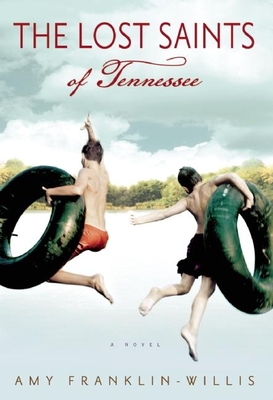
Lost Saints of Tennessee by Amy Franklin-Willis

Lost Saints of Tennessee is the story of Ezekiel Cooper, a man in his forties, driven to the brink of suicide by the death of his twin brother, ten years ago. It's a book that surprised me with its heart and its raw emotion. You must not miss the suicide scene that comes early in the book. I don't want to give too much away but it's in no way what you expect.

Amy Franklin-Willis has set herself the daunting task of drawing out a good old boy from Tennessee, divorced, working at a factory, taciturn, connected only to his old dog and his truck, into the lovable and believable narrator of his own story. It's a story of loss, betrayal, and bitterness in the past, despair in the present, and the possibility of a new chance at life in the future. She does it majestically -- portraying love without sentimentality, grief without mawkishness, hope without artifice. I can't remember when I have connected on such an emotional level to a male character written by a female author.

Maybe not since Water for Elephants has a male character been so moving. Lost Saints in Tennessee is authentic, deep, and true. A heartbreaking story of the realities of loneliness and the power of brotherly love.

I got the chance to ask Amy a few questions about the craft choices she made in her novel. I loved learning about how the novel came about -- some early narrators that dropped away and the process of opening up her main character in a way that would be true to his personality and still support narrating an entire novel. Here are her answers:

LN: You wrote from the point of view of a narrator who is not really a talker, by his own confession and as evidenced by his behavior in the novel. How did you go about finding a speaking/writing/narrating voice for this character who is so taciturn and so guarded?

AFW: Zeke's voice was a real challenge for me in the first year or two of writing the book. He is so shut down when the story begins that in writing his story, I really had to go back to his childhood and meet him then to get to know the man he became. Earlier versions of the story included a lot more of the "past storyline" which allowed me to see Zeke as a happy young boy, full of promise and connected to his twin brother, to understand the devastation he feels as an adult when Carter drowns. 

For me, some of the best lines Zeke utters are the two times he uses the f-word in the novel. In both cases, he is at a break-point, a place where he must either stay in the Loserville he's been hanging out in for 10 years or DO something. Zeke's primary companion in the early sections of the book is the dog Tucker. He was not originally in the book but he provides much needed humor and connection for Zeke in the story. You can see the goodness in Zeke through how he interacts with Tucker. What people say can be so far from what they actually do or who they are. With Zeke, you almost only have his actions to take the measure of his character. But it took me years to find the right balance of insight into Zeke and action on the page because I'm not a big fan of books that are only in the character's head. 

LN: One thing I really loved was how this prickly, locked-up character took a whole novel to warm up to telling us the question that haunts the novel from the beginning, and it takes another character's prodding to drag it out of him. So instead of feeling like you as the author were keeping a secret, it genuinely felt like the narrator was developing the ability to talk about it more as the book went on. Can you talk a bit about the decision to put that final reveal in dialogue? 

AFW: In Lost Saints, I think one of the things I was trying to explore was the notion of how a person can be pulled back from the edge of disaster or despair by another person or being. The guilt Zeke's been toting around for ten years finally gets let loose through his confession of what he regards as his own unspeakable sin. But he has to tell someone, the secret has to be shared in order to lift the burden from his shoulders. 

LN: The book is told in three sections -- the first and third from Ezekiel's point of view, and the second from his mother's. Did you always know that you would give Lillian her own voice in the novel? At what point did you decide to include a section where she could tell her story? 

AFW: I originally wrote Lost Saints with three narrators--Zeke, Lillian & Moses Washington. After a draft or two, I realized Moses had to go as a narrator--though I think he's got enough in him for his own novel. The primary writing challenges I had with this book were structural. Once I narrowed the narrators down to Zeke and Lillian, I had to figure out how their voices should be heard. 

I experimented with going back and forth between chapters, or having the time shift change from past to "current" in each chapter, and none of it felt right. I was aiming for this seamless world for the reader, where you stepped in on page one and none of the writing work showed--it was just a story told as compellingly as I could make it. With all the shifting around of voice and time, it felt choppy to me. And as a reader, I can get annoyed when I start feeling close to a character and then the author takes me into another character. I finally settled on the three-part structure for the book because it honestly seemed like the only way to tell the story. By putting Zeke's voice first, I felt like the reader was on a blind date with Zeke. You get introduced in Part One, you learn some of his history, you meet some of his family. Part Two is when things start getting serious. You meet his mother. You hear her side of Zeke's childhood story, which offers perspective Zeke can't give you. Part Three brings back Zeke's voice and now you know enough about him to understand some of the choices he's made and to be just a bit annoyed, perhaps, by his stubborn refusal to forgive his mother. 

Lillian's voice was one of those "taking dictation from God" kind of characters for me. Some of the scenes in her chapters are almost as I wrote them in first draft form. And I certainly can't say that about the rest of the book. I'm not sure where her voice came from but as I moved through the book, I began to think about my maternal grandmother. She, like Lillian, got pregnant when she was 15, married at 15, and had seven children by her mid-twenties. My grandmother had her fair share of tragedy as well. Through writing Lillian's story, I gained some empathy for my grandmother, whom I recall as an odd and distant person. My mother, who turns 70 this year, told me recently that her mother never told her that she loved her. Not once. And she lived into her early 80's. Hard to fathom.

My recommendation: go get Lost Saints of Tennessee and see how it all comes together.

Monday, February 20, 2012

The Future of Publishing: A Meditation on the Purging of VHS Tapes

Recently we moved.

Goodbye, friends. Imma download you.
Instead of wisely and slowly sifting through our possessions first, and taking only what we wanted to keep, we paid movers to pack everything into boxes and bring it here, to the new house, where we would dutifully sort as we unpacked. We moved in a hurry. Living in that old house after our new one was bought seemed like continuing to live with that guy you've broken up with already, just because you had a lease together. And moving things bit by bit in an orderly fashion to the new house was like surreptitiously trying to date someone new at the same time you're still living with that guy. Even though it's not really cheating, you still sneak. And because you're not Jennifer Aniston and he's not Vince Vaughn, you don't end up falling back in love, you just move out at the end of the lease, and it's not funny, it's just awkward. And you forget everything that was in the bathroom, and you don't go back for it.

Anyway, we moved.

In the mountain of stuff we no longer want that is now sitting grumpily in our new house, there are a mazillion VHS tapes. These are objects that should have been purged years ago. We haven't watched any of them since we moved the last time. We don't even have a VCR connected to our TV. If we did hook up a VCR, and managed to remember what the button "Rewind" does, I guarantee the tapes would look awful in 1080 resolution. It's at a point with these VHS tapes that I don't even think the Salvation Army wants them. I don't think anyone wants them. But every time we began to hustle them into bags to push them out the door, we got all oogly about it. Here's our copy of "The Long Kiss Goodnight," which we watched and rewound several times. Here's "Household Saints," one of the first movies I ever owned. "Welcome Home Roxy Carmichael." "Go." "Four Rooms." "Sweetie." Here's that copy of "City of Lost Children" that was almost impossible to get. "Evita." Shut up, I have the whole thing memorized. I have a romantic attachment to these objects -- they remind me of when we were younger, poorer, and dumber, when I was working at a 1/2 porn video store during graduate school, when our TV was small and given to fits of rage instead of large and austere and firmly in control of itself.

So I put them, all, ruthlessly in the trash. I kept the ultrasound videos from my kids. I kept a couple of other personal things. But anything that I can get on DVD or download, I tossed.

Then I had a horrifying thought. AM I DOING THAT THING THAT PEOPLE DO WHEN THEY ARE LIKE, "OH, WHATEVER, BOOKS ARE PASSE, I HAVE MY WHOLE LIBRARY RIGHT HERE IN THIS ELECTRONIC THINGER." Shudder.

This was not the cover.
But I wish it had been.
Because this cover's badass.
I have a romantic attachment to my books too. But I don't need to tell you that. You know I have the first paperback edition of Moby Dick I read in high school, with all my scrawled little teenaged marginal notes. You know I have the Candide I got in college, the used Italo Calvino I got in Milan, all my signed copies of friends' books, including stuff you can't hardly find ever like My Horse and Other Stories by Stacey Levine and You're a Bad Man Aren't You by Susannah Breslin. I like books. I have a lot. And I will never, ever, ever get rid of them. EVER.

But will my children? Will their children? Will publishing really change forever like everyone is saying it will, so that we'll all be walking around in future times with retinal projectors that allow us to store small libraries behind our ear drums and books will seem dumb like VCRs and twisty knobs on televisions, and jello molds? If I throw away these tapes, will I tomorrow throw away my Gormenghast novels? With the same reckless abandon? Will I?

Moment of panic. Moment of almost pulling those VHS tapes back out of the trash. Then, relief.

Here's what I realized. Books are not like VHS. They're not like DVDs or film canisters or analog recordings or vinyl. You can't say "Well, I can get my books on my Kindle" just like you can say "Well, I can get my songs on my iPod." They're not like that. Here's what they're really like: Theater. Live concerts. You can make them work just with your eyes. You can make all the parts function just by looking at them. It's not a product, it's an entertainment. It's not an object, it's an experience. An experience you can collect, and keep in pretty rows, and share, and and have again and again. And then I felt much better.

I felt better because not only did I NOT have to keep all those VHS tapes, and not only did I NOT have to get rid of all my books and start buying up eBooks on Google, but this: publishers are going to be okay. They really are. Call me Pollyanna or a crack addict or in denial or call me ignorant but here's what I'm saying: Books aren't going anywhere. 

Things may change, in publishing. E-books rise. Paperbacks fall. Publishers will try fetishizing, and niche marketing, and different production models. Fine. But people will still go to the theater. People will still go to live music shows. And people are still going to have books, want books, read books, hoard books, dive into books, and love books. Believe it.

Some of my favorite books.

Sunday, February 19, 2012

A Visit from Joshilyn Jackson

My excellent friend and NYT bestselling author Joshilyn Jackson was in town this weekend for a visit and some book events promoting her awesome new book, A Grown-Up Kind of Pretty! We have been friends since graduate school, but since we normally go away together to hole up in the mountains and write, we have not seen each other's children in forever. It was very nice to have her here and witness my actual life when I'm not stuffing sticks into my hair and foaming at the mouth in the middle of novel production. The children loved her. The dog loved her. She saw my new house. She saw my old house. And there was rejoicing.

We started out in Richmond at The Woman's Club. Joshilyn did a talk and Q&A hosted by Fountain Bookstore. Here she is talking:


Here we are in the bathroom, wondering what's in that abandoned glass on the counter:


Here's Joshilyn with fantastic bookseller Kelly Justice from Fountain Bookstore:


And here we are afterward at the British pub around the corner, eating sausage rolles, Cornish pasties, and absolutely dreadful fish that was full of bones and fail:


Finally, here's Joshilyn at her reading at Prince Books in Norfolk. This morning she rolled out in her orange car to travel back to Atlanta. I miss her already!


Wednesday, February 8, 2012

Pure by Julianna Baggott


Pure is brutal, layered, and new. Its world is bleak and strange, its characters are flawed, complicated, beautiful, and damned, every single one of them. This book is highly original, with a plot you could never predict and a climax you'll never see coming. You have not read a book like this -- you may think you have, but this is different.

Reviewers are comparing Pure to The Hunger Games. Alright, let's talk about that. I've read The Hunger Games. At the base of it, the idea is simple: People are cruel. War is hell. Power corrupts. Compelling engines, but not exactly ripping the lid off anything new. A spunky heroine takes on the cruel world. This is familiar.

Pure explodes more interesting questions. Where does humanity begin and end? What is absolute ruin, beyond which point you cannot be saved? and what does redemption look like, for people beyond that point? Where is the point of no return? What happens after that? These characters have no precedent -- they're not salvageable, they can't be cleaned up and put right or dressed properly and put in a parade, and that's what makes them so interesting. Meet Pressia, who has a doll head fused to her hand, so it is part of her. Meet Bradwell, who has living birds embedded in his back. Meet El Capitan, whose brother Helmud is permanently affixed to him in a life-and-death piggy-back ride. They cannot be extricated. Since it cannot end well for these characters, how will it end?

Baggott takes every question too far, and then asks it anyway. She's got her fist around a full throttle and she's burning every drop of gas in the tank. I have absolute respect for the scope of her vision, I'm totally obsessed with these fascinating characters, and I can't believe I have to wait so long to read the next book in the series.

***

I met Julianna Baggott in person at ABA Winter Institute. I had been a fan since my son decided her The Ever Breath was a stay-up-all-night must-read during a time he was only reading books about space. So after I finished reading Pure, I sent her an email with the one burning question I was dying to ask. Here's the question and her response.

Lydia: My favorite character was El Capitan. He is so original, so complicated. He had my full attention from the first time he came on the scene. Talk to me about the evolution of this guy. Did he emerge from your imagination as fused with his brother -- was that the beginning of the idea of his character? When did his backstory come to you? Did you always know that Helmud would be on some level separately sentient or did that happen during the writing? I'm so interested in how these layers evolved and how he came to be... anything you can share about your process in creating him, without giving too much away?  

Julianna: I was a small child. Abnormally small and the youngest of four kids. And so I was always hoisted on shoulders, piggybacked. I complained to my mother that the other kids in kindergarten were always picking me up. I was the smallest in my school for years. I remember when I finally got ONTO the doctor's charts at all, as undersized. A real feat. My 16 year old daughter will now often walk up to me and instead of a hug, she'll pick me right up off the ground. I also grew up in the era of doubling people on the backs of bikes, on handle bars. There were packs of kids all over the place and we rode in packs on bikes and someone was always short a bike. I was the one on the back of the bike, never strong enough to peddle. 
In other words, I was, in fact, Helmud, El Capitan's younger brother, the one who was fused to him when the Detonations hit, while he was doubling Helmud on the back of his motorbike. El Capitan is doomed to carry his brother for the rest of his life. I'm that brother. El Capitan loves his brother and is deeply burdened by him. This is how I was raised -- by my siblings at least -- sometimes cute sometimes a terrible burden.
I love El Capitan. He began for me as purely evil. He had no point of view. But as soon as he showed up eating a tin of chicken, his brother bobbing over his shoulder, I felt for him. Once he started having his own voice, I was in. No characters in the novel surprised me more than El Capitan.

Pressia with her doll-head fist came first to my mind, along with Our Good Mother, fused to her child. In fact, Our Good Mother may have come first. The fusings, in general, come in large part from having offspring -- oddly named, because in those early years, they don't spring off. They are Velcro-ed to the body, attached, fused. Partridge was next. Bradwell, too. He's Marquez-influenced. I had the concept of Beasts, Dusts, and Groupies wandering the scorched earth, and I wanted a groupie as an important set of characters. He' ain't heavy; he's my brother... Yeah, I know the song. Not well, but those lines are there in my head.
It felt like the quintessential story of brothers -- literally bound. I wanted to explore that relationship and then, of course, Helmud surprised me greatly, and, of course, El Capitan's response to his brother's surprise was completely and absolutely natural. (I think is what you meant by "without giving much away.")
The fact is that I can't write a character who's purely evil -- not if I get into their point of view. I don't know anyone who thinks they're the evil in the world. El Capitan is a strong character, a survivor, a protector, and as I got to know him, I learned how very, very tender he is. 
I'm deep into book II edits, FUSE, and looking closely at this relationship. I love them both. But of the two, yes, I'm Helmud. No doubt about it.

***

Thank you, Julianna, for that window into your head. I recommend Pure for the kid that loved The Hunger Games and wants more, or for the adult that's ready for smart post-apocalyptic fiction with more of a purpose than just grossing you out.