Monday, December 28, 2009

Everyday Psychokillers: A History for Girls by Lucy Corin


That's no catcher, and this is not rye.

That's no catcher, and this is not rye.

Everyday Psycho Killers: A History for Girls

Lucy Corin's first novel, Everyday Psychokillers: A History for Girls, published by FC2, begins as a wild, unapologetic mess. The story of a young girl in southern Florida, Psychokillers reminded me initially of Lynda Barry's Cruddy, Kathy Acker's Blood and Guts in High School, or a number of other ragged, jagged narratives yanked out of confused teenaged women. It's messy in that way, in that essentially female way, and its zigs and zags are almost familiar to me, this unpredictable, non-linear tempo.


It's the kind of book that leads reviewers and jacket copy writers to create lists of disparate elements: a Ted Bundy reject, the God Osiris, a Caribbean slave turned pirate, a circus performer living in a box, broken horses, a Seminole chief in a swamp, and a murderous babysitter. And the book is good in this way; it's inventive, fresh, out of control. You spend most of the first half asking yourself, "Where is she going with this?"


But ultimately what's interesting about the book is not the way it's fragmented. The story is told in mad, intense chunks, increasingly so disconnected from the central narrative of the young girl. We go from a fairly chronological account of a home life, a school life, of this main character, into digressions that start as anecdotes or asides from the character herself and evolve into separate stories -- stories of death and killers, murders, fear. That aspect of it is great, and Corin pulls together a very bold collage.


The interesting thing, though, is how it isn't fragmented, how the book spirals back on itself, revisiting ideas, images, and even sentence structures, so that while in some ways time, characters, and realities are fractured, the idea of the book spirals inward to a point, and comes together where the book blows apart. There are six or seven absolutely tight and monstrous pages toward the end that clearly express the book's central theme. I realized, reading them, the path I had to take to get there, to be told I am a killer, and that I am being killed, and that both are me. That realization is at the center of the spiral.


Looking at it from the top, a spiral moving outward looks the same as a spiral moving inward. It's not immediately obvious how Corin's book functions in this way, but the destination is worth the journey, and the investment in the book, you will find, sneaks up on you. Along the way, you'll find chapters that work as short stories, you'll see a dazzling slideshow of images you definitely have not seen before, and you'll find yourself falling into suspense over this character. Yes, in the middle of a novel built of formal experimentation, you'll be worried about this girl, and the question central to her psycho psyche -- will she kill or be killed?

Thursday, December 24, 2009

Elegy for a Fabulous World by Alta Ifland


Elegy for a Fabulous World by Alta Ifland

Elegy for a Fabulous World by Alta Ifland

Publisher: Ninebark Press


For its second offering to the hungry world of literary fiction, Ninebark Press brings us Alta Ifland's short story collection, Elegy for a Fabulous World. From the very first story, Ifland had me in her grasp with merciless, darkly funny tales from her childhood in communist Ukraine. In bleak, unapologetic images, she shows us the gypsies that camped outside her town, the gravedigger the children all harrassed, the way the trash collectors failed, and the magic of one coveted bottle of Coca Cola. You can read the titular story online at AGNI Magazine. Not my favorite example, but the strange picture of what constitutes a seaside vacation for Soviets will give you an idea of what the rest of the book has to offer.


Ifland's gift is control. She shrugs at absurdity with the measured pace of a female Nabokov. Yet just as you're sinking into a mild rhythm of predictable slice-of-life revelations, she jerks the image just a bit, skews it enough to remind you: this is foreign. So, the mute adopted sister you're accustomed to seeing, with her iconic silence and her mild beauty, may not stop as a symbol of some unknowable aspect of childhood. She may suddenly go jetting off into space as the story takes a sudden flinch outside the deftly drawn limitations of the village, the family, the characters, the way of life. Ifland injects just enough of these blank surprises to elevate her work from competent memoir into the realm of contemporary craft.


The second half of the book delivers more typical contemporary short stories. Well crafted, interesting, satisfying, but lacking the depth and impact of the first section.


A few stories into the collection, when I was so enchanted with the voice, the landscape, the complex dark shadows of it, it occurred to me how impossible, how thin it would all seem if these same stories were set in modern times, in the loud, plastic American world. Is it possible for her, I wondered, to create this same kind of elegant starkness without the exterior starkness of village life, without cell phones or televisions or that brisk cacophony a more contemporary set of characters would be wading through. There's a timelessness to the childhood that Ifland renders that would be, maybe, fractured by the introduction of technology, information, something faster and less private. The second half of the book answered, to some extent, my question, as the stories that took place in office buildings and other less austere locations didn't have the same effect on me as those in the sort of anti-fairytale settings of the earlier pieces. So the mute sister could only fly away into space out of the house without wires attached to it, and the man crying in the graveyard could only be as profound if his life existed in rumor and legend, instead of a newspaper story.


The best thing about the book is the way the identities shift and change, particularly the mother and the main character herself. One can find these common characters in the earlier stories but not necessarily pin down a "she" throughout, or even an "I." A great example of this is a story where the main character takes her husband back to the old country to meet her parents, whose desire to feed him and nurture him and impress him with food nearly kills him. Her return to her homeland, accompanied by the uninitiated American, made me think of my experience reading the book, how hopeless it was for the husband to understand her family, or for her to show him to them properly. Ultimately, there is only the reality of what they are, and what he is, physically, to show for it. And this was what impressed me about Elegy for a Fabulous World. Ultimately, it is in surreal images and what facts and memories can be clearly delivered that this other, fabulous world exists. And if this old, communist life can only be understood in fragmentary, shifting narratives, looped through with the myths of the old country and the realities of the new, then Ifland's atttempt is a success.


For more information: Purchase Elegy for a Fabulous World, visit Alta Ifland's web site, read more about Ninebark Press.

Sunday, September 20, 2009

What's on your Inspiration Shelf?


If life is finite, your book stash must be too.

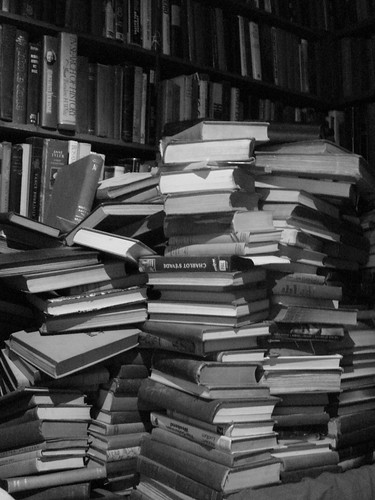
I think that hoarding books is a stand against mortality. If we've read them already, we might want to read them again. If we haven't read them yet, we might want to. Looking around at my shelves and boxes, I want to believe I will have time before I die to read them all, maybe again and again. Even if my current rate of reading means I'd need to live three lifetimes. To admit that I can't read all these would be to admit that at some point I'll stop reading. Difficult to imagine.


I recently some changes to my personal book hoard, and culled three boxes of books from the stacks. I decided to get rid of all the books I've read that I do not want to read again. That helped. But it also hurt to say goodbye to these objects. I'm tech-positive in so many ways, but like so many writers and readers, I am in love with the physical presence of books, and I have a hard time getting rid of them. A hard time embracing Kindle, and hard drives.


To make myself feel better, as I was sorting through the books I would let go, I decided to make another stack of books that I would never let go, that I would fetishize in the extreme. I made my inspiration shelf of books I've read that motivate me to write, a little shrine to their actual selves, a space for them to take up unapologetically in the world. If I must be mortal and my reading experience must be finite, then let's make it exquisitely finite, limit my great books to one shelf only. These are the books that are important to my life, at least, right now.


Here's my list, in no particular order. For some, it's the scope of the book. For some, it's the daring. The personal connection. The theme. The innovation. For a few it's just the time it was in my life, and how much it affected me. This is not a list of great books, or a list of personal favorites, but these are the books I can look at and feel something in me reaching. So, it varies:

Moby Dick by Herman Melville. The very copy I first read in high school. I have read it maybe 20 times, and in this copy I can see all my teenage notes.


House of Seven Gables by Nathaniel Hawthorne.


His Dark Materials Trilogy by Phillip Pullman.


Lord of the Rings Trilogy by J.R.R. Tolkien.


Jonathan Strange and Mr. Norrell by Susanna Clarke


Penrod by Booth Tarkington. A book I read again and again when I was a child, before I understood the irony, before I understood racism at all.


My Horse and Other Stories by Stacey Levine


You're a Bad Man Aren't You by Susannah Breslin\


Between Georgia by Joshilyn Jackson


The Rainbow by D.H. Lawrence


Tess of the D'Urbervilles by Thomas Hardy


Geek Love by Katherine Dunn


Observatory Mansions by Edward Carey


The Intuitionist by Colson Whitehead


The Most of P.G. Wodehouse


We the Living by Ayn Rand


A Room of One's Own by Virginia Woolf


Dubliners by James Joyce


Candide by Voltaire


So, I've broken it down to these 20 volumes. If I add another, I think I should subtract one -- that's how the brain works best. My own two books are not on the shelf, but I hope my next one will be. It's what I aspire to: to write something that belongs in my brain with these.


Challenge: What's on your inspiration shelf? What one book would definitely have to be there? If you take a picture, I'd like to see.

Thursday, September 3, 2009

How Twilight Killed "The Wasteland"

Lev Grossman, book reviewer for Time Magazine, has bravely prophesied an end to modernism. In his Wall Street Journal article, Grossman posits that the modernist stranglehold on novel-writing is finally over. A new day has come! Nuts to you, Joyce, Eliot, Faulkner, and Kafka. You guys are history! No longer will readers suffer through beautiful language to get to an epiphany. Today's readers want plot, plot, and more plot. "Lyricism is on the wane," gloats Grossman, citing high sales of the Twilight series as proof that plot trumps beauty for these kids today.

Grossman, possibly unaware that Joyce and Eliot have been dead for fifty years, believes that these "modernists" have tricked us into thinking that a decent plot is indicative of a weak book. So, we're secretly reading mysteries and scifi, wishing literary writers would just take heed. "Should we still be writing difficult novels?" he asks, "Isn't it time we made our peace with plot?"

Grossman has graciously forgiven the moderns for blowing up the conventions of the Victorian novel. But he now feels that the time has come to embrace plot again. His evidence? The popularity of young adult novels, which never aspired to disregard plot in the first place. For Grossman, there have been no intervening literary movements. No novels of consequence that delivered any measure of plot with their lyricism, or any lyricism with their genre. The article has the intellectual weight of a strawberry tart, and yet the internet is upside down with panic over it. Is literary fiction over? Do we all have to start writing vampire novels?

Relax. Grossman's thinking is reductive, cowardly, but mostly just silly.

Consider these three major flaws:

1. It's weak on literary history. Did modernists shatter plot? Maybe. But look at the novels Grossman cites: Wharton, Hemingway, Lawrence, Fitzgerald. Really? These writers may be moderns, but in theme and ethos, not in formal experimentation. Pound, yes. Kafka, yeah. Joyce, okay. But Grossman's list of defiant modernist novels is full of plot. Sorry.

2. He uses the word "Pavlovianly."

3. His prognostications don't make sense. In proving his point that plot is back in style, Grossman uses Chabon, Lethem, Niffenegger, Gaiman, and Susanna Clarke as examples. These are the literary champions that are boldly bringing back the storylines we have all been silently, hopelessly craving for 80 years. However, these writers are all contemporaries of the Twilight juggernaut. The figures that Grossman so gloomily references (adult trade sales down 2.3% while Twilight author Stephanie Meyer sells 8 million books) would seem to reflect that while Chabon and Niffenegger may have been slinging Grossman-approved level of plot, the book-buying public wanted to buy Twilight books anyway.

I hope that writers of difficult books will not pause to listen to Grossman's confused ramblings about how literary movements from one hundred years ago are stultifying contemporary fiction. I hope writers will disregard all petulant whines about how "we the people" really want to read inglorious garbage like Twilight. I hope writers of difficult books will not take plot advice from a guy who lifted his own plot from Harry Potter. Yes, Twilight is selling. Yes, cheap fiction does move. It always has. But greatness is not easy, in reading or writing, and you weren't really writing for guys like Grossman anyway. Write for the smart people, the people that filled a football stadium to hear T.S. Eliot, the people who still celebrate Bloomsday. Write for me. I will still work for an epiphany.

Monday, August 17, 2009

To Hell with Publishing: Neither Irreverent nor Inventive

The name promises much. The name inspires obstreperous agreement. Yeah, to hell with publishing, anyway! This is 2009. We're all about downloads, and Kindle, and Twittered novels, and free information, and Google books, and plots we can download via wires straight into our arteries, and plugging into authors via Friendfeed, and instant updates, and modules! To hell with publishing, to hell with journals, to hell with prizes, to hell with first novels. Yeah! Fist-pump!


From a group of projects so provocatively named, I now expect mind-blowing innovation. I expect earthshaking progress. I expect, at the very least, heaps of scorn for the old way of doing things, and arms flung wide open to the new, digital world. Please, make sense of fiction on Twitter for me. Please, package blogged novels. Please, help me to understand new media. I beg you! Unfortunately, what I'm finding here is same old, same old. Instead of revolution, "To Hell with Publishing" is pushing cardstock, ink, and contracts. Readings at a library under a dropped ceiling. Submission guidelines -- click here! And please include a cover letter.


"To Hell with Publishing" is just another small press. Like every other small press in the history of earth, they desire to "return vital writing, and in particularly, the best in contemporary fiction, to the main literary stage." Well bra-thumping-vo. They publish... books. Books made of paper and glue. And they publish journals. They have a prize for... unpublished manuscripts, but unagented manuscripts are not considered. Please submit paper copies in triplicate, because at "To Hell with Publishing" they are all about the snail mail.


That name followed by that business model is like the sound of a trumpet fanfare followed by the sound of a drunk falling downstairs. Where's the innovation? Where's the middle finger raised to the literary establishment? Listen: Here are the two ways that "To Hell with Publishing" bites its thumb at the mainstream presses.


1. They will only publish first novels. No second novels! Oh my god! Their plan is that other publishers will swoop in and take over their authors' careers after novel #1. Because yeah, mainstream publishers are so interested in picking up seconds after the author has been deflowered of his first novel. Do I really have to pursue that analogy?


2. Their journal (To Hell with Journals) will only have 26 issues. They have decided this... in advance. Only 26 and no more, even if thousands of screaming fans are lined up outside the bookshop, demanding just one more issue, tearing up their organs in despair that only 26 issues can possibly be produced. They will stand innovatively firm on this principle: THEY WILL FOLD AFTER TWO YEARS.


These two policies manage to be simultaneously defeatist and overly ambitious. Yeah, we MEANT that journal to go under, and we MEANT that author to never produce another book, because that's all part of the rakish, devil-may-care plan we have here at "To Hell with Publishing." Look, there are already small presses out there doing exactly what THWP desires to do, but without these weird stipulations that seem to undercut any kind of longevity or long term relationship between press, author, and reader. Obviously a few more domain names are needed: tohellwithlegitimacy.com, tohellwithauthorloyalty.com, and tohellwithrelevance.com. "To Hell with Publishing" is a profound disappointment, leaving this reader still looking for the next great thing. When it comes along, I have a feeling that "To Hell with Publishing" would be a really cool name for it. Unfortunately, that domain name is already taken.


For more info: I found out about To Hell With Publishing from the Book Ninja.