Showing posts with label short stories. Show all posts

Friday, April 5, 2013

How to Write a Sci-Fi Flash Fiction Story: Part 3: The Crack in the Wall


(This post is part of a series. For part 1, click here. For part 2, click here.) 

I have one more tip for those of you who are writing sci-fi flash fiction, maybe even entering the Fly-By Sci-Fi contest to benefit Up Center Books this summer. This one may help you find a story that’s big enough to be significant and affecting, and small enough to be told in two pages, or 500 words. In the last part of this series, I focused on dissecting the climax, but now I want to look at the beginning of the story. The full plot arc of a novel has an inciting incident at one end and a climax at the other -- consider that you can tell your flash fiction from either end.

Yep, she's cracked.
When a writer thinks of when to start her story, it’s a good idea to look for firsts or lasts -- the first time something happened, or the last straw. You always want to launch your story on a day that violates the status quo, a day unlike any other, when something pushes your character to action and changes his/her world forever. When you’re writing micro-fiction, you can tell a whole story around just that first moment, when the change is initiated.

So how can a day be unlike any other? There are tons of ways -- tornado, plague, discovery, a lost tooth, , but here’s one that’s uniquely suited for the sci-fi milieu: it's a very tiny reversal that I'm calling the crack in the wall. It’s the very moment when good turns to bad, when safe turns to dangerous, when fixed turns to broken. This moment can be just small enough to be a perfect subject for flash fiction.

Think of a huge strong dam, holding back megatons of water, and imagine the moment that the very first crack is born.

Think of an impenetrable planetary shield, which keeps the inhabitants absolutely safe from all contact with the outside world, and imagine the moment that one small first particle (or person) gets through.

Good technology is good, until it's not. Then it kills you.
Think of a completely reliable piece of technology, that is unswervingly good and helpful and trustworthy, and imagine the moment that it first malfunctions, and wounds.

Think of a person who has been completely moral, just, and upstanding for her whole life, and imagine that first moment that she sins.

I’m talking about a crack in the metaphorical wall. The first, tiny crack. Sometimes in that first moment, the whole story is encapsulated, and that’s the kind of subject I’m looking for in flash fiction. Give me that first tiny crack and 500 words that let me see it, and my brain can fill in the rest of the fissure, the crumbling, the devastation. Give me that first crime, and my imagination can supply the dissolution, the aftermath, the ending.

You might also find yourself imagining sort of the opposite of a crack -- a tiny reversal that takes a character from devastation to redemption. The first good thing that happens. The first motion toward salvation. The first failure of an evil mechanism, when hope is born. The first friendly alien in a galaxy of wickedness. Writing in this direction could have the same effect -- a suggestion of the future that leads the reader to the beginning of the story.

Much of flash fiction’s value comes from what you say, but much of it comes from what you do not say, the necessary gaps you create that your reader fills in with her own extrapolation. And if you do it right, a short fiction can imply a whole novel’s worth of material, exploding, like a flash, in the reader’s brain. Good luck!


This spring, I am judging the Fly-By Sci-Fi Flash Fiction Contest, a writing contest to benefit Up Center Books. Writers in the Hampton Roads area will submit their best science-fiction-themed flash fiction to be judged first by instructors at The Muse Writing Center and then by me. Winners will win a writing class at The Muse, a nifty prize basket, and will share the microphone with me at the launch of the paperback edition of Shine Shine Shine, on July 10th, at Up Center Books. To encourage college students and adult writers who are tackling this challenge, and to give some guidance and support to teachers and parents who may be working with a younger child, I created this three part guide to explain a few (of many!) possible ways to approach writing a sci-fi short.

How to Write a Sci-Fi Flash Fiction Story: Part 2: Three Parts of the Punch


(This post is part of a series. For part 1, click here.)

Not this punch, smartass.
The second strategy for putting together a great story in a tiny space has less to do with topic and more to do with structure and chronology. You have decided on your story of a character in conflict, but the full scope of any character’s story really starts when the character is born and doesn't end until the character dies. Your most crucial job as a writer, especially as a flash fiction writer but really as a writer of any length of story, is to decide where to start and where to end. In the span of your character’s life, there may be a dozen major moments -- crises of relationships, physical dangers, decisions, turning points, etc. Maybe each character has the potential in him or her for a dozen novels or five hundred flash fictions.

The important decision is which one to tell, and then you must get as close to that critical moment as possible. You may have heard the popular writing advice to begin as late as you can and end as soon as you can. This is especially true in micro form, because there is no time to waste building up to a climax or wrapping up with explanations. No one wants to read a brief summary of a story -- they want to read the story itself, and that means immediacy, scene, physicality, dialogue. Some short shorts sound like elevator pitches for entire novels -- don't do that to yourself. Narrow your focus to the exact moment of conflict, to the pivotal scene itself, whichever one encapsulates the whole story. Now you deliver something visceral and immediate to your reader, while still telling the whole piece.

The moment of impact. 
To help you break it down into even smaller bits, think of a punch. Maybe the act of punching someone is the climax to which your character has been building, or maybe a punch is just an example and your actual climax is a kiss or a declaration or an exit or a car crash or the clink of handcuffs or a foot landing on a mountain summit or a baby being born -- whatever. I’m asking you to take that climax and break it into three smaller parts, and to help us examine that, let’s look at a punch.

A punch can be divided into three moments: the swing, the impact, and the shock. Those three discrete intervals can each be their own stories. You can tell a story in the moment when the hand is still in swing, you can tell a story in the moment with the hand and the face connect, and you can tell a story in the moment when the head is kicked back, reeling.

Check the ripples! That's shock.
When you take any climax and divide it like this, interesting things happen. For one thing, point of view becomes very important and clear. In the punch example, your story is of “the swing” is very different depending on whether you’re telling the story of the person punching or the person anticipating the pain. Likewise “the shock” would be very different. Examining your choices about where to position your narrative camera, you’ll find the most minute changes bring about interesting reverberations in your story.

So when you’re getting down to the business of writing a tiny story, I recommend you examine your scope. First, the character’s whole life. Second, the moment of climax you want to illustrate. Third, within that climax, which of the sections you want to focus on -- the swing, the impact, or the shock?

Back to Part 1 | On to Part 3
This spring, I am judging the Fly-By Sci-Fi Flash Fiction Contest, a writing contest to benefit Up Center Books. Writers in the Hampton Roads area will submit their best science-fiction-themed flash fiction to be judged first by instructors at The Muse Writing Center and then by me. Winners will win a writing class at The Muse, a nifty prize basket, and will share the microphone with me at the launch of the paperback edition of Shine Shine Shine, on July 10th, at Up Center Books. To encourage college students and adult writers who are tackling this challenge, and to give some guidance and support to teachers and parents who may be working with a younger child, I created this three part guide to explain a few (of many!) possible ways to approach writing a sci-fi short.

Thursday, April 4, 2013

How to Write a Sci-Fi Flash Fiction Story: Part 1: Fish Out of Water


Sci-fi Version: "For sale: Space suit. Never worn."
How hard could it be to write flash fiction!? After all, it only has to be 500 words long. You could get 500 words out of a detailed grocery list or an angry Facebook post calling for genetically modified undersea pothole relief. (Or calling for an end to it.)

True, writing 500 words is not hard. But what makes a story a story? What elevates your 500 words from the realm of the vignette or scene or sketch to the level of an actual short story? A reader can tell the difference between a paragraph and a piece of fiction -- there’s something about a story that feels complete, finished, whole, no matter how short it is.

This something is conflict. Conflict can be a fistfight or an internal battle, but either way it is struggle -- the struggle to move, either physically or emotionally, from point A to point B. So a story is a fight to move, no matter how minute the obstacle and no matter how infinitesimal the motion. That’s what makes it whole.

Conflict can be tricky to set up even in a long form short story, and sci-fi conflict can be even more tricky. You may find yourself imagining world-building that takes chapters, alien races that must be described in glorious detail, histories of space battles with implications that span thousands of years. The idea of condensing it into the space of 500 words seems laughable. But here are three ways you can ignite your story in a very tiny space, and a few secrets to help you get it firing immediately. (Parts 2 and 3 are linked below.)

#1. THE FISH OUT OF WATER


When sci-fi works best, the most alien of situations relate to very familiar human experiences. One category of conflict that is instantly relatable and needs very little wordy explanation is the fish out of water.

Get your jungle character into this neighborhood.
Generating this story is easy: Take a character and place him in circumstances that are opposite what he’s used to.

On the most obvious level, this can be physical. Take a character who’s used to the desert and put him on a snowy planet. Take a character who breathes water and put him on a mountain (literally the fish out of water). A city dweller in the country, a nocturnal person forced out in the day, a cave dweller on the plains. Instant conflict, just add physical discomfort, the urgent need to adapt, survive, on a primal level.

Goodbye, city life! 
On another level, this shift in circumstances might have less to do with setting and the fear of death, and more to do with the character’s identity and the fear of discovery. Maybe this is a man living as a woman, a child in a man’s body, a corporate drone living like a king on a tropical island. (Apparently Tom Hanks has a gift for portraying the fish out of water on film!) Again you have immediate and impending doom in the threat of people finding out -- any near escape would give you a chunk of conflict just the right size for a story in micro.

Your character misses his lonely hermitage.
Perhaps the most interesting way to do this type of conflict is on an ideological level. A character accustomed to freedom is in chains, a character accustomed to oppression is suddenly free, a character who lives in a ruggedly individualistic society finds himself on a commune, a character from a caste system finds himself in an egalitarian world. Here the character’s understanding must shift in some significant way, giving way to pressure from his new surroundings, or coming to a new understanding based on this new context.

Science fiction or speculative fiction is perfect for this type of set-up. Time travel, interplanetary travel, alien species, and the pervasive themes of exploration and discovery lead to many of these juxtapositions -- showing a moment of the resulting conflict can be just enough story to fill up a short short.

In the next post in this series, I’ll talk about strategy #2: Find Three Parts of the Peak.

This spring, I am judging the Fly-By Sci-Fi Flash Fiction Contest, a writing contest to benefit Up Center Books. Writers in the Hampton Roads area will submit their best science-fiction-themed flash fiction to be judged first by instructors at The Muse Writing Center and then by me. Winners will win a writing class at The Muse, a nifty prize basket, and will share the microphone with me at the launch of the paperback edition of Shine Shine Shine, on July 10th, at Up Center Books. To encourage college students and adult writers who are tackling this challenge, and to give some guidance and support to teachers and parents who may be working with a younger child, I created this three part guide to explain a few (of many!) possible ways to approach writing a sci-fi short.

Monday, January 1, 2007

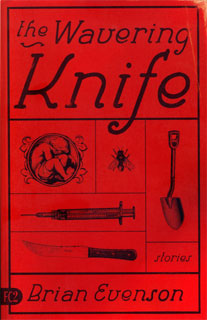
The Wavering Knife by Brian Evenson

One of the best things an author can do for you is to leave you with an image that you'll never forget. Short stories do this for me more than novels, I think. From novels, I mostly take away characters, or a general feeling of the novel's place or a memory of its stylistic affect. From poems, when I read them (which I try not to) I am sometimes left with a memorable line or even a word. Short stories, though, deliver a single frame -- like the ranting in the doctor's office waiting room from Flannery O'Connor. The bent translucent form over the candle from Melville. The throbbing floorboards from Poe. Recently I remember remembering the one-armed man in the tree, pruning it with a chainsaw, from Karen Brennan. (Of course there are those memorable moments I'd rather scrape from my brain, like every scene in any movie that helpfully features a person being burned alive. Thanks Hollywood!)

From Brian Evenson's collection, The Wavering Knife, I am left with a residue of images I have never seen before, and that's saying something small, but significant.

Half of these stories are brutal, relentless, and cold. The other half (and I don't mean exactly 50 percent, but *some*) present a lighter, more ridiculous fare. The latter and lighter group are about silly men and the dumb things they do and say -- from the Promisekeeper group that meets in a bar to the guy who tries to set up a church in Walmart, to the pair of redneck gravediggers who have so much trouble getting their corpse into a shallow hole in hard packed dirt that they chop him up, pee on him, eviscerate him, stomp on him, and eventually throw what's left of him into a ravine and pretend to cover up the grave. What happens next? The family and minister come over the hill, with the coffin he was supposed to go in, asking to "dig up" the body. These stories, though smart and wry, are not my cup of irony. The other half of the book, however, is priceless. Evenson's great accomplishment, his genius, lies in these other stories: "The Ex-Father," "The Intricacies of Post-Shooting Etiquette," "The Wavering Knife," "Virtual," "One Over Twelve," "The Progenitor," and my favorite, though it isn't the showiest story in the book, "House Rules." "House Rules" affected me the most, though it is quiet and drab, and the image of the velvet rope across the stairway will stick with me for sure.

Maybe these stories are evolved Kafka, or maybe they're perfect scifi. This is a fiery imagination kept rigidly contained in exacting boxes, let out in discreet units, each one perfect and with a strange serenity. These stories take you in utterly, and then truly reward you, like magic tricks that really work. I can't really give you any plot nuggets or summaries for these, because they don't work except in their own context, provided by the stern, rigorous language and the limitations of the prose. They're so strange and explosive in the ideas that drive them that they need Evenson's specific containers to make them conceivable. Story after story I would finish and then say, "That was so WEIRD. And FABULOUS." Then I'd hungrily go on to the next.

It's not surrealism -- everything is true within its own law. It's maybe alterealism. Whatever it is, it was enormously engaging and challenging to read and halfway through I was already thinking in my head of people I know who would love a book like this. Definitely read it. A small black rendering on a blank tablet, of something truly different, is more intriguing than a dense and colorful mural, six blocks long, of something we already know.

I met Evenson a long time ago at a conference in Denver, and I can't remember much about that conference, including meeting Evenson, except that I know I did and that he had kind of a wild aspect. He looked more like the book jacket photo on The Wavering Knife than he did this photo here, but I'll include this more respectable one since he's now the Director of the Literary Arts program at Brown University.

Saturday, June 17, 2006

The Garden in Which I Walk by Karen Brennan

OKAY.

On to a collection of short stories.


Karen Brennan wrote several books before this one, notably Wild Desire back in 1990 which was positively reviewed in the NYT Review of Books. Now she's a professor at the University of Utah. She's written five books, total, and she teaches the graduate level poetry workshop at U of U. I'm 100 pages into this book and there's not much left, about half as much again, I'd say. It's what they used to call a slim volume, back when they said that sort of thing. There are a few things I have to say, at this point...

1. This writing is very controlled, very lovely, very fine. There isn't a lot of warbling excess -- it's carefully honed. It reads like poetry, lots of it, and I'm not surprised to find that she's also a poet. Reading these very short short stories, where often what's central is an image, or a situation, or an idea, and not a plot exactly, I'm thinking of this analogy: Handling good writing, like this, good images and interesting phrases and bright language, is like handling a lap full of sparkly jewels. It's pleasurable. Maybe poems are like the loose jewels, unset, just rolling around. Maybe short stories are like the jewels strung onto a wire, that you can wear, but with no interstitial weave or anything, just a sequencing. Maybe novels (I could be wrong, maybe they are nothing like this) are like a beaded garment, where you not only have the pretty gems, but you have to arrange them over a space, and it can't be too crowded or too sparse, and you have to also create the fabric between them, and make sure that fits, and that the seams are hidden. These stories, while all beautiful in themselves, are not connecting together to make anything wearable. I carry them off in my memory as separate things. It's really hard to write a novel. This writing, here in this book, is gifted and at times genius, but I don't think it was *hard* to write this. That's not a criticism, it's just the way the book feels.

2. It's not a good idea, in my opinion, to have a lot of first person stories in a row, all sounding alike. They started to bleed together in my mind, and I felt when I started the next story that I was still reading about the last character. I liked the third person stories best, I think, because the narrators of the others failed to differentiate themselves. I think my favorite was the one in three sections about the wreckage, the face, and the... sleeping. That was very well woven. My least favorite were the most fragmentary ones in first person. I also very much liked the one about the beautiful woman who maims her hand with a chainsaw accidentally. That one I will remember.

3. I was already struck with an example of why I don't usually read contemporary fiction. After reading this book, so rich in the image department, I was outside watering flowers with my little daughter. She had the hose in her hand, looking very picturesque with the little cotton dress and the flowers and her wavy hair. I was just loving watching her and I kept smelling something awful and rotten, and eventually I looked around carefully and there were two dead baby birds under the tree. Baby birds that fell out of the nest and died and there was nothing anyone could do. And my first thought, all seeped in this kind of literary brainjuice was, 'I should write a short story and use that.' Which, of course, wouldn't be altogether BAD. But the right thing to do, if I do use it, would be to work it into my novel... or just think about it and let it filter in. Or blog it. When I was in grad school I used to keep running lists of these "things" you know, what I would call jewels using my analogy above, and when the list got long enough I'd write a story using all of them, forcing them all in together like a salad.

4. Everyone in this book is miserable. Some extremely miserable. It's funny because from the first three pages I thought it was going to be kind of sweet and nice and boring. I think that's why that story is first.

So, on I go to finish and release it. I'm trying to decide whether to email these authors. Seems kind of pushy, like hey, I'm reading your BOOOK pay attention to MEEEE. Heh heh.