Showing posts with label reviews. Show all posts

Monday, August 6, 2012

Great Britain and Shine Shine Shine

Shine Shine Shine has been published in the United Kingdom and Australia by Simon & Schuster! Here is the beautiful cover they designed, and here are some reviews coming in from the UK press:

‘Packed with original ideas and compelling characters … funny, lyrical and fascinating … This is a novel about the strangeness of being human. Lydia Netzer says she wrote it when she was pregnant with her first child and feeling “paralysed with fear …” Hopefully, she feels better now. Or at least, a lot less alone in her imagined weirdness. After meeting Sunny and Maxon, I know I do’ -- Independent on Sunday

‘Think The Corrections meets Geek Love in this captivating modern love story. Sweet. Funny clever’  -- Red Magazine

‘This debut novel is  a sparky study of family life with a slightly surreal twist’  Bella Magazine

‘This is a love story with a difference. Looking at marriage, loss and the choices that make us all human, everyone will be talking about this one’ -- Look Magazine

‘Quirky and inventive’ --Mirror

‘You have to admire Shine Shine Shine’s ambition and originality’ --Stylist


Huge thank you and air kisses to the wonderful team at Simon & Schuster UK, who are really pulling in some amazing reviews here!

Monday, March 12, 2012

Arcadia by Lauren Groff

Lauren Groff's new novel, Arcadia, is a hypnotic, addicting book. Although this is not a plot-driven page-turner in the traditional sense, I found it hard to tear myself away. Two things impressed me enormously here: 


1. Unfiltered Point of View: Groff tells the story of Bit, a child born in a hippie commune, in three stages. In the first section he's a very young child, in the second a teenager, and in the third approaching middle age. Writing from a child's point of view is so dangerous -- it's so easy to send it into sentiment or to clunk it up with asides to the reader all the time. Sometimes you feel the author speaking through the child, trying to push through a meaning at you, and the character disappears. 


Not here. It was immediately obvious that the narration here, while in third person, would have no filter -- there's no "looking back on those days" or "now that he was older." In fact, there is no intrusion between the reader and the child's authentic consciousness. What he sees we see. What he feels we feel. And the things that we as adult readers can piece together from his experience are our own to interpret. That was awesome. 


The part where Bit goes silent, the description of what that was like for him -- really masterful writing.


2. Cast of Thousands: Groff has a huge cast in a fairly short novel yet they never bleed into each other and become muddy. Somehow she deftly maintains the uniqueness of a lot of characters that are very similar in context. And while these hippies are so close to ridiculous -- the nakedness, the soy everything, the language of love revolution -- they never become cartoons. Many of these images, many of these phrases now make us roll our eyes. The outfits sound like Halloween costumes. Yet these people are so real on the page, so specific to themselves, it's impossible to dismiss them as caricatures or deny them as wholly rounded, interesting characters with their own lives, their own identities within the demographic they typify. 


photo: Sarah McKune
One of my favorite things about feeling like I have "backstage access" is that I'm emboldened to ask authors questions about their novels. Because I'm me, and quite fixated on the actual structure and construction of books, I am focusing my questions as I have been focusing my reviews: on craft. This time, I was able to ask Lauren Groff a question about her methodology in handling such a mass of characters. Here's what she said:


LN: As I was reading, I kept trying to figure out how you were managing to seamlessly keep all these balls in the air with all these different characters -- I mean SO many! And to my eye, you never resorted to the easy route of just categorizing them and referencing that. Can you talk about how you approached this -- did you originally have more or fewer characters, did you take out anyone in revisions, did you consciously bring back references to characters if we had been too long without hearing of them (like in the middle section)? For example, there were several times when Sweetie was mentioned that I thought, I wonder if this is a nudge to my brain so I don't forget who Sweetie is?
LG: This is a marvelous question because it made me go all the way back to the very long drafting process and try to noodle through what I had done. In the end, I think I'd made a kind of character palimpsest: I made very long profiles of about forty of the important characters, I made a physical map of the way the characters related to one another, and I tried to see how they would pop up in the later sections. I hope I didn't try to nudge your brain to keep in mind who a character was--that's taking you out of the story, which I'd hate to do!--but the very short answer is: oh my gosh, that was a very long time ago, so maybe? If the character is useful later, maybe it's good to nudge your brain once in a while to keep in mind who they are. 
(Aside: I think I was really looking hard for the scaffolding here, and I don't think these references were heavy-handed or noticeable at all. I actually think it was gracefully invisible and impressed the hell out of me.) 
LN: I have one tiny extra bonus question, because I was really curious, while reading the last section especially -- do you see this as Bit's story really, or is it ultimately Hannah's story?

LG: Oh, I love you for saying that. I think that, though Bit is the point-of-view character, it's really the story of both mother and son. I probably meant to make it Bit's story, but because I'm a mother, like Hannah, and because my eldest son really shares a lot of Bit's soul, I couldn't help but make it also Hannah's story.
Confession: Hannah is my favorite character. Her experiences really illustrate, to my eye, the agony and the ecstasy of the Arcadian experience in ways that Bit, who doesn't know any better, can't possibly show. Yet she is never in the foreground, never takes up the full screen -- the restraint that Groff demonstrates in allowing this character to exist so completely through the lens of another is really majestic. 


To sum up. At one point in the book, someone articulates the priorities of the Arcadia commune: hard work, poverty, simple food, and community. Somehow, it all goes awry. Yet it is not only in the beginning that it is beautiful and in the end that it's terrible. In the small ways, in the real ways, it's beautiful and terrible all the way through.


Arcadia launches tomorrow. Find Lauren Groff on Twitter and tell her happy launch day. 

Saturday, March 3, 2012

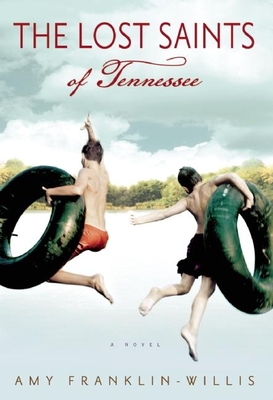
Lost Saints of Tennessee by Amy Franklin-Willis

Lost Saints of Tennessee is the story of Ezekiel Cooper, a man in his forties, driven to the brink of suicide by the death of his twin brother, ten years ago. It's a book that surprised me with its heart and its raw emotion. You must not miss the suicide scene that comes early in the book. I don't want to give too much away but it's in no way what you expect.

Amy Franklin-Willis has set herself the daunting task of drawing out a good old boy from Tennessee, divorced, working at a factory, taciturn, connected only to his old dog and his truck, into the lovable and believable narrator of his own story. It's a story of loss, betrayal, and bitterness in the past, despair in the present, and the possibility of a new chance at life in the future. She does it majestically -- portraying love without sentimentality, grief without mawkishness, hope without artifice. I can't remember when I have connected on such an emotional level to a male character written by a female author.

Maybe not since Water for Elephants has a male character been so moving. Lost Saints in Tennessee is authentic, deep, and true. A heartbreaking story of the realities of loneliness and the power of brotherly love.

I got the chance to ask Amy a few questions about the craft choices she made in her novel. I loved learning about how the novel came about -- some early narrators that dropped away and the process of opening up her main character in a way that would be true to his personality and still support narrating an entire novel. Here are her answers:

LN: You wrote from the point of view of a narrator who is not really a talker, by his own confession and as evidenced by his behavior in the novel. How did you go about finding a speaking/writing/narrating voice for this character who is so taciturn and so guarded?

AFW: Zeke's voice was a real challenge for me in the first year or two of writing the book. He is so shut down when the story begins that in writing his story, I really had to go back to his childhood and meet him then to get to know the man he became. Earlier versions of the story included a lot more of the "past storyline" which allowed me to see Zeke as a happy young boy, full of promise and connected to his twin brother, to understand the devastation he feels as an adult when Carter drowns. 

For me, some of the best lines Zeke utters are the two times he uses the f-word in the novel. In both cases, he is at a break-point, a place where he must either stay in the Loserville he's been hanging out in for 10 years or DO something. Zeke's primary companion in the early sections of the book is the dog Tucker. He was not originally in the book but he provides much needed humor and connection for Zeke in the story. You can see the goodness in Zeke through how he interacts with Tucker. What people say can be so far from what they actually do or who they are. With Zeke, you almost only have his actions to take the measure of his character. But it took me years to find the right balance of insight into Zeke and action on the page because I'm not a big fan of books that are only in the character's head. 

LN: One thing I really loved was how this prickly, locked-up character took a whole novel to warm up to telling us the question that haunts the novel from the beginning, and it takes another character's prodding to drag it out of him. So instead of feeling like you as the author were keeping a secret, it genuinely felt like the narrator was developing the ability to talk about it more as the book went on. Can you talk a bit about the decision to put that final reveal in dialogue? 

AFW: In Lost Saints, I think one of the things I was trying to explore was the notion of how a person can be pulled back from the edge of disaster or despair by another person or being. The guilt Zeke's been toting around for ten years finally gets let loose through his confession of what he regards as his own unspeakable sin. But he has to tell someone, the secret has to be shared in order to lift the burden from his shoulders. 

LN: The book is told in three sections -- the first and third from Ezekiel's point of view, and the second from his mother's. Did you always know that you would give Lillian her own voice in the novel? At what point did you decide to include a section where she could tell her story? 

AFW: I originally wrote Lost Saints with three narrators--Zeke, Lillian & Moses Washington. After a draft or two, I realized Moses had to go as a narrator--though I think he's got enough in him for his own novel. The primary writing challenges I had with this book were structural. Once I narrowed the narrators down to Zeke and Lillian, I had to figure out how their voices should be heard. 

I experimented with going back and forth between chapters, or having the time shift change from past to "current" in each chapter, and none of it felt right. I was aiming for this seamless world for the reader, where you stepped in on page one and none of the writing work showed--it was just a story told as compellingly as I could make it. With all the shifting around of voice and time, it felt choppy to me. And as a reader, I can get annoyed when I start feeling close to a character and then the author takes me into another character. I finally settled on the three-part structure for the book because it honestly seemed like the only way to tell the story. By putting Zeke's voice first, I felt like the reader was on a blind date with Zeke. You get introduced in Part One, you learn some of his history, you meet some of his family. Part Two is when things start getting serious. You meet his mother. You hear her side of Zeke's childhood story, which offers perspective Zeke can't give you. Part Three brings back Zeke's voice and now you know enough about him to understand some of the choices he's made and to be just a bit annoyed, perhaps, by his stubborn refusal to forgive his mother. 

Lillian's voice was one of those "taking dictation from God" kind of characters for me. Some of the scenes in her chapters are almost as I wrote them in first draft form. And I certainly can't say that about the rest of the book. I'm not sure where her voice came from but as I moved through the book, I began to think about my maternal grandmother. She, like Lillian, got pregnant when she was 15, married at 15, and had seven children by her mid-twenties. My grandmother had her fair share of tragedy as well. Through writing Lillian's story, I gained some empathy for my grandmother, whom I recall as an odd and distant person. My mother, who turns 70 this year, told me recently that her mother never told her that she loved her. Not once. And she lived into her early 80's. Hard to fathom.

My recommendation: go get Lost Saints of Tennessee and see how it all comes together.

Saturday, March 21, 2009

Jack Pendarvis is One of Those Guys

I just can't hang. I don't know what happened to me. I want to say that when I was 23 I could tolerate or even enjoy these books organized on the principle of "what the hell." These novels that challenge what it means to be a novel, characters who defy the idea of a character, whose authors seem to make decisions because they're the ones holding the pen, and tee-hee who's going to stop them?

I know I dated guys who wrote books like this when I was in my 20s. But I also remember putting down The Hitchhiker's Guide to the Galaxy as a child, and only part of the reason was because I thought the sacrilege would send me to hell. I have a feeling that if the narrative truly compelled me, I would have dared to face the consequences.

The first book I read by Jack Pendarvis was Your Body is Changing, a collection of short stories. At first, I was really digging it. Yes, it tended a little toward the type of story collection that holds up one character after another saying, "Look at this idiot! Okay, now look at this idiot! Isn't he a tool? Now check out this guy -- what a tool!" But it was really imaginative and interesting. I particularly liked the story "Outsiders" about a woman who announces constantly that she's really someone who will "call you on your shit." Then I got to the title story, about an adolescent zealot who comes into age and cynicism in various har-har ways. And I started to wonder, is Jack Pendarvis one of those guys? One of those guys who produces desultory idylls revolving around randomness, irony, and a wry, intellectual detachment? One of those McSweeney's type guys? When the main character set off on a cross country journey in a goat cart, I had to face the truth: Jack Pendarvis is one of those guys.

Then I read his novel, Awesome, which is about a giant and his robot friend. Pendarvis' giant (named "Awesome") is as inaccessible as the prose itself, and unfortunately he tells his own story mixing low and high discourse like it's 1999. I couldn't finish Your Body is Changing, but I will admit I read to the end of Awesome, to see if penises are really like guns. You know the old plotting rule: If you show a gun in Act I, it has to go off in Act III, right? So, if you cut off your penis on a whim in Act I, does it have to return to you when you least expect it, in Act III? Answer: yes. Penises are just like guns in this respect.

Right after I had finished reading Awesome, a friend loaned me The Thirteen and a Half Lives of Captain Bluebear. It was through realizing the proximity of the latter to The Hitchhiker's Guide that I realized the proximity of Awesome to this iconic work, and so I have to admit: There may be people out there who will find this book to be gorgeous, revelatory, and profound. I am not one of them. However, I salute MacAdam Cage for publishing it, I salute Pendarvis for writing it, and I'm glad it's out there on the bookshelves, in all its weirdness, in all its belligerent quirkiness, because the world doesn't need another mild romance, and Jack Pendarvis ain't no Nicholas Sparks.

Sunday, March 1, 2009

Hamlet 2: Sometimes Even Catherine Keener Cannot Save You


Okay, I didn't like "Dogma" either. It's not that I'm prudish or can't appreciate a good satire, but "Hamlet 2" bored me, literally to sleep. That's the same way I felt about "Dogma," I realize. Bored. Steve Coogan (he was the little tiny Roman guy in "Night at the Museum") plays a failed actor who is now a drama teacher. But, OH NO! The drama program is in trouble. It's going to be eliminated from the school! Just when a bunch more kids have signed up for drama class, as shop and computer classes have also been eliminated!

So what do we do in a movie, if the drama program is in trouble? That's right. We put on a show to save it! Do we all have to pull together, and overcome our differences, and in the process do we all learn a little bit about ourselves?

I don't know, because right at that point I turned to Dan and said, "I didn't know this was going to be a movie about saving the community center." And then I fell asleep. I also didn't know the movie was going to be about children, or rather 26-year-olds pretending to be children. I also didn't know that Catherine Keener was going to be given such slim material to work on, not that she can't work with less, but still. A little brutal.

Good points in the movie: Elizabeth Shue plays herself, having given up Hollywood to become a nurse. Catherine Keener counts as a good point. She is always hilarious and perfect. Steve Coogan manages to be likeable in spite of the overwrought situation.

To me, it played like a Monty Python skit writ American and writ about a hundred times too long. Coogan definitely seemed to be channeling Terry Gilliam at times, but the character couldn't bear the weight of the entire movie. But then, I didn't watch the whole thing. Maybe I'm letting my bias against movies in which the community center must be saved hold me back from watching a great comedy. What do you think. Should I watch the rest of it?

Friday, January 23, 2009

Wait by Frank Turner Hollon

This is not a review. It's a reaction. There are spoilers. If you want a review, here it is: Wait is a worthwhile novel from an interesting mind, that will make you think about your soul, and the state of it, and the reasons why your soul may be in that state. It will make you look around your life with a new, healthy suspicion, and try to imagine your spouse with a gun in his hand, standing there blankly, ready to pull the trigger. So there's your review. Go get the book, and read it, and come back here and talk to me about it.

Frank Turner Hollon has written the life story of Early Winwood, a guy you might pass on the street without noticing, a character you might not think was worthy of having a novel written about him. A regular guy. The difference between Early and most regular guys is that right in the middle of the book, after living through a few dozen unremarkable years, Early does something very remarkable: he kills a man. Then, later, he kills another one.

This book is telling me one of two things. No, there are no other interpretations:

1. The narrator is unreliable. The book is psychological study that takes us deep under cover in the mind of a murderer, to show us how he, twisted and inhuman as he is, sees himself as normal, fitting snugly into the fabric of society. I have two bits of evidence for this interpretation. First, the ambiguity of his relationship to Kate Shepherd, and the fact that this drug user turned model citizen at one point tells the court he is a kidnapper and a stalker. The second is the way the murders really fail to haunt the guy, at least fail to haunt him to the extent that a murder would haunt me. Or maybe a murder wouldn't really haunt me that much, which brings me to possibility #2.

2. Early is a murderer, and Early is an average guy. Both. One does not preclude the other. Murder is closer to you than you think it is, reader, and only a thin hair of opportunity and impetus stands between you and the act itself. Looking back on the book, this explanation seems more elegant. It is as if the whole plot of this man's life was constructed to be a doughy, bland container for that one act of violence, so that the blandness leaks into the violence, and makes it ordinary, all part of the whole.

I don't know which one is the correct reading but I hope it's two. It's not that I agree with him, in fact I don't like the idea that we're all base, we're all murderers, we're all that low, as vile as the least of us is vile. I don't agree. But I think that makes the more perfect novel, and I've never read a book constructed like this, with so much fire-retardant wadding packed around a fuel cell on fire.

The book fails me in a couple of ways -- the second "murder" doesn't seem to fit either of my explanations, and it blurs the lines of what's a reasonable excuse to commit the crime. I was disappointed also a little bit in the lesser characters, in Early's fake son and fake daughter. I never knew what lens I was seeing them through, and Early's take on it seemed more suspect when he was describing these relationships than it did when he was talking about Kate.

Ultimately, a very interesting book and a book that worked my brain. I will have to try another by this author.

Friday, January 16, 2009

Sin in the Second City by Karen Abbott

There are two fine lines that Abbott had to navigate when writing Sin in the Second City, a historical account of the Everleigh Club, the fanciest and most infamous brothel in Chicago at the turn of the century.

The first line is between two moral positions.

Abbott has two heroines here: Minna and Ada Everleigh, the jewel-encrusted madams who elevated their little corner of the vice district beyond the dirty dance hall and onto a level of elegance and sophistication that attracted millionaire visitors and international attention. Minna and Ada are characters that the author clearly loves. As we follow their story from a mysterious lowly past to their glorious position as quiet, powerful queens of vice in a vicious city, we are invited to fall in love with them as well. There are pimps and madams that we can scorn, lesser characters who live down the street from the Everleighs, who run shitty dives and beat their girls, drug their customers and stick to their own floors. But the Everleighs are a different breed: smart, ethical, pure.

If the Everleighs are the heroes, then the villains must be the reformers, the demonstrators and politicians who were trying to eliminate the vice district and "save" the girls who had "fallen" there as prostitutes. Among the characters on this team are pastors and evangelists, pious ladies, and also city officials trying to look good and crack down on crime. The problem with villainizing this side of the fight is that they actually did have a point. The danger with making a madam your hero is that there actually was a lot of horrifying stuff going on in these houses, stuff you don't want to cheer for, and can't fall in love with.

So, as a writer, do you position yourself with the madams, and giggle and titter your way through the book, pretending it's all so naughty and wry, and those stuffy old reformers are just party poopers? Or do you position yourself with the reformers, and spend the book pushing out that really new and interesting concept that prostitution is bad? Maybe there's a third solution, to just report what happened, be historically accurate, and educate us all so we can make... oh, wait, I just fell asleep while suggesting that as an option. So, none of those are books that I would want to read.

Fortunately, Abbott is smart. Very smart. And her smart book can present all these possibilities simultaneously. This is not an expose of the horrors of segregated vice in turn of the century Chicago. Nor is this a blushing homage to all those fabulous madams and the sexual excesses of the times. No one is exempt from criticism here. Abbott tells the stories of those vainglorious preachers and the hypocritical politicians, but also shines an unforgiving fluorescent light into the depths of vice: the strip-and-whip fights where girls lashed each other bloody for an audience, the girl's palm rotting from syphilis while still performing its handjob, the lies, the greed, the corruption, and all of it.

No one is exempt, that is, except the Everleighs themselves. In understanding this, I began to understand where the moral compass of the book truly points. I believe that Abbott would say that the sins of the vice district were black enough -- the sins of the white slavers and the opium dealers and the lower madams operating their 50 cent dives. The Everleighs, however, weren't doing anything very wrong, and in shutting down their clean, sophisticated, elegant club, where the men were treated fairly and the girls lined up to get a job, where the health and well being of the harlots was a priority and the customers were treated like customers, not sinners, the authorities threw the baby out with the bathwater. That is, I think, the way the book gets out of its predicament.

This moral subtlety allows the book to transcend that "choice" between the whores and the reformers, and allows the story of the characters to flourish without the weight of a judgment or the tension of the absence of judgment.

The second line that Abbott dances down is a literary one. She is, of course, telling the true story of actual people, and the research that went into this book is amazing. One look at the bibliography and your jaw will drop. However, there are things that cannot be known from research. The biographer's job is to tell the story in an engaging way that will live on the page, without embellishing the facts too much, to navigate between too strict a focus on reality and too fanciful an elaboration. Abbott accomplishes this brilliantly. Everything in quotation marks, in the book, was actually said by the real Everleighs, or other characters, and recorded in court documents, journals, or letters. But Abbott's story goes beyond the bare facts and delivers a prose that reads like fiction. None of the "we can't possibly know" or "it's unclear" but loads of vibrant descriptions, delightful details, and a narrative sense that really brings the landscape of the levee to life.

Sin in the Second City exploded my expectations. You know I loves me some violated dichotomies, yo. By defying the obvious choices, and creating her own rules, Abbott pays the Everleigh sisters great honor by putting them in the context they deserve.

Friday, August 31, 2007

Shopgirl and Broken English: What is Wrong with these Movies?

What is up with you, Ms. Zoe Cassevetes? What is going on, Mr. Steve Martin? There are actually six movies here, each of these stories being broken down into three different mismatching parts, so variant that they're almost in disagreement with each other.

"Broken English" is not a movie in three acts, it's a movie in three movies. In the first movie, Parker Posey stars as a drunk, irritated single girl in her thirties who's striking out in love. She dates a gay guy. She dates a guy who is hung up on his ex. She dates a famous guy who has another girlfriend. She dates a marmoset. It's wacky, it's dry, and everyone is walking around with a cocktail having good lines. I am all over it. Whee!

Then Parker Posey meets Julian, this French guy in a straw hat who is wearing a linen or, wait, was it seersucker blazer over a grey v-neck t-shirt. I don't even want to talk about his shoes or his scrawny bullet head. We are comfortably assuming that he's going to be another awful lesson in what not to date, when we realize, wait, we are supposed to be loving him. This is when movie #2 begins, which is about their very serious and interesting and important romance, except that I never buy they are in love, because of his bobbly head and her constant drunkenness. Movie #2 goes on way too long. They take a bath together. He keeps kissing her on the forehead. I get fidgety. All the shots are very close and making me regret our HDTV. Parker Posey has a panic attack over a plate of cannolis and I know what she's going through.

Fortunately, movie #3 is about to begin. Suddenly, Julian McFrencherton is leaving for Paris immediately and after he shakes off the unflattering Parker Posey hanging on his abdomen, he goes. He leaves her a number to reach her in Paris. Now the camera backs up to a comfortable distance and the movie becomes a Lifetime TV Drama about how Parker Posey must now go off to Paris and find him. Except drat! She loses his number. Most of movie #3 is about Parker Posey and her totally best superfriend, who looks like what Portia de Rossi would have looked like if she had turned to drastic cosmetic surgery to make her look the way she looks, trip around Paris. It is neither picturesque nor droll. It is kind of desperate. Skintight Portia de Rossi leaves, Parker Posey stays, and there are scenes on public transportation where the Eiffel tower is seen going by.

She finds him. They have a conversation in a deli. The end. What do all three of these movies have in common? In all of them, I love Parker Posey, but I hate what she's doing to me.

Now, on to Shopgirl I, II, and III.

In Shopgirl I, Claire Danes is a moist, long-eared gazelle who works at Saks and has trouble finding a boyfriend. She briefly dates Steve Carrell, played by Jason Schwartzman, but he's so flaky. It is from this movie that most of the trailer is harvested, making us think the movie is a comedy. There is a funny bit with the cat.

In Shopgirl II, Claire Danes is a pensive gazelle who works at Saks and has a weird, tense relationship with a rich and taciturn Steve Martin, who gets to kiss her, fondle her, and pretend to have sex with her. At one point, she stops taking her anti-depressants and has some kind of awful breakdown. Awkward for them, awkward for us. But at least, during that scene, she had a facial expression.

In Shopgirl III, Claire Danes is an emotionally matured gazelle who realizes that Steve Martin is never going to love her properly, so goes back to Steve Carrell, played by Jason Schwartzman. He has fortunately spent the second movie on tour with a band listening to self help tapes, and now knows how to comb his hair and wear white suits. She becomes a famous artist and is happy with her dopey boyfriend, although she still secretly deeply tragically hopelesly pines for the immortal pleasures of Steve Martin and his old richness.

What do these three movies have in common? Claire Danes' hair is never mussed. Steve Martin's voice is never raised. And Steve Carrell looks even hairier than he normally does.

I understand a three act structure, I really do. But if I go to the bathroom watching "Singles" I don't want to come back to "Remains of the Day."