Friday, February 22, 2008

Tom Wolfe: A Man in Full

Since I have been writing about American Idol for two days, I feel the need to elevate the tone of this blog a little. Of course John Irving called this book "entertainment" as opposed to "literature." I'm not going to get into it with John Irving on the merits of various books. John Irving and I have never had a problem before, in all the many times we've exchanged thoughts on art and pop culture.

I very much like entertainment. However, it took me six weeks to read A Man in Full. It is very long. If you had told me on the first of the year that I would spend six weeks of my young, vibrant, fascinating life reading a book about Atlanta politics, real estate developers, bank management, and Stoic philosophy, I would have said, No. However, Wolfe's true subject was one that held me in its thrall from the first chapter, and kept me coming back eagerly, through all 750 pages, during ballet class and through late nights, until the paperback was falling apart from being crammed into my bag. His subject is men. What is it to be a man at the end of the 20th century? What is it to be a man at all? The book follows four men through a twisted plot that would take me several pages to summarize. I'd rather talk about the way the book is written.

Wolfe goes back. Way back. And he goes in. Way in. There are two main characters who meet at the very end of the book, and in a sense the book truly begins when they meet. However, the book begins months in advance of that meeting, and the ostensible impetus for the book is only actually tangentially related to them. There is an alleged crime, if you must know. Which has also got a tangential relation to the real theme (what is a man). The books starts after 700 pages, when the main characters meet for the first time. Using the fake impetus allows Wolfe to begin at the true beginning, when these characters are at a stable place. Then Wolfe can put them in the butter churn and start beating them into butter.
The other thing that I found interesting about the construction of this novel was the episodic nature of the chapters. At the beginning of the book, the chapters focus exclusively on one character or another, and some of them are so brilliantly episodic that they would be amazing short stories, with no context at all. After one of the early chapters about Conrad, the youngest and possibly most sympathetic of the four central men, I shut the book and put it down, because I felt I had just read such a great scene, I had to stop.
Let's talk about the whole concept of sympathetic characters, for a moment. With the exception of Conrad, every one of the men has significant flaws. Even Conrad, if you think about it, is deeply flawed. It's hard to see the flaws of these male characters, however, because they are presented so sympathetically. Well, not sympathetically. The narrative is not sympathetic, but it is exhaustively detailed, claustrophobically close to the characters' consciousnesses, minute. We feel that we know them so well, understand them so well, perceive their contexts and histories so well, it is hard to pull back enough to remember that they are doing things that are pretty reprehensible. It's part of what makes this book so interesting -- the moral ambiguity that's available to the reader, as we are allowed to put on all of these different identities, and really inhabit them without judgment, without even reflecting on right and wrong.
How does Wolfe do this? How does he simultaneously show us all of these slimy lowlifes, and give us permission to cheer for them, to wish them luck, to hope things work out somehow. I am not even sure.

After I recover from the effort, I will read another book by Tom Wolfe. Maybe I Am Charlotte Simmons. Want to trade your copy of that for my copy of this? Wolfe takes a long time to write his novels. I like that about him. A Man In Full was just wonderful. I highly recommend.

Monday, January 28, 2008

The Analogy of the Farting Horse

Just when you think you're being insulted, it turns out you're being enlightened.

So I'm working on the book proposal. My friend Susannah recently read a rough draft of the overview. She said, and I'm paraphrasing, "Look, it's a mess, but you're just rusty. It's like you were a horse that was cooped up in his stall all winter, and then he gets let out in the paddock, and he's bucking and farting and bucking and farting, you know?" And after I had finished reeling, and staggering, and after I'd said, "Wow, I've heard rough drafts compared to vomit, and excrement, and saliva, but never a horse fart," she explained, "Hey, it's not a criticism. No one stands there watching that horse thinking he's stupid because he's bucking and farting. He just has to get that out of his system."


So, I think I'm going to embrace the farting horse analogy, actually. There's something joyful and mad about a farting horse. If you've never experienced it, I can't explain it. I'm not going to say it's sublime or anything, but it makes you smile. And bucking, farting horses are certainly not concerned with how their moves are going over in the press.

Monday, January 21, 2008

My Future Shelf

This is the shelf where my non-fiction book will be sold in the future.

Thursday, January 17, 2008

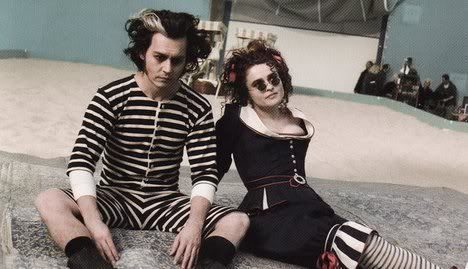
Sweeney Todd and Cloned Beef


I am a big fan of Tim Burton. I am a big fan of musicals. I abjectly love Johnny Depp and Helena Bonham Carter. And I really like steak. My prediction was that watching Sweeney Todd was going to be the pinnacle of my existence thus far, and that eating cloned beef was going to be pretty much unnoticeable and unexciting. Unfortunately, the movie failed to deliver the kind of rapture I was anticipating. I was ready to revise my top ten list, people! I was ready to make space next to Evita and The City of Lost Children and The Nightmare Before Christmas! We even imposed on our only local relative so we could go and see it in an actual theater. But Sweeney Todd failed to transcend.

The whole thing was a little claustrophobic. The shots too tight. The storyline too controlled. The surfaces too grimy. Where were the sweeping shots, the dazzling landscape, the bitter contrast between in and out, Halloweentown and Christmastown, the woods and the hearth, the suburbs and the castle? In one number only, Burton emerged: during Mrs. Lovett's "By the Sea" song, we saw everything his movies can be: it was like Big Fish and Corpse Bride all in one song.


But that was all, really. The rest was very tight, very close, very monotonous. Johnny Depp looking haunted next to this window, Johnny Depp looking haunted next to that window, and Helena BC rushing up and down the stairs. Did I love it? Well, yes. Of course. Johnny Depp and Alan Rickman sang a duet, using their own voices. Helena Bonham Carter and Sacha Baron Cohen made me laugh. The two little birds he cast to play the young lovers were swell. But it just didn't go there, for me. It wasn't beautiful. It wasn't grand. Dark is great, terrible is great, but I need a more expansive scope, a broader arc, a higher swell. Dan says my expectations were too high.

But never fear. A light is dawning on the horizon. Surely cloned beef will satisfy my intestines, where Sweeney Todd has failed to thrill my soul. Or, at least, it will go through my digestive system completely unnoticed, a perfect simulation of regular meat that came about via the original reproductive process. People are cranks. They say it's unnatural, weird, creepy; some even say "abominable." Ever the optimist, I approach my cloned beef consumption with a bright spirit. No, it won't be labelled. No, I won't have any idea when the cloned beef is about to pass my lips. But I have faith that when I spoon up that next bite of chili, so full of such a technological wonder, that I, like those poor souls in Mrs. Lovett's shop, will eat hungrily, happily, without concern. Forget the barber upstairs, people, and enjoy your damned meat pie.

Sunday, January 13, 2008

The 2007 National Book Critics Circle Award Finalists

Joyce Carol Oates is nominated by the National Book Critics Circle in two categories: Fiction and Autobiography. Her autobiography is called The Journals of Joyce Carol Oates, 1973–1982. Well, that's one way to do it. I don't know about you but I'm totally pissing my pants with anticipation -- how will I put in the long lonely months before The Journals of Joyce Carol Oates, 1983–1992 comes out?

Her fiction is called The Gravedigger's Daughter, in the glittering tradition of naming things The X's Daughter, where X is something dark and unsavory. Hey it worked for Loretta Lynn and Amy Tan.

Other notable nominations: A biography of Thomas Hardy. A book called American Transcendentalism (How long are people going to waste their time promoting the myth of Emerson?) And finally, the poetry nominees rip their wigs off and light up the night with their awesome titles: Elegy, Modern Life, Sleeping and Waking, The Ballad of Jamie Allan, and New Poems. Next to the stage: Storage, Breathing In and Out in a Steady Predictable Rhythm, and Sand.

CRITICAL MASS: The 2007 National Book Critics Circle Award Finalists