Sunday, September 20, 2009

What's on your Inspiration Shelf?


If life is finite, your book stash must be too.

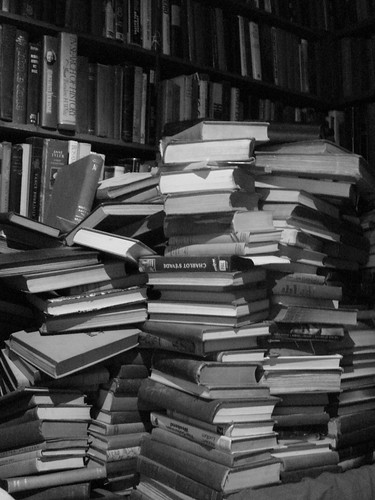
I think that hoarding books is a stand against mortality. If we've read them already, we might want to read them again. If we haven't read them yet, we might want to. Looking around at my shelves and boxes, I want to believe I will have time before I die to read them all, maybe again and again. Even if my current rate of reading means I'd need to live three lifetimes. To admit that I can't read all these would be to admit that at some point I'll stop reading. Difficult to imagine.


I recently some changes to my personal book hoard, and culled three boxes of books from the stacks. I decided to get rid of all the books I've read that I do not want to read again. That helped. But it also hurt to say goodbye to these objects. I'm tech-positive in so many ways, but like so many writers and readers, I am in love with the physical presence of books, and I have a hard time getting rid of them. A hard time embracing Kindle, and hard drives.


To make myself feel better, as I was sorting through the books I would let go, I decided to make another stack of books that I would never let go, that I would fetishize in the extreme. I made my inspiration shelf of books I've read that motivate me to write, a little shrine to their actual selves, a space for them to take up unapologetically in the world. If I must be mortal and my reading experience must be finite, then let's make it exquisitely finite, limit my great books to one shelf only. These are the books that are important to my life, at least, right now.


Here's my list, in no particular order. For some, it's the scope of the book. For some, it's the daring. The personal connection. The theme. The innovation. For a few it's just the time it was in my life, and how much it affected me. This is not a list of great books, or a list of personal favorites, but these are the books I can look at and feel something in me reaching. So, it varies:

Moby Dick by Herman Melville. The very copy I first read in high school. I have read it maybe 20 times, and in this copy I can see all my teenage notes.


House of Seven Gables by Nathaniel Hawthorne.


His Dark Materials Trilogy by Phillip Pullman.


Lord of the Rings Trilogy by J.R.R. Tolkien.


Jonathan Strange and Mr. Norrell by Susanna Clarke


Penrod by Booth Tarkington. A book I read again and again when I was a child, before I understood the irony, before I understood racism at all.


My Horse and Other Stories by Stacey Levine


You're a Bad Man Aren't You by Susannah Breslin\


Between Georgia by Joshilyn Jackson


The Rainbow by D.H. Lawrence


Tess of the D'Urbervilles by Thomas Hardy


Geek Love by Katherine Dunn


Observatory Mansions by Edward Carey


The Intuitionist by Colson Whitehead


The Most of P.G. Wodehouse


We the Living by Ayn Rand


A Room of One's Own by Virginia Woolf


Dubliners by James Joyce


Candide by Voltaire


So, I've broken it down to these 20 volumes. If I add another, I think I should subtract one -- that's how the brain works best. My own two books are not on the shelf, but I hope my next one will be. It's what I aspire to: to write something that belongs in my brain with these.


Challenge: What's on your inspiration shelf? What one book would definitely have to be there? If you take a picture, I'd like to see.

Thursday, September 3, 2009

How Twilight Killed "The Wasteland"

Lev Grossman, book reviewer for Time Magazine, has bravely prophesied an end to modernism. In his Wall Street Journal article, Grossman posits that the modernist stranglehold on novel-writing is finally over. A new day has come! Nuts to you, Joyce, Eliot, Faulkner, and Kafka. You guys are history! No longer will readers suffer through beautiful language to get to an epiphany. Today's readers want plot, plot, and more plot. "Lyricism is on the wane," gloats Grossman, citing high sales of the Twilight series as proof that plot trumps beauty for these kids today.

Grossman, possibly unaware that Joyce and Eliot have been dead for fifty years, believes that these "modernists" have tricked us into thinking that a decent plot is indicative of a weak book. So, we're secretly reading mysteries and scifi, wishing literary writers would just take heed. "Should we still be writing difficult novels?" he asks, "Isn't it time we made our peace with plot?"

Grossman has graciously forgiven the moderns for blowing up the conventions of the Victorian novel. But he now feels that the time has come to embrace plot again. His evidence? The popularity of young adult novels, which never aspired to disregard plot in the first place. For Grossman, there have been no intervening literary movements. No novels of consequence that delivered any measure of plot with their lyricism, or any lyricism with their genre. The article has the intellectual weight of a strawberry tart, and yet the internet is upside down with panic over it. Is literary fiction over? Do we all have to start writing vampire novels?

Relax. Grossman's thinking is reductive, cowardly, but mostly just silly.

Consider these three major flaws:

1. It's weak on literary history. Did modernists shatter plot? Maybe. But look at the novels Grossman cites: Wharton, Hemingway, Lawrence, Fitzgerald. Really? These writers may be moderns, but in theme and ethos, not in formal experimentation. Pound, yes. Kafka, yeah. Joyce, okay. But Grossman's list of defiant modernist novels is full of plot. Sorry.

2. He uses the word "Pavlovianly."

3. His prognostications don't make sense. In proving his point that plot is back in style, Grossman uses Chabon, Lethem, Niffenegger, Gaiman, and Susanna Clarke as examples. These are the literary champions that are boldly bringing back the storylines we have all been silently, hopelessly craving for 80 years. However, these writers are all contemporaries of the Twilight juggernaut. The figures that Grossman so gloomily references (adult trade sales down 2.3% while Twilight author Stephanie Meyer sells 8 million books) would seem to reflect that while Chabon and Niffenegger may have been slinging Grossman-approved level of plot, the book-buying public wanted to buy Twilight books anyway.

I hope that writers of difficult books will not pause to listen to Grossman's confused ramblings about how literary movements from one hundred years ago are stultifying contemporary fiction. I hope writers will disregard all petulant whines about how "we the people" really want to read inglorious garbage like Twilight. I hope writers of difficult books will not take plot advice from a guy who lifted his own plot from Harry Potter. Yes, Twilight is selling. Yes, cheap fiction does move. It always has. But greatness is not easy, in reading or writing, and you weren't really writing for guys like Grossman anyway. Write for the smart people, the people that filled a football stadium to hear T.S. Eliot, the people who still celebrate Bloomsday. Write for me. I will still work for an epiphany.

Monday, August 17, 2009

To Hell with Publishing: Neither Irreverent nor Inventive

The name promises much. The name inspires obstreperous agreement. Yeah, to hell with publishing, anyway! This is 2009. We're all about downloads, and Kindle, and Twittered novels, and free information, and Google books, and plots we can download via wires straight into our arteries, and plugging into authors via Friendfeed, and instant updates, and modules! To hell with publishing, to hell with journals, to hell with prizes, to hell with first novels. Yeah! Fist-pump!


From a group of projects so provocatively named, I now expect mind-blowing innovation. I expect earthshaking progress. I expect, at the very least, heaps of scorn for the old way of doing things, and arms flung wide open to the new, digital world. Please, make sense of fiction on Twitter for me. Please, package blogged novels. Please, help me to understand new media. I beg you! Unfortunately, what I'm finding here is same old, same old. Instead of revolution, "To Hell with Publishing" is pushing cardstock, ink, and contracts. Readings at a library under a dropped ceiling. Submission guidelines -- click here! And please include a cover letter.


"To Hell with Publishing" is just another small press. Like every other small press in the history of earth, they desire to "return vital writing, and in particularly, the best in contemporary fiction, to the main literary stage." Well bra-thumping-vo. They publish... books. Books made of paper and glue. And they publish journals. They have a prize for... unpublished manuscripts, but unagented manuscripts are not considered. Please submit paper copies in triplicate, because at "To Hell with Publishing" they are all about the snail mail.


That name followed by that business model is like the sound of a trumpet fanfare followed by the sound of a drunk falling downstairs. Where's the innovation? Where's the middle finger raised to the literary establishment? Listen: Here are the two ways that "To Hell with Publishing" bites its thumb at the mainstream presses.


1. They will only publish first novels. No second novels! Oh my god! Their plan is that other publishers will swoop in and take over their authors' careers after novel #1. Because yeah, mainstream publishers are so interested in picking up seconds after the author has been deflowered of his first novel. Do I really have to pursue that analogy?


2. Their journal (To Hell with Journals) will only have 26 issues. They have decided this... in advance. Only 26 and no more, even if thousands of screaming fans are lined up outside the bookshop, demanding just one more issue, tearing up their organs in despair that only 26 issues can possibly be produced. They will stand innovatively firm on this principle: THEY WILL FOLD AFTER TWO YEARS.


These two policies manage to be simultaneously defeatist and overly ambitious. Yeah, we MEANT that journal to go under, and we MEANT that author to never produce another book, because that's all part of the rakish, devil-may-care plan we have here at "To Hell with Publishing." Look, there are already small presses out there doing exactly what THWP desires to do, but without these weird stipulations that seem to undercut any kind of longevity or long term relationship between press, author, and reader. Obviously a few more domain names are needed: tohellwithlegitimacy.com, tohellwithauthorloyalty.com, and tohellwithrelevance.com. "To Hell with Publishing" is a profound disappointment, leaving this reader still looking for the next great thing. When it comes along, I have a feeling that "To Hell with Publishing" would be a really cool name for it. Unfortunately, that domain name is already taken.


For more info: I found out about To Hell With Publishing from the Book Ninja.

Thursday, July 2, 2009

The Significant Objects Project

How to create a significant object:


1. Find some tchotchke. Any tchotchke will do. The weirder the better.


2. Pretend in your brain that it is significant.


3. Write a story telling everyone about how significant it is.


4. Sell the object, and the story, on Ebay.


In other words, (from the web site of the Significant Objects project): A talented, creative writer invents a story about an object. Invested with new significance by this fiction, the object should — according to our hypothesis — acquire not merely subjective but objective value. How to test our theory? Via eBay!


In order for the significance to be created, the object must begin with no significance at all, before the story is written. The items in the project were collected at thrift stores and garage sales, obtained for very little coin. If an object of no actual value gets valuable via its place in a piece of fiction, then these garage sale finds (the web site categorizes them as talismans, totems, evidence, and fossils) should be commanding a higher price on Ebay than they did at the garage sale. According to the evidence, this is actually happening. Take for example Susannah Breslin's story about the button in the photo, the All American Official Necking Team button. The button is for sale on Ebay, along with the story, and the bidding is now over $35. It was listed at $0.50, which was the price it commanded at the thrift store. There are five days left -- who knows how high this piece could sell for?


The idea of making "real" the objects that appear in fictional work is not new. Here's one example: When author Joshilyn Jackson toured with her book The Girl Who Stopped Swimming, she took along a quilt that represented the quilt created by her artist main character. The actual quilt was made by collage artist Pamela Allen, and brought the quilt in the book to life in the smallest detail. Another example: last month a gallery in the UK showed a collection of books that exist only as titles in other books. The idea of an object from a piece of writing coming to life as a physical object you can hold in your hand is kind of magical, it creates the kind of fetish object that deserves the title "totem" or "talisman."


However, when I think of these pieces from SignificantObjects.com, I am less interested in the value created in the object via the fiction, and more interested in the value created in the fiction, via the object. How difficult would it be for an author to sell a short story on Ebay, without the object attached? Especially a story given in full, which a potential buyer could immediately read online or print out for him/herself? Pretty difficult. Yet here is a story, connected to an old button found at a thrift store, that's selling for the price of three paperbacks. Remember, we are in a time when even books are seen as archaic, where people download cheap digital versions of novels, and fiction is readily available all over the internet in a bazillion online magazines.


Maybe what this buyer is actually purchasing is a feeling of ownership that escapes the average reader of a Kindle download or a mass market paperback. This reader will possess the button, and therefore possess the story, in a way that no one else will or can. Like an illustrated text, before the printing press was invented, there is a real sense of exclusivity to this type of writing -- it can only truly be owned by one person.


For more info: For more significant objects to bid on, follow @significobs on Twitter.

Tuesday, June 30, 2009

Alice Hoffman Freaks Out, and Plus Her Book is Bad

Yesterday, angry author Alice Hoffman used Twitter to publish a reviewer's phone number and (misspelled) email address. She encouraged her followers to "tell [the reviewer] off," after reviewer Roberta Silman published a lukewarm review of Hoffman's most recent book, The Story Sisters, in the Boston Globe. Instructing followers to "Tell her what u think of snarky critics," Hoffman caused eyebrows around the twitterverse to raise a few languid millimeters, as the book world vaguely pondered whether reviewers should really be punished for saying what they think.


Their conclusion: No, they should not. After receiving some flack for her tweet, Hoffman tried to turn this tantrum into a principled stance, saying, "Girls are taught to be gracious and keep their mouths shut. We don't have to. And we writers don't have to say nothing when someone tries to destroy us." Uh, yeah.


In an incredibly synchronous coincidence, I just yesterday finished reading Alice Hoffman's novel Here on Earth. Do I dare tell you exactly how I feel about this book? Will my phone number be posted on Twitter tomorrow, beside an impassioned call to action?


I did not like Here on Earth. I only picked it up because my brain somehow crossed wires and I thought I was picking up an Angela Carter book. Carter wrote The Infernal Desire Machines of Dr. Hoffman. She is not, as I now know, related in any way to Alice Hoffman. I had never read Alice Hoffman before.


Here on Earth is a romance novel dressed up as literary chick-lit. Its central character is an unlikeable woman whose choices are dense and reprehensible, and whose family and friends are only slightly less loathsome. Switching through point-of-view characters with irritating frequency and loping along in an uncomfortable present tense, the book spirals outward away from an increasingly irrational and self-destructive heroine as if the plot is mirroring the reader's desire to get out of her unsavory story. Several times in the book, young characters are told that they just don't know anything about love. Maybe my failure to connect with this novel is a result of a similar misunderstanding.


Or maybe it's because of lines like this: "He can spend hours watching a wounded cedar beetle and weep over its rare beauty, as well as its agony." Or this: "He knows what can happen to any man who won't let go of his pain." These lines were written without sarcasm about two different male characters, and they're not even the ones we're *supposed* to hate! Maybe it's because of the close attention paid to sweaters and cookies. Ultimately, though, I didn't buy the violence, the pain, the delusions, or even the love.


The Boston Globe said about Here on Earth: "A sound addition to an impressive body of work." I wonder if that reviewer would have been called out on Twitter, had it been around back in 1997 when Here on Earth was published? Because all that reviewer really said was, "Alice Hoffman has written another of many books." And sometimes, if you're trying to be nice, that's all you can really say.


UPDATE: Alice Hoffman's twitter account is no longer. However, Gawker has screen caps.


Here's a list of the people I referenced in the article if you want to follow them on Twitter:


Alice Hoffman @alicehof (deleted? suspended? torn down in a fit of rage?)


Ron Charles, Washington Post Writer: @roncharles


Islinda, outraged fan: @darkonfire


Thanks to Maud Newton who retweeted it: @maudnewton


Thanks to Susannah Breslin who sent it to me: @reversecowpie


And this is me: @lostcheerio